Fekete Zsolt, Ignat Patricia, Resiga Amelia Cristina, Todor Nicolae, Muntean Alina-Simona, Resiga Liliana, Curcean Sebastian, Lazar Gabriel, Gherman Alexandra, Eniu Dan
Department of Oncology, "Iuliu Hațieganu" University of Medicine and Pharmacy, 400006 Cluj-Napoca, Romania.
"Prof. Dr. I. Chiricuță" Oncology Institute, 400015 Cluj-Napoca, Romania.
Diagnostics (Basel). 2024 Apr 18;14(8):836. doi: 10.3390/diagnostics14080836.
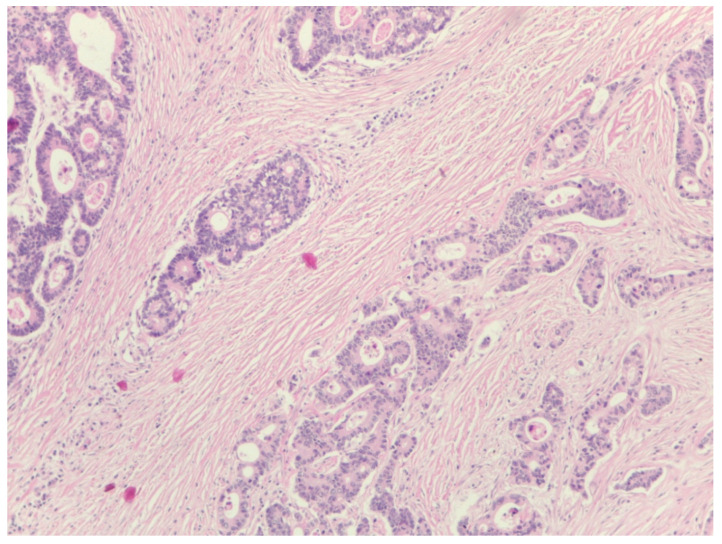
The tumor-to-stroma ratio is a highly debated prognostic factor in the management of several solid tumors and there is no universal agreement on its practicality. In our study, we proposed confirming or dismissing the hypothesis that a simple measurement of stroma quantity is an easy-to-use and strong prognostic tool. We have included 74 consecutive patients with colorectal cancer who underwent primary curative abdominal surgery. The tumors have been grouped into stroma-poor (stroma < 10%), medium-stroma (between 10 and 50%) and stroma-rich (over 50%). The proportion of tumor stroma ranged from 5% to 70% with a median of 25%. Very few, only 6.8% of patients, had stroma-rich tumors, 4% had stroma-poor tumors and 89.2% had tumors with a medium quantity of stroma. The proportion of stroma, at any cut-off, had no statistically significant influence on the disease-specific survival. This can be explained by the low proportion of stroma-rich tumors in our patient group and the inverse correlation between stroma proportion and tumor grade. The real-life proportion of stroma-rich tumors and the complex nature of the stroma-tumor interaction has to be further elucidated.
肿瘤与基质比值是几种实体瘤治疗中备受争议的预后因素,对于其实用性尚无普遍共识。在我们的研究中,我们提出证实或否定这样一个假设,即简单测量基质数量是一种易于使用且强大的预后工具。我们纳入了74例连续接受原发性根治性腹部手术的结肠癌患者。肿瘤被分为基质贫乏型(基质<10%)、中等基质型(10%至50%之间)和基质丰富型(超过50%)。肿瘤基质比例在5%至70%之间,中位数为25%。很少有患者(仅6.8%)患有基质丰富型肿瘤,4%患有基质贫乏型肿瘤,89.2%患有中等基质量的肿瘤。在任何切点处,基质比例对疾病特异性生存均无统计学显著影响。这可以通过我们患者组中基质丰富型肿瘤比例较低以及基质比例与肿瘤分级之间的负相关来解释。基质丰富型肿瘤在现实生活中的比例以及基质与肿瘤相互作用的复杂性质还有待进一步阐明。