Di Lazzaro Giulia, Ricci Mariachiara, Saggio Giovanni, Costantini Giovanni, Schirinzi Tommaso, Alwardat Mohammad, Pietrosanti Luca, Patera Martina, Scalise Simona, Giannini Franco, Pisani Antonio
Dept. of Systems Medicine, University of Rome Tor Vergata, Rome, Italy.
Dept. of Clinical and Movement Neurosciences, Institute of Neurology, University College London, London, UK.
NPJ Parkinsons Dis. 2021 Sep 17;7(1):82. doi: 10.1038/s41531-021-00227-1.
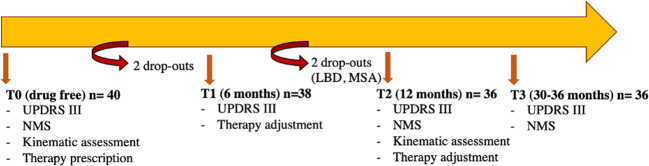
Early noninvasive reliable biomarkers are among the major unmet needs in Parkinson's disease (PD) to monitor therapy response and disease progression. Objective measures of motor performances could allow phenotyping of subtle, undetectable, early stage motor impairments of PD patients. This work aims at identifying prognostic biomarkers in newly diagnosed PD patients and quantifying therapy-response. Forty de novo PD patients underwent clinical and technology-based kinematic assessments performing motor tasks (MDS-UPDRS part III) to assess tremor, bradykinesia, gait, and postural stability (T0). A visit after 6 months (T1) and a clinical and kinematic assessment after 12 months (T2) where scheduled. A clinical follow-up was provided between 30 and 36 months after the diagnosis (T3). We performed an ANOVA for repeated measures to compare patients' kinematic features at baseline and at T2 to assess therapy response. Pearson correlation test was run between baseline kinematic features and UPDRS III score variation between T0 and T3, to select candidate kinematic prognostic biomarkers. A multiple linear regression model was created to predict the long-term motor outcome using T0 kinematic measures. All motor tasks significantly improved after the dopamine replacement therapy. A significant correlation was found between UPDRS scores variation and some baseline bradykinesia (toe tapping amplitude decrement, p = 0.009) and gait features (velocity of arms and legs, sit-to-stand time, p = 0.007; p = 0.009; p = 0.01, respectively). A linear regression model including four baseline kinematic features could significantly predict the motor outcome (p = 0.000214). Technology-based objective measures represent possible early and reproducible therapy-response and prognostic biomarkers.
早期非侵入性可靠生物标志物是帕金森病(PD)中尚未满足的主要需求之一,用于监测治疗反应和疾病进展。运动表现的客观测量可以对PD患者细微、难以察觉的早期运动障碍进行表型分析。这项工作旨在识别新诊断的PD患者的预后生物标志物并量化治疗反应。40例初发PD患者接受了基于临床和技术的运动学评估,执行运动任务(MDS-UPDRS第三部分)以评估震颤、运动迟缓、步态和姿势稳定性(T0)。安排在6个月后进行一次随访(T1),并在12个月后进行临床和运动学评估(T2)。在诊断后的30至36个月之间进行临床随访(T3)。我们进行了重复测量方差分析,以比较患者在基线时和T2时的运动学特征,以评估治疗反应。在基线运动学特征与T0和T3之间的UPDRS III评分变化之间进行Pearson相关性检验,以选择候选运动学预后生物标志物。创建了一个多元线性回归模型,使用T0运动学测量来预测长期运动结果。多巴胺替代治疗后,所有运动任务均有显著改善。在UPDRS评分变化与一些基线运动迟缓(足趾敲击幅度减小,p = 0.009)和步态特征(手臂和腿部速度、从坐到站的时间,p = 0.007;p = 0.009;p = 0.01)之间发现了显著相关性。一个包含四个基线运动学特征的线性回归模型可以显著预测运动结果(p = 0.000214)。基于技术的客观测量代表了可能的早期且可重复的治疗反应和预后生物标志物。