Center for Evaluation and Surveys Research, National Institute of Public Health, Cuernavaca, Mexico.
J Cachexia Sarcopenia Muscle. 2021 Dec;12(6):1848-1859. doi: 10.1002/jcsm.12787. Epub 2021 Sep 17.
Recent evidence from cross-sectional and longitudinal studies supports the hypothesis that sarcopenia is associated with worsening cognitive function. However, primary evidence largely comes from high-income countries, whereas in low- and middle-income countries, this association has been underexplored. This study aimed to estimate the longitudinal association between sarcopenia and mild cognitive impairment in a sample of older Mexican adults.
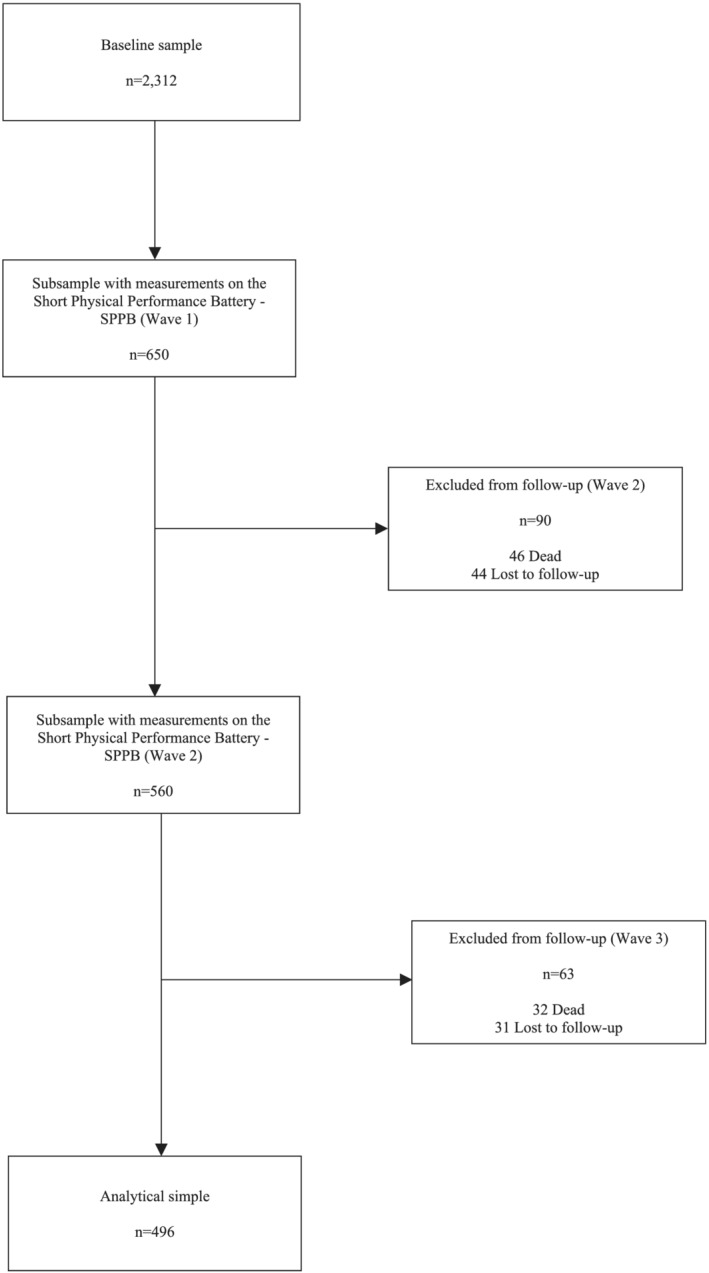
Data come from the three waves of the World Health Organization (WHO) Study on Global AGEing and Adult Health (SAGE) in Mexico (2009, 2014, 2017). Four hundred ninety-six older adults, aged ≥50, were included. Sarcopenia was defined as having low muscle quantity and either/both slow gait speed and weak handgrip strength. Mild cognitive impairment was determined based on the recommendations of the National Institute on Aging-Alzheimer's Association. Cognitive function was evaluated by a composite cognitive score of five different cognitive tests: immediate and delayed recall, forward and backward digit span and semantic verbal fluency. Three-level mixed-effects models (logistic and linear) were used to estimate the longitudinal associations between sarcopenia, mild cognitive impairment and cognitive function.
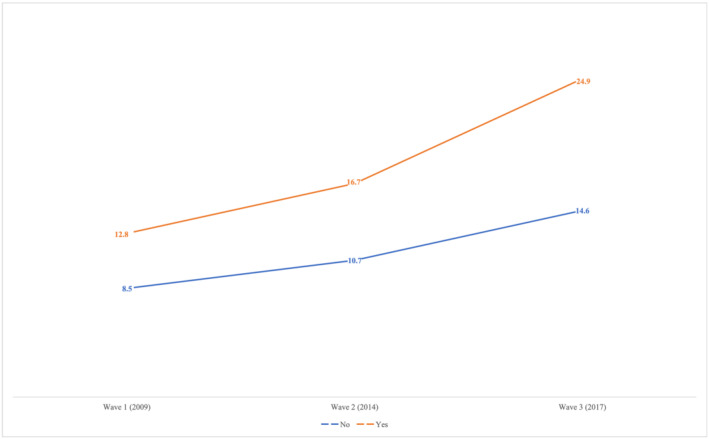
The prevalence of mild cognitive impairment (8.9%, 12.9%, 16.0%) and sarcopenia (10.5%, 20.7%, 23.3%) showed a significant temporal increase for Waves 1, 2 and 3 (P-value < 0.01, respectively). The presence of sarcopenia was significantly associated with mild cognitive impairment (OR = 1.74; CI95% 1.02, 2.96; P = 0.04) and worse cognitive function (β = -0.57; CI95% -0.93, -0.21; P < 0.01). We observed significant associations between sarcopenia and immediate verbal recall (β = -0.14; CI95% -0.28, -0.01; P = 0.04), delayed verbal recall (β = -0.12; CI95% -0.23, -0.01; P = 0.03) and semantic verbal fluency (β = -0.17; CI95% -0.28, -0.05; P = 0.01). The prevalence of mild cognitive impairment increased at an annual rate of 0.8% for non-sarcopenic older adults, but nearly 1.5% for sarcopenic adults.
Significant longitudinal associations were observed between sarcopenia, mild cognitive impairment and cognitive function among older Mexican adults. Public health strategies, including policy research and clinical interventions, must be implemented in low- and middle-income countries in order to reduce or delay the onset of sarcopenia and thus improve population-level cognitive health among older adults.
横断面和纵向研究的最新证据支持这样一种假设,即肌少症与认知功能恶化有关。然而,主要证据主要来自高收入国家,而在中低收入国家,这种关联尚未得到充分探索。本研究旨在评估墨西哥老年人群体中肌少症与轻度认知障碍之间的纵向关联。
数据来自世界卫生组织(WHO)全球老龄化和成人健康研究(SAGE)在墨西哥的三次波次(2009 年、2014 年、2017 年)。共纳入 496 名年龄≥50 岁的老年人。肌少症的定义是肌肉量低,同时/或者步行速度慢和握力弱。轻度认知障碍是根据国家老龄化研究所-阿尔茨海默病协会的建议确定的。认知功能通过五项不同认知测试的综合认知评分来评估:即时和延迟回忆、向前和向后数字跨度以及语义口头流畅性。使用三级混合效应模型(逻辑和线性)来估计肌少症、轻度认知障碍和认知功能之间的纵向关联。
轻度认知障碍(8.9%、12.9%、16.0%)和肌少症(10.5%、20.7%、23.3%)的患病率在波 1、2 和 3 中均呈显著的时间增加(P 值均<0.01)。肌少症的存在与轻度认知障碍(OR=1.74;95%CI95% 1.02,2.96;P=0.04)和认知功能下降(β=-0.57;95%CI95% -0.93,-0.21;P<0.01)显著相关。我们观察到肌少症与即时言语回忆(β=-0.14;95%CI95% -0.28,-0.01;P=0.04)、延迟言语回忆(β=-0.12;95%CI95% -0.23,-0.01;P=0.03)和语义口头流畅性(β=-0.17;95%CI95% -0.28,-0.05;P=0.01)之间存在显著关联。非肌少症老年人的轻度认知障碍患病率每年增加 0.8%,而肌少症老年人则增加近 1.5%。
在墨西哥老年人群体中,肌少症、轻度认知障碍和认知功能之间存在显著的纵向关联。中低收入国家必须实施公共卫生策略,包括政策研究和临床干预,以减少或延迟肌少症的发生,从而改善老年人的人群认知健康。