Maryland Institute for Applied Environmental Health, University of Maryland School of Public Health, 2234F SPH Building #255, College Park, MD, 20742, USA.
Aclima, Inc., San Francisco, CA, USA.
Environ Health. 2021 Sep 18;20(1):105. doi: 10.1186/s12940-021-00787-y.
Infections with nontyphoidal Salmonella cause an estimated 19,336 hospitalizations each year in the United States. Sources of infection can vary by state and include animal and plant-based foods, as well as environmental reservoirs. Several studies have recognized the importance of increased ambient temperature and precipitation in the spread and persistence of Salmonella in soil and food. However, the impact of extreme weather events on Salmonella infection rates among the most prevalent serovars, has not been fully evaluated across distinct U.S. regions.
To address this knowledge gap, we obtained Salmonella case data for S. Enteriditis, S. Typhimurium, S. Newport, and S. Javiana (2004-2014; n = 32,951) from the Foodborne Diseases Active Surveillance Network (FoodNet), and weather data from the National Climatic Data Center (1960-2014). Extreme heat and precipitation events for the study period (2004-2014) were identified using location and calendar day specific 95 percentile thresholds derived using a 30-year baseline (1960-1989). Negative binomial generalized estimating equations were used to evaluate the association between exposure to extreme events and salmonellosis rates.
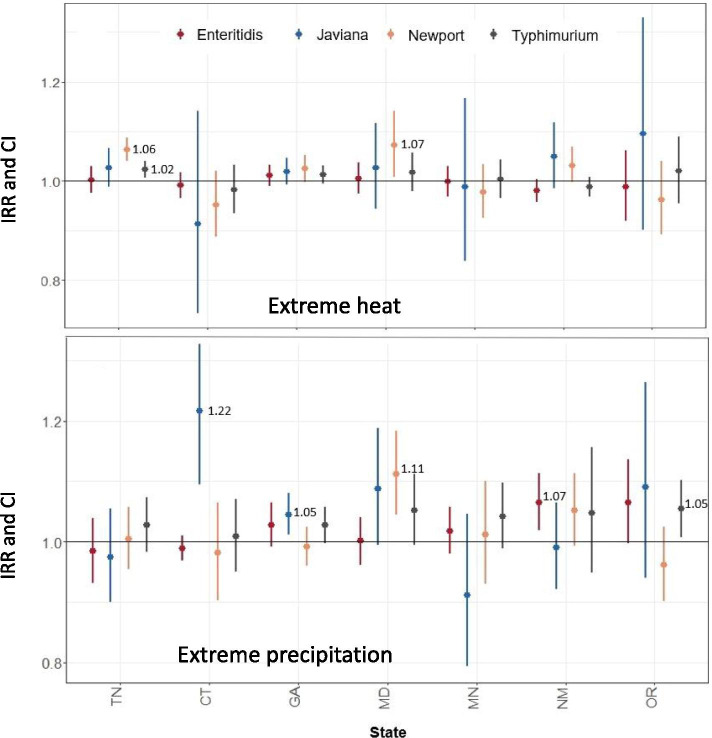
We observed that extreme heat exposure was associated with increased rates of infection with S. Newport in Maryland (Incidence Rate Ratio (IRR): 1.07, 95% Confidence Interval (CI): 1.01, 1.14), and Tennessee (IRR: 1.06, 95% CI: 1.04, 1.09), both FoodNet sites with high densities of animal feeding operations (e.g., broiler chickens and cattle). Extreme precipitation events were also associated with increased rates of S. Javiana infections, by 22% in Connecticut (IRR: 1.22, 95% CI: 1.10, 1.35) and by 5% in Georgia (IRR: 1.05, 95% CI: 1.01, 1.08), respectively. In addition, there was an 11% (IRR: 1.11, 95% CI: 1.04-1.18) increased rate of S. Newport infections in Maryland associated with extreme precipitation events.
Overall, our study suggests a stronger association between extreme precipitation events, compared to extreme heat, and salmonellosis across multiple U.S. regions. In addition, the rates of infection with Salmonella serovars that persist in environmental or plant-based reservoirs, such as S. Javiana and S. Newport, appear to be of particular significance regarding increased heat and rainfall events.
在美国,每年估计有 19336 人因感染非伤寒沙门氏菌而住院。感染源因州而异,包括动物和植物源性食品以及环境储层。一些研究已经认识到,气温升高和降水增加会影响土壤和食物中沙门氏菌的传播和持续存在。然而,极端天气事件对美国不同地区最常见血清型沙门氏菌感染率的影响尚未得到充分评估。
为了弥补这一知识空白,我们从食源性疾病主动监测网络(FoodNet)获得了 2004 年至 2014 年期间(n=32951)沙门氏菌肠炎、鼠伤寒沙门氏菌、纽波特沙门氏菌和雅文氏沙门氏菌(S. Newport、S. Javiana)的病例数据,以及国家气候数据中心(National Climatic Data Center)的天气数据(1960-2014 年)。使用基于 30 年基线(1960-1989 年)的特定地点和日历日 95%分位数阈值,确定研究期间(2004-2014 年)的极端高温和降水事件。使用负二项式广义估计方程评估暴露于极端事件与沙门氏菌病率之间的关联。
我们发现,马里兰州(发病率比(IRR):1.07,95%置信区间(CI):1.01,1.14)和田纳西州(IRR:1.06,95% CI:1.04,1.09)的极端高温暴露与纽波特沙门氏菌感染率增加有关,这两个地点都是动物饲养场(如肉鸡和牛)密度较高的地方。极端降水事件也与雅文氏沙门氏菌感染率增加有关,康涅狄格州增加 22%(IRR:1.22,95% CI:1.10,1.35),佐治亚州增加 5%(IRR:1.05,95% CI:1.01,1.08)。此外,马里兰州与极端降水事件有关的纽波特沙门氏菌感染率增加了 11%(IRR:1.11,95% CI:1.04-1.18)。
总的来说,我们的研究表明,与高温相比,极端降水事件与美国多个地区的沙门氏菌病之间的关联更强。此外,环境或植物源性储层中持续存在的沙门氏菌血清型(如 S. Javiana 和 S. Newport)的感染率似乎与高温和降雨事件的增加有特别重要的关系。