Shin Hakseung, Nicolau Juan Luis, Kang Juhyun, Sharma Abhinav, Lee Hoon
Division of Tourism, College of Social Science, Hanyang University, 222, Wangsimni-ro, Seongdong-gu, Seoul, 04763, Republic of Korea.
Howard Feiertag Department of Hospitality and Tourism Management, Pamplin College of Business, Virginia Tech Blacksburg, VA, 24061, USA.
Tour Manag. 2022 Feb;88:104428. doi: 10.1016/j.tourman.2021.104428. Epub 2021 Sep 8.
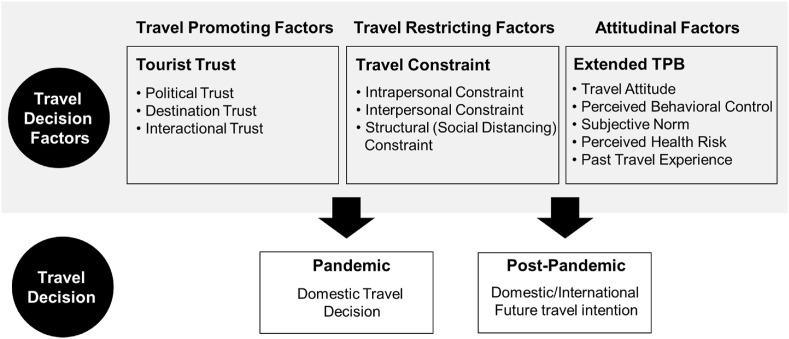
The COVID-19 pandemic has forced tourism practitioners to create efficient strategies to attract travelers. Using three theoretical frameworks, such as tourist trust (political, destination, and interactional trust), travel constraint (intrapersonal, interpersonal, and "social distancing" structural constraint), and extended theory of planned behavior (travel attitude, perceived behavioral control, subjective norm, perceived health risk, past travel experience), we develop a comprehensive framework to explain the impact of travel promoting, restricting, and attitudinal factors on travel decision during and after the pandemic. Data was obtained through an extensive survey conducted on 1451 Korean travelers and was analyzed using probabilistic choice models and count models. The results show the specific factors that determine travel decisions during the pandemic (whether to travel and frequency) and travel intention after the pandemic. This study provides important theoretical and practical insights into how to develop successful COVID-19 recovery strategies in the tourism industry.
新冠疫情迫使旅游业从业者制定有效的策略来吸引游客。我们运用三个理论框架,即游客信任(政治信任、目的地信任和互动信任)、旅行限制(个人内部限制、人际限制和“社交距离”结构限制)以及计划行为扩展理论(旅行态度、感知行为控制、主观规范、感知健康风险、过去的旅行经历),构建了一个综合框架,以解释旅行促进因素、限制因素和态度因素在疫情期间及之后对旅行决策的影响。数据通过对1451名韩国游客进行的广泛调查获得,并使用概率选择模型和计数模型进行分析。结果显示了在疫情期间决定旅行的具体因素(是否旅行以及旅行频率)以及疫情之后的旅行意愿。本研究为旅游业如何制定成功的新冠疫情后复苏策略提供了重要的理论和实践见解。