Sungkhaphan Piyarat, Thavornyutikarn Boonlom, Kaewkong Pakkanun, Pongkittiphan Veerachai, Pornsuwan Soraya, Singhatanadgit Weerachai, Janvikul Wanida
Biofunctional Materials and Devices Research Group, National Metal and Materials Technology Center, Pathumthani, Thailand.
Department of Chemistry and Center of Excellence for Innovation in Chemistry (PERCH-CIC), Faculty of Science, Mahidol University, Bangkok, Thailand.
R Soc Open Sci. 2021 Sep 15;8(9):210808. doi: 10.1098/rsos.210808. eCollection 2021 Sep.
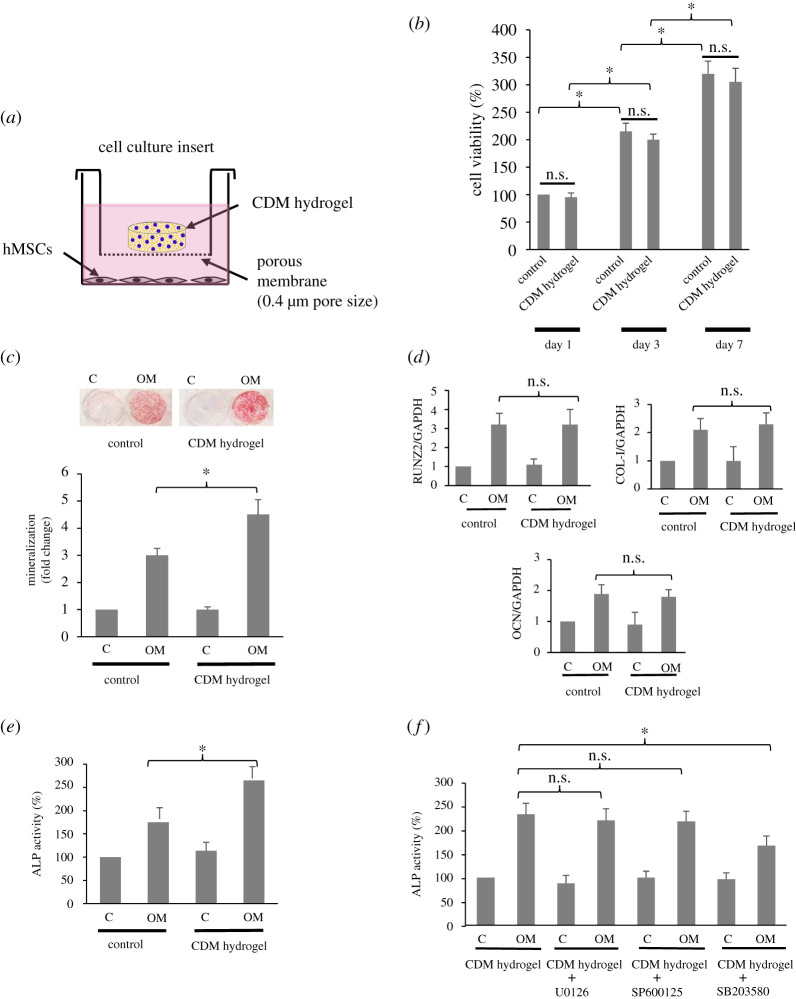
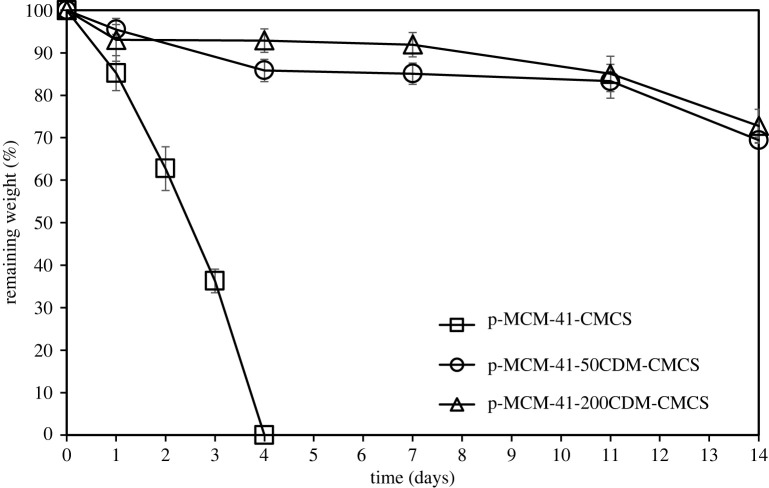
Conventional treatment of jaw bone infection is often ineffective at controlling bacterial infection and enhancing bone regeneration. Biodegradable composite hydrogels comprised of carboxymethyl chitosan (CMCS) and clindamycin (CDM)-loaded mesoporous silica nanoparticles (MCM-41), possessing dual antibacterial activity and osteogenic potency, were developed in the present study. CDM was successfully loaded into both untreated and plasma-treated MCM-41 nanoparticles, denoted as (p)-MCM-41, followed by the incorporation of each of CDM-loaded (p)-MCM-41 into CMCS. The resulting CDM-loaded composite hydrogels, (p)-MCM-41-CDM-CMCS, demonstrated slow degradation rates (about 70% remaining weight after 14-day immersion), while the CDM-free composite hydrogel entirely disintegrated after 4-day immersion. The plasma treatment was found to improve drug loading capacity and slow down initial drug burst effect. The prolonged releases of CDM from both (p)-MCM-41-CDM-CMCS retained their antibacterial effect against for at least 14 days assessment of osteogenic activity showed that the CDM-incorporated composite hydrogel was cytocompatible to human mesenchymal stem cells (hMSCs) and induced hMSC mineralization via p38-dependent upregulated alkaline phosphatase activity. In conclusion, novel (p)-MCM-41-CDM-CMCS hydrogels with combined controlled release of CDM and osteogenic potency were successfully developed for the first time, suggesting their potential clinical benefit for treatment of intraoral bone infection.
颌骨感染的传统治疗方法在控制细菌感染和促进骨再生方面往往效果不佳。本研究开发了一种由羧甲基壳聚糖(CMCS)和负载克林霉素(CDM)的介孔二氧化硅纳米颗粒(MCM - 41)组成的可生物降解复合水凝胶,该水凝胶具有双重抗菌活性和成骨能力。CDM成功负载到未处理和经等离子体处理的MCM - 41纳米颗粒(称为(p)-MCM - 41)中,然后将每种负载CDM的(p)-MCM - 41掺入CMCS中。所得负载CDM的复合水凝胶(p)-MCM - 41 - CDM - CMCS显示出缓慢的降解速率(浸泡14天后剩余重量约为70%),而不含CDM的复合水凝胶在浸泡4天后完全分解。发现等离子体处理可提高药物负载能力并减缓初始药物突释效应。CDM从(p)-MCM - 41 - CDM - CMCS中的延长释放对……至少保持14天的抗菌效果。成骨活性评估表明,掺入CDM的复合水凝胶对人间充质干细胞(hMSCs)具有细胞相容性,并通过p38依赖性上调碱性磷酸酶活性诱导hMSC矿化。总之,首次成功开发了具有CDM控释和成骨能力相结合的新型(p)-MCM - 41 - CDM - CMCS水凝胶,表明其在治疗口腔内骨感染方面具有潜在的临床益处。