Long Qiuyue, Li Jiwei, Hu Xiaoyi, Bai Yangyuyan, Zheng Yali, Gao Zhancheng
Department of Respiratory, Critical Care and Sleep Medicine, Xiang'an Hospital of Xiamen University, Xiamen, China.
School of Medicine, Xiamen University, Xiamen, China.
Front Med (Lausanne). 2021 Sep 3;8:702635. doi: 10.3389/fmed.2021.702635. eCollection 2021.
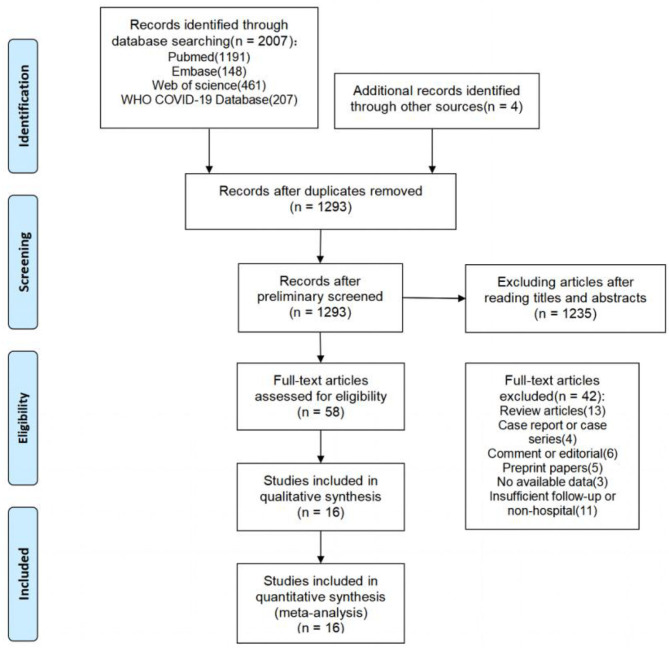
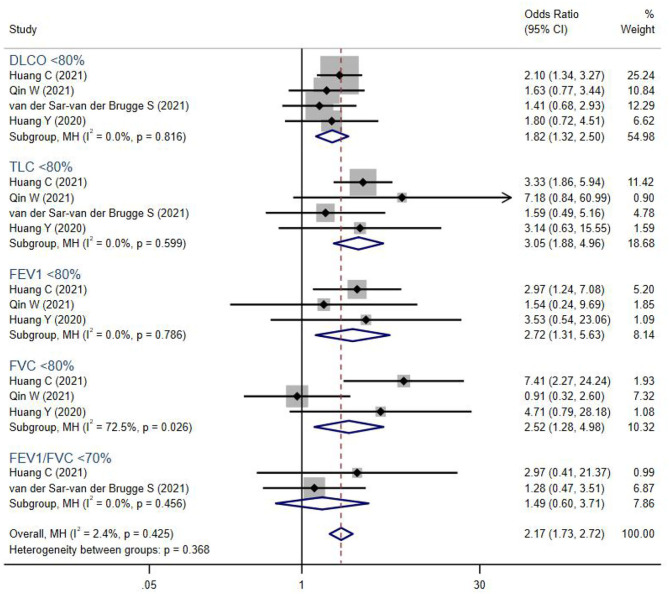
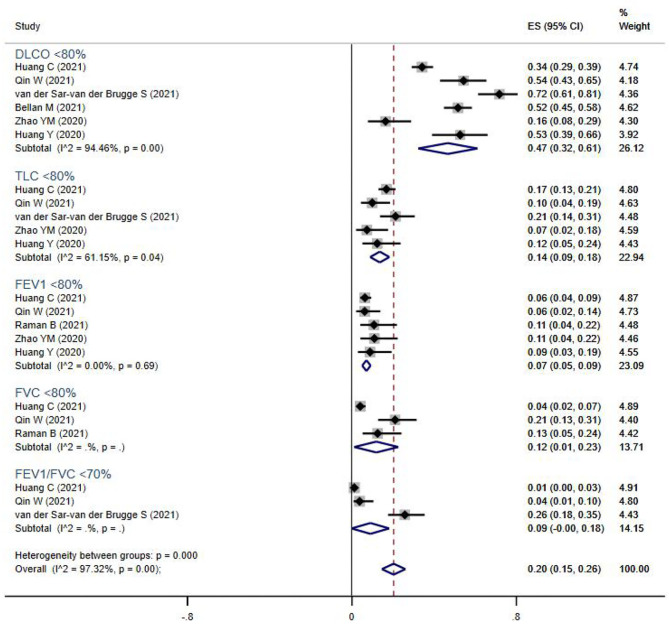
As the number of recovering COVID-19 patients increases worldwide, the persistence of symptoms and signs through the post-acute phase indicates an urgent need for prolonged follow-up care. To explore existing data about post-acute COVID-19 syndrome, this meta-analysis assesses the prevalence of persistent manifestations in multiple systems and abnormalities in lung function, as well as their related risks in patients with various severities. Articles about discharged COVID-19 patients (published from January 1, 2020 to February 23, 2021) were obtained by searching four databases. Cohort studies with follow-up periods >1 month post-discharge or >2 months post-admission were included. A total of 4,478 COVID-19 patients from 16 cohort studies were included in this meta-analysis. Fatigue or weakness (47%) were the most prevalent physical effects of post-acute COVID-19 syndrome, while psychosocial (28%) symptoms were the most common manifestations among several systems. Abnormalities in lung function of recovering patients, i.e., DLCO <80% (47%, 95% CI: 32-61%) persisted for long periods. Severe patients were more likely to present joint pain (OR 1.84, 95% CI: 1.11-3.04) and decreased lung functions compared with non-severe patients, with pooled ORs for abnormal TLC, FEV1, FVC, and DLCO of 3.05 (95% CI: 1.88-4.96), 2.72 (95% CI: 1.31-5.63), 2.52 (95% CI: 1.28-4.98), and 1.82 (95% CI: 1.32-2.50), respectively. Our research indicates that patients recovering from COVID-19 manifest long-term, multi-system symptoms, and the adverse effects on psychosocial health and lung functions were the most extensive and persistent. These findings together may facilitate much needed in-depth study of clinical treatments for long-term, post-acute phase symptoms that affect a great number of recovering COVID-19 patients.
随着全球新冠康复患者数量的增加,急性期后症状和体征的持续存在表明迫切需要延长后续护理。为了探索有关新冠后急性综合征的现有数据,本荟萃分析评估了多个系统中持续症状的患病率、肺功能异常情况,以及不同严重程度患者的相关风险。通过检索四个数据库获取了关于出院新冠患者(发表于2020年1月1日至2021年2月23日)的文章。纳入了出院后随访期>1个月或入院后>2个月的队列研究。本荟萃分析共纳入了来自16项队列研究的4478例新冠患者。疲劳或虚弱(47%)是新冠后急性综合征最常见的身体影响,而心理社会症状(28%)是多个系统中最常见的表现。康复患者的肺功能异常,即一氧化碳弥散量(DLCO)<80%(47%,95%置信区间:32 - 61%)持续时间较长。与非重症患者相比,重症患者更易出现关节疼痛(比值比1.84,95%置信区间:1.11 - 3.04)和肺功能下降,总肺活量(TLC)、第一秒用力呼气容积(FEV1)、用力肺活量(FVC)和DLCO异常的合并比值比分别为3.05(95%置信区间:1.88 - 4.96)、2.72(95%置信区间:1.31 - 5.63)、2.52(95%置信区间:1.28 - 4.98)和1.82(95%置信区间:1.32 - 2.50)。我们的研究表明,新冠康复患者表现出长期的多系统症状,对心理社会健康和肺功能的不良影响最为广泛和持久。这些发现共同可能有助于对影响大量新冠康复患者的长期急性期后症状的临床治疗进行急需的深入研究。