Al-Menhali Afnan Saleh, Anderson Cali, Gourine Alexander V, Abramov Andrey Y, D'Souza Alicia, Jaganjac Morana
Division of Medicine, University College London, London, United Kingdom.
Qatar Analytics and BioResearch Lab, Anti Doping Lab Qatar, Doha, Qatar.
Front Mol Biosci. 2021 Sep 1;8:723858. doi: 10.3389/fmolb.2021.723858. eCollection 2021.
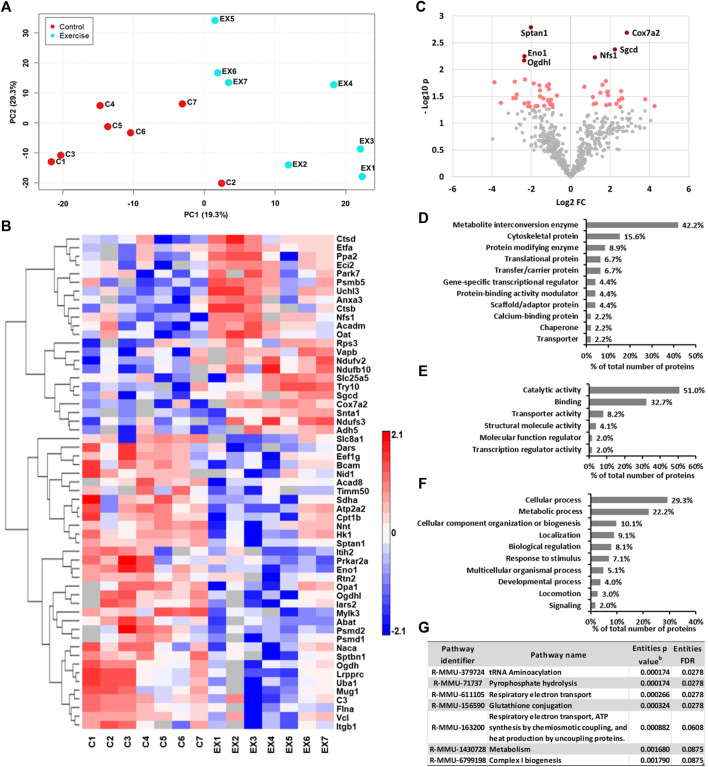
Regular exercise has many health benefits, among which is a significant reduction of cardiovascular risk. Although many beneficial effects of exercise are well described, the exact mechanisms by which exercise confers cardiovascular benefits are yet to be fully understood. In the current study, we have used high resolution mass spectrometry to determine the proteomic responses of the heart to exercise training in mice. The impact of exercise-induced oxidative stress on modifications of cardiomyocyte proteins with lipid peroxidation biomarker 4-hydroxynonenal (4-HNE) was examined as well. Fourteen male mice were randomized into the control (sedentary) group and the exercise group that was subjected to a swim exercise training program for 5 days a week for 5 months. Proteins were isolated from the left ventricular tissue, fractionated and digested for shotgun proteomics. Peptides were separated by nanoliquid chromatography and analyzed on an Orbitrap Fusion mass spectrometer using high-energy collision-induced dissociation and electron transfer dissociation fragmentation. We identified distinct ventricular protein signatures established in response to exercise training. Comparative proteomics identified 23 proteins that were upregulated and 37 proteins that were downregulated with exercise, in addition to 65 proteins that were identified only in ventricular tissue samples of exercised mice. Most of the proteins specific to exercised mice are involved in respiratory electron transport and/or implicated in glutathione conjugation. Additionally, 10 proteins were found to be modified with 4-HNE. This study provides new data on the effects of exercise on the cardiac proteome and contributes to our understanding of the molecular mechanisms underlying the beneficial effects of exercise on the heart.
规律运动对健康有诸多益处,其中显著降低心血管风险。尽管运动的许多有益作用已得到充分描述,但运动赋予心血管益处的确切机制仍有待完全理解。在本研究中,我们使用高分辨率质谱来确定小鼠心脏对运动训练的蛋白质组学反应。还研究了运动诱导的氧化应激对心肌细胞蛋白质与脂质过氧化生物标志物4-羟基壬烯醛(4-HNE)修饰的影响。将14只雄性小鼠随机分为对照组(久坐不动)和运动组,运动组每周进行5天游泳运动训练,持续5个月。从左心室组织中分离蛋白质,进行分级分离并消化以用于鸟枪法蛋白质组学。肽段通过纳升液相色谱分离,并在Orbitrap Fusion质谱仪上使用高能碰撞诱导解离和电子转移解离碎片化进行分析。我们确定了运动训练后建立的不同心室蛋白质特征。比较蛋白质组学确定了23种运动后上调的蛋白质和37种运动后下调的蛋白质,此外还在运动小鼠的心室组织样本中鉴定出65种仅在该组中存在的蛋白质。大多数运动小鼠特有的蛋白质参与呼吸电子传递和/或与谷胱甘肽结合有关。此外,发现有10种蛋白质被4-HNE修饰。本研究提供了关于运动对心脏蛋白质组影响的新数据,并有助于我们理解运动对心脏有益作用的分子机制。