Pallett Laura J, Dimeloe Sarah, Sinclair Linda V, Byrne Adam J, Schurich Anna
Division of Infection and Immunity, Institute of Immunity and Transplantation, University College London, London, UK.
Institute of Immunology and Immunotherapy, Institute of Metabolism and Systems Research, College of Medical and Dental Sciences, University of Birmingham, Birmingham, UK.
Immunother Adv. 2021 Jun 1;1(1):ltab010. doi: 10.1093/immadv/ltab010. eCollection 2021 Jan.
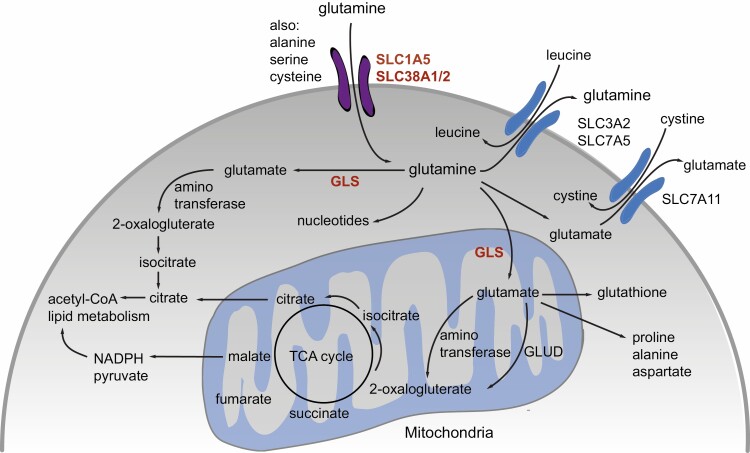
Within the tumour microenvironment (TME), there is a cellular 'tug-of-war' for glutamine, the most abundant amino acid in the body. This competition is most evident when considering the balance between a successful anti-tumour immune response and the uncontrolled growth of tumour cells that are addicted to glutamine. The differential effects of manipulating glutamine abundance in individual cell types is an area of intense research and debate. Here, we discuss some of the current strategies in development altering local glutamine availability focusing on inhibition of enzymes involved in the utilisation of glutamine and its uptake by cells in the TME. Further studies are urgently needed to complete our understanding of glutamine metabolism, to provide critical insights into the pathways that represent promising targets and for the development of novel therapeutic strategies for the treatment of advanced or drug resistant cancers.
在肿瘤微环境(TME)中,细胞间围绕谷氨酰胺展开了一场“拔河比赛”,谷氨酰胺是体内最丰富的氨基酸。当考虑成功的抗肿瘤免疫反应与依赖谷氨酰胺的肿瘤细胞不受控制的生长之间的平衡时,这种竞争最为明显。在个体细胞类型中操纵谷氨酰胺丰度的不同影响是一个激烈研究和辩论的领域。在此,我们讨论了当前正在开发的一些策略,这些策略旨在改变局部谷氨酰胺的可用性,重点是抑制参与谷氨酰胺利用及其被TME中细胞摄取的酶。迫切需要进一步的研究来完善我们对谷氨酰胺代谢的理解,为代表有前景靶点的途径提供关键见解,并开发用于治疗晚期或耐药癌症的新型治疗策略。