Drobni Zsofia D, Murphy Sean P, Alvi Raza M, Lee Charlotte, Gong Jingyi, Mosarla Ramya C, Rambarat Paula K, Hartmann Sarah B, Gilman Hannah K, Zubiri Leyre, Raghu Vineet K, Sullivan Ryan J, Zafar Amna, Zlotoff Daniel A, Sise Meghan E, Guidon Amanda C, Reynolds Kerry L, Dougan Michael, Neilan Tomas G
Cardiovascular Imaging Research Center, Department of Radiology and Division of Cardiology, Massachusetts General Hospital, Harvard Medical School, Boston, MA, USA.
Cardiovascular Imaging Research Group, Heart and Vascular Center, Semmelweis University, Budapest, Hungary.
Immunother Adv. 2021 Jun 16;1(1):ltab014. doi: 10.1093/immadv/ltab014. eCollection 2021 Jan.
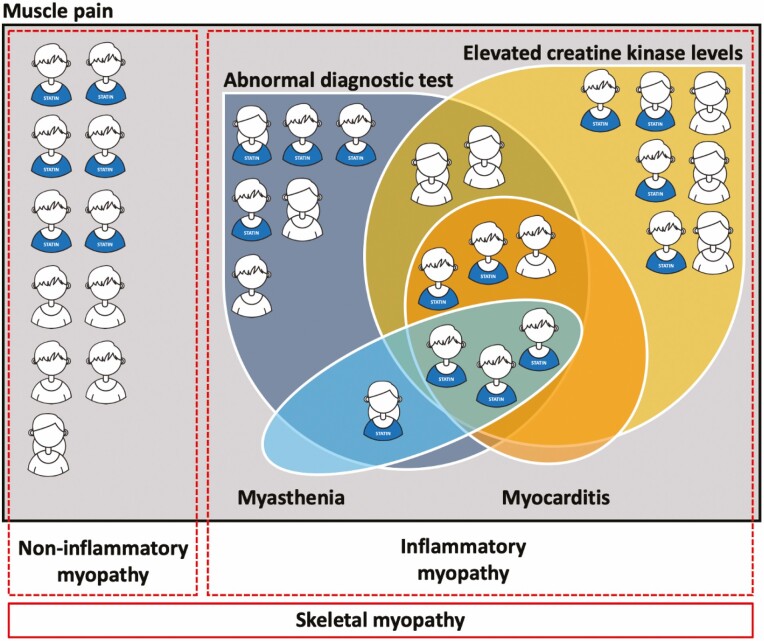
Skeletal myopathies are highly morbid, and in rare cases even fatal, immune-related adverse events (irAE) associated with immune checkpoint inhibitors (ICI). Skeletal myopathies are also a recognized statin-associated side effect. It is unknown whether concurrent use of statins and ICIs increases the risk of skeletal myopathies.
This was a retrospective cohort study of all patients who were treated with an ICI at a single academic institution (Massachusetts General Hospital, Boston, MA, USA). The primary outcome of interest was the development of a skeletal myopathy. The secondary outcome of interest was an elevated creatine kinase level (above the upper limit of normal).
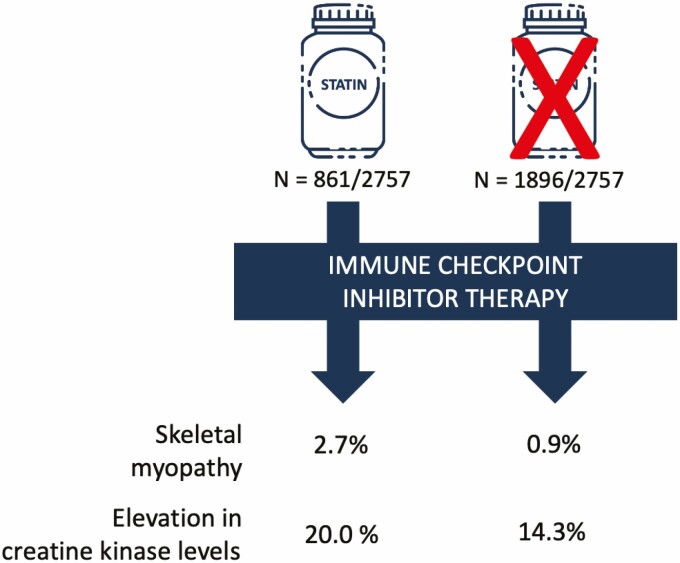
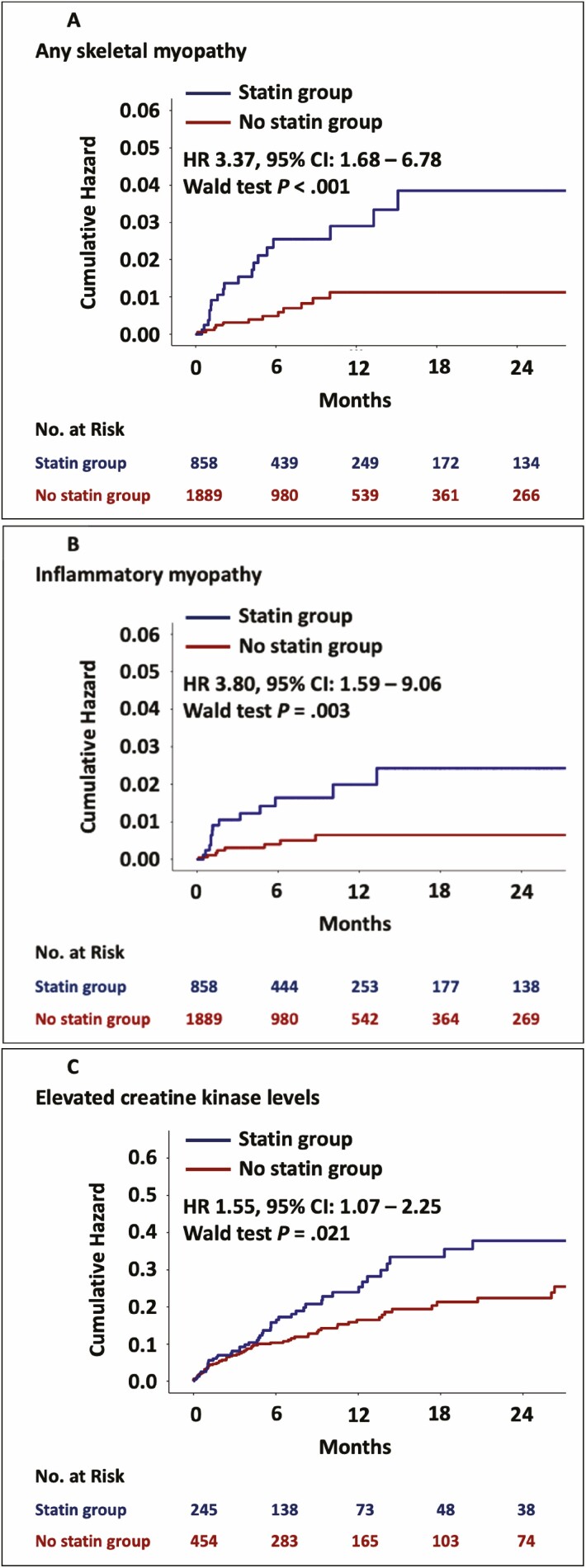
Among 2757 patients, 861 (31.2%) were treated with a statin at the time of ICI start. Statin users were older, more likely to be male and had a higher prevalence of cardiovascular and non-cardiovascular co-morbidities. During a median follow-up of 194 days (inter quartile range 65-410), a skeletal myopathy occurred in 33 patients (1.2%) and was more common among statin users (2.7 vs. 0.9%, < 0.001). Creatine kinase (CK) elevation was present in 16.3% (114/699) and was higher among statin users (20.0 vs. 14.3%, = 0.067). In a multivariable Cox model, statin therapy was associated with a >2-fold higher risk for skeletal myopathy (HR, 2.19; 95% confidence interval, 1.07-4.50; = 0.033).
In this large cohort of ICI-treated patients, a higher risk was observed for skeletal myopathies and elevation in CK levels in patients undergoing concurrent statin therapy. Prospective observational studies are warranted to further elucidate the potential association between statin use and ICI-associated myopathies.
骨骼肌病是与免疫检查点抑制剂(ICI)相关的高发病率、在罕见情况下甚至致命的免疫相关不良事件(irAE)。骨骼肌病也是一种公认的他汀类药物相关副作用。目前尚不清楚同时使用他汀类药物和ICI是否会增加骨骼肌病的风险。
这是一项对美国马萨诸塞州波士顿市麻省总医院这一学术机构中所有接受ICI治疗的患者进行的回顾性队列研究。感兴趣的主要结局是骨骼肌病的发生。感兴趣的次要结局是肌酸激酶水平升高(高于正常上限)。
在2757例患者中,861例(31.2%)在开始使用ICI时接受了他汀类药物治疗。使用他汀类药物的患者年龄较大,男性比例更高,心血管和非心血管合并症的患病率也更高。在中位随访194天(四分位间距65 - 410天)期间,33例患者(1.2%)发生了骨骼肌病,在使用他汀类药物的患者中更为常见(2.7%对0.9%,P<0.001)。16.3%(114/699)的患者出现肌酸激酶(CK)升高,在使用他汀类药物的患者中更高(20.0%对14.3%,P = 0.067)。在多变量Cox模型中,他汀类药物治疗与骨骼肌病风险高出2倍以上相关(风险比,2.19;95%置信区间,1.07 - 4.50;P = 0.033)。
在这个接受ICI治疗的大型队列中,观察到同时接受他汀类药物治疗的患者发生骨骼肌病和CK水平升高的风险更高。有必要进行前瞻性观察研究,以进一步阐明他汀类药物使用与ICI相关肌病之间的潜在关联。