UniSA Justice & Society, University of South Australia, Adelaide, South Australia, Australia.
UniSA Clinical & Health Sciences, University of South Australia, Adelaide, South Australia, Australia.
J Med Internet Res. 2021 Sep 20;23(9):e29210. doi: 10.2196/29210.
Apathy is a frequent and underrecognized neurological disorder symptom. Reduced goal-directed behavior caused by apathy is associated with poor outcomes for older adults in residential aged care. Recommended nonpharmacological treatments include person-centered therapy using information and communication technology. Virtual reality (VR) in the form of head-mounted displays (HMDs) is a fully immersive technology that provides access to a wide range of freely available content. The use of VR as a therapy tool has demonstrated promise in the treatment of posttraumatic stress disorder and anxiety. In addition, VR has been used to improve conditions including depression, anxiety, cognitive function, and balance in older adults with memory deficits, Alzheimer disease, and Parkinson disease. Research using VR for the symptoms of apathy in older adults living in residential aged care facilities is limited.
This study aims to examine whether using HMDs as a tool for reminiscence therapy improves the symptoms of apathy compared with using a laptop computer and physical items with older adults living in residential aged care.
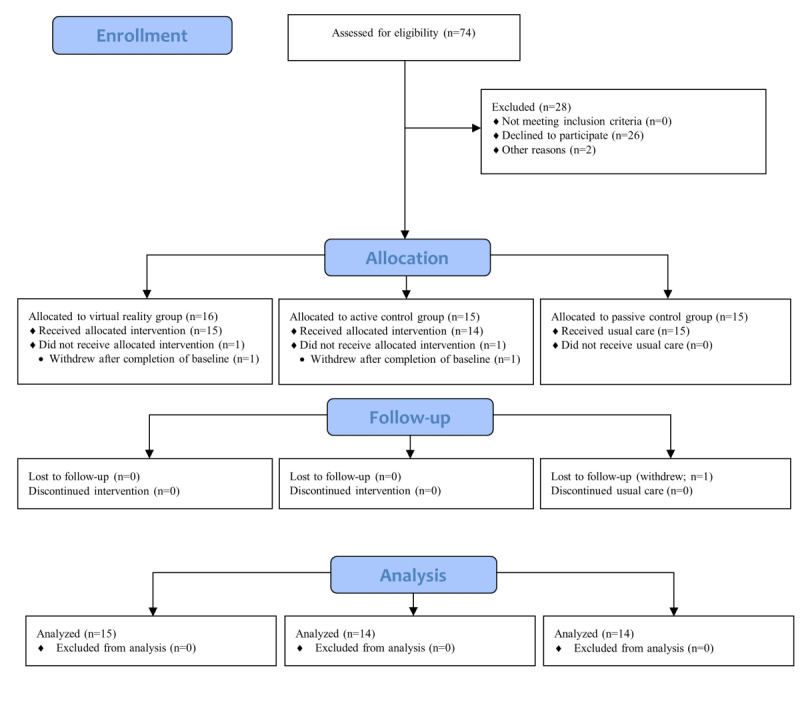
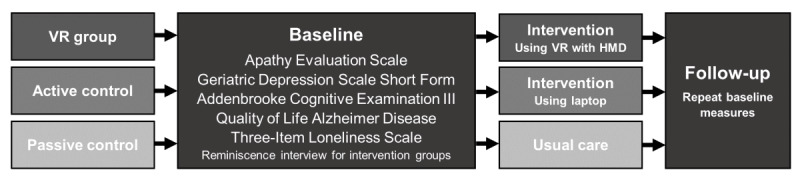
In this multisite trial, 43 participants were allocated to one of three groups: reminiscence therapy intervention using VR in the form of HMDs, reminiscence therapy using a laptop computer supplemented by physical items if required (active control), and a usual care (passive control) group. The primary outcome was apathy, and the secondary outcomes included cognition and depression. The side effects of using HMDs were also measured in the VR group.
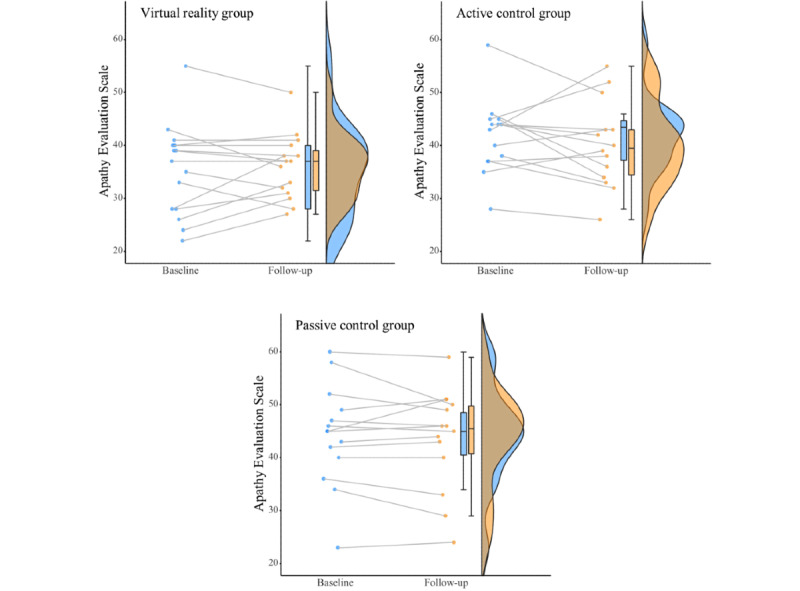
Mixed model analyses revealed no significant group interaction over time in outcomes between the VR and laptop groups (estimate=-2.24, SE 1.89; t=-1.18; P=.24). Pooled apathy scores in the two intervention groups compared with the passive control group also revealed no significant group interaction over time (estimate=-0.26, SE 1.66; t=-0.16; P=.88). There were no significant secondary outcomes. Most participants in the VR group stated that they would prefer to watch content in VR than on a flat screen (Χ=11.2; P=.004), side effects from HMD use were negligible to minimal according to the Simulator Sickness Questionnaire cutoff scores.
Although there were no significant results in outcome measures, this study found that participants engaged in the research and enjoyed the process of reminiscing using both forms of technology. It was found that VR can be implemented in an aged care setting with correct protocols in place. Providing residents in aged care with a choice of technology may assist in increasing participation in activities. We cannot dismiss the importance of immediate effects while the therapy was in progress, and this is an avenue for future research.
Australian New Zealand Clinical Trials Registry ACTRN12619001510134; https://www.anzctr.org.au/Trial/Registration/TrialReview.aspx?id=378564.
INTERNATIONAL REGISTERED REPORT IDENTIFIER (IRRID): RR2-DOI: 10.1136/bmjopen-2020-046030.
冷漠是一种常见且未被充分认识的神经障碍症状。冷漠导致的目标导向行为减少与居住在养老院的老年人预后不良有关。推荐的非药物治疗包括使用信息和通信技术的以患者为中心的治疗。虚拟现实(VR)形式的头戴式显示器(HMD)是一种完全沉浸式技术,可提供广泛的免费可用内容。VR 作为一种治疗工具已在治疗创伤后应激障碍和焦虑症方面显示出前景。此外,VR 已被用于改善认知功能、平衡等状况,包括有记忆缺陷的老年人的抑郁、焦虑、抑郁和帕金森病。针对居住在养老院的老年人冷漠症状使用 VR 的研究有限。
本研究旨在探讨使用 HMD 作为怀旧疗法工具是否比使用笔记本电脑和实物对居住在养老院的老年人更能改善冷漠症状。
在这项多中心试验中,43 名参与者被分配到三个组之一:使用 HMD 形式的 VR 进行怀旧疗法干预、使用笔记本电脑进行怀旧疗法,如果需要则补充实物(主动对照组)和常规护理(被动对照组)。主要结局是冷漠,次要结局包括认知和抑郁。还测量了 VR 组使用 HMD 的副作用。
混合模型分析显示,VR 组和笔记本组之间在两组之间的时间无显著的组间交互作用(估计值=-2.24,SE 1.89;t=-1.18;P=.24)。与被动对照组相比,两个干预组的 pooled 冷漠评分也没有显示出随时间的显著组间交互作用(估计值=-0.26,SE 1.66;t=-0.16;P=.88)。没有显著的次要结局。大多数 VR 组的参与者表示,他们更愿意在 VR 中观看内容,而不是在平面屏幕上观看(Χ=11.2;P=.004),根据模拟器疾病问卷的截断分数,HMD 使用的副作用可以忽略不计或最小。
尽管在结果测量方面没有显著的结果,但本研究发现参与者参与了研究,并喜欢使用这两种技术进行怀旧。研究发现,VR 可以在适当的协议下在养老院环境中实施。为养老院居民提供技术选择可能有助于增加他们对活动的参与度。虽然治疗过程中存在即时效果,但我们不能忽视这一点,这是未来研究的一个方向。
澳大利亚新西兰临床试验注册 ACTRN12619001510134;https://www.anzctr.org.au/Trial/Registration/TrialReview.aspx?id=378564。
国际注册报告标识符(IRRID):RR2-DOI:10.1136/bmjopen-2020-046030。