Centers for Disease Control and Prevention-Nigeria Country Office, Abuja, Federal Capital Territory, Nigeria.
Maryland Global Initiatives (affiliate of the University of Maryland, Baltimore), Abuja, Federal Capital Territory, Nigeria.
PLoS One. 2021 Sep 20;16(9):e0257476. doi: 10.1371/journal.pone.0257476. eCollection 2021.
Ineffective linkage to care (LTC) is a known challenge for community HIV testing. To overcome this challenge, a robust linkage to care strategy was adopted by the 2018 Nigeria HIV/AIDS Indicator and Impact Survey (NAIIS). The NAIIS linkage to care strategy was further adapted to improve Nigeria's programmatic efforts to achieve the 1st 90 as part of the Nigeria Antiretroviral Therapy (ART) Surge initiative, which also included targeted community testing. In this paper we provide an overview of the NAIIS LTC strategy and describe the impact of this strategy on both the NAIIS and the Surge initiatives.
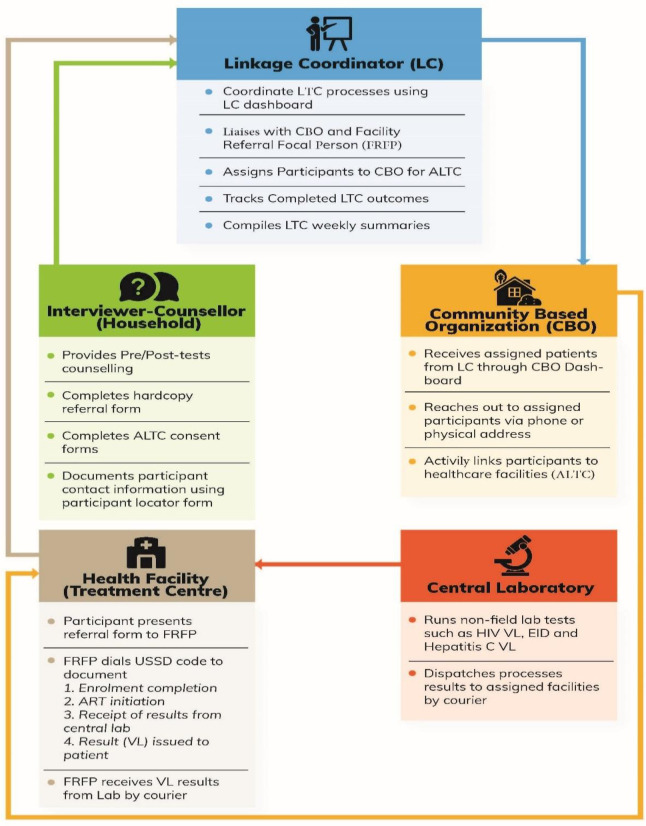
The NAIIS collaborated with community-based organizations (CBOs) and deployed mobile health (mHealth) technology with real-time dashboards to manage and optimize community LTC for people living with HIV (PLHIV) diagnosed during the survey. In NAIIS, CBOs' role was to facilitate linkage of identified PLHIV in community to facility of their choice. For the ART Surge, we modified the NAIIS LTC strategy by empowering both CBOs and mobile community teams as responsible for not only active LTC but also for community testing, ART initiation, and retention in care.
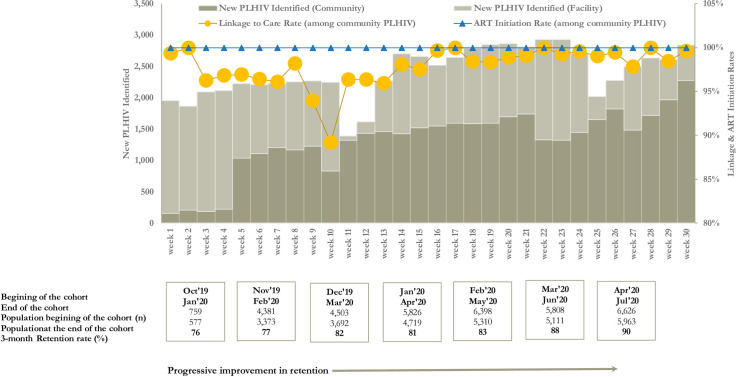
Of the 2,739 PLHIV 15 years and above identified in NAIIS, 1,975 (72.1%) were either unaware of their HIV-positive status (N = 1890) or were aware of their HIV-positive status but not receiving treatment (N = 85). Of these, 1,342 (67.9%) were linked to care, of which 952 (70.9%) were initiated on ART. Among 1,890 newly diagnosed PLHIV, 1,278 (67.6%) were linked to care, 33.7% self-linked and 66.3% were linked by CBOs. Among 85 known PLHIV not on treatment, 64 (75.3%) were linked; 32.8% self-linked and 67.2% were linked by a CBO. In the ART Surge, LTC and treatment initiation rates were 98% and 100%, respectively. Three-month retention for monthly treatment initiation cohorts improved from 76% to 90% over 6 months.
Active LTC strategies by local CBOs and mobile community teams improved LTC and ART initiation in the ART Surge initiative. The use of mHealth technology resulted in timely and accurate documentation of results in NAIIS. By deploying mHealth in addition to active LTC, CBOs and mobile community teams could effectively scale up ART with real-time documentation of client-level outcomes.
社区艾滋病毒检测面临着无效的衔接护理(LTC)的挑战。为了克服这一挑战,2018 年尼日利亚艾滋病毒/艾滋病指标和影响调查(NAIIS)采用了一项强大的衔接护理战略。该衔接护理战略还进一步适应了提高尼日利亚实现第 1 个 90 的方案努力,这也是尼日利亚抗逆转录病毒治疗(ART)激增倡议的一部分,该倡议还包括有针对性的社区检测。在本文中,我们提供了 NAIIS 衔接护理战略的概述,并描述了该战略对 NAIIS 和激增倡议的影响。
NAIIS 与社区组织(CBO)合作,并部署移动健康(mHealth)技术,通过实时仪表板来管理和优化社区中艾滋病毒感染者(PLHIV)的衔接护理,这些 PLHIV 是在调查期间诊断出来的。在 NAIIS 中,CBO 的作用是促进社区中确定的 PLHIV 与他们选择的机构的衔接。对于抗逆转录病毒治疗激增倡议,我们修改了 NAIIS 的衔接护理战略,授权 CBO 和移动社区团队不仅负责积极的衔接护理,还负责社区检测、ART 启动和护理保留。
在 NAIIS 中,年龄在 15 岁及以上的 2739 名 PLHIV 中,有 1975 名(72.1%)要么不知道自己的 HIV 阳性状况(N=1890),要么知道自己的 HIV 阳性状况但未接受治疗(N=85)。其中,有 1342 名(67.9%)被衔接至护理,其中 952 名(70.9%)开始接受抗逆转录病毒治疗。在新诊断的 1890 名 PLHIV 中,有 1278 名(67.6%)被衔接至护理,33.7%的人自行衔接,66.3%的人由 CBO 衔接。在 85 名已知未接受治疗的 PLHIV 中,有 64 名(75.3%)被衔接,32.8%的人自行衔接,67.2%的人由 CBO 衔接。在抗逆转录病毒治疗激增倡议中,衔接护理和治疗启动率分别为 98%和 100%。对于每月启动治疗的队列,3 个月的保留率从 6 个月的 76%提高到 90%。
当地 CBO 和移动社区团队的积极衔接护理战略提高了抗逆转录病毒治疗激增倡议中的衔接护理和抗逆转录病毒治疗启动率。移动健康技术的使用导致在 NAIIS 中及时和准确地记录结果。通过在积极的衔接护理之外部署移动健康技术,CBO 和移动社区团队可以有效地扩大抗逆转录病毒治疗的规模,并实时记录客户层面的结果。