Department of Cell and Molecular Biology and Biochemistry, School of Biological and Chemical Sciences, University of Missouri-Kansas City, Kansas City, Missouri, United States of America.
PLoS Pathog. 2021 Sep 20;17(9):e1009622. doi: 10.1371/journal.ppat.1009622. eCollection 2021 Sep.
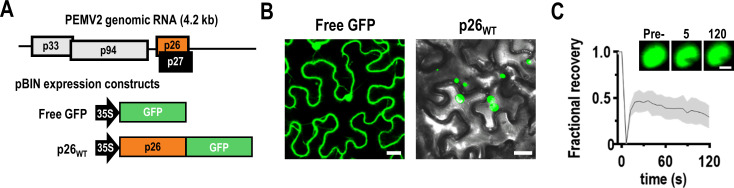
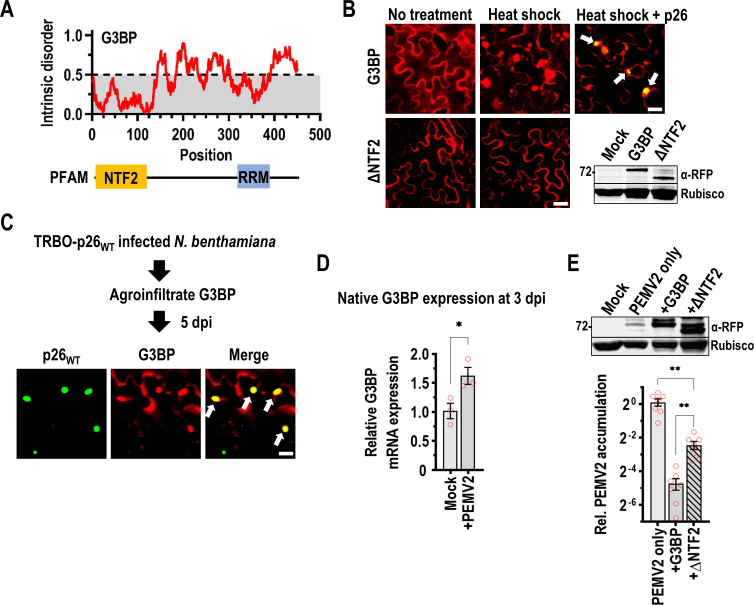
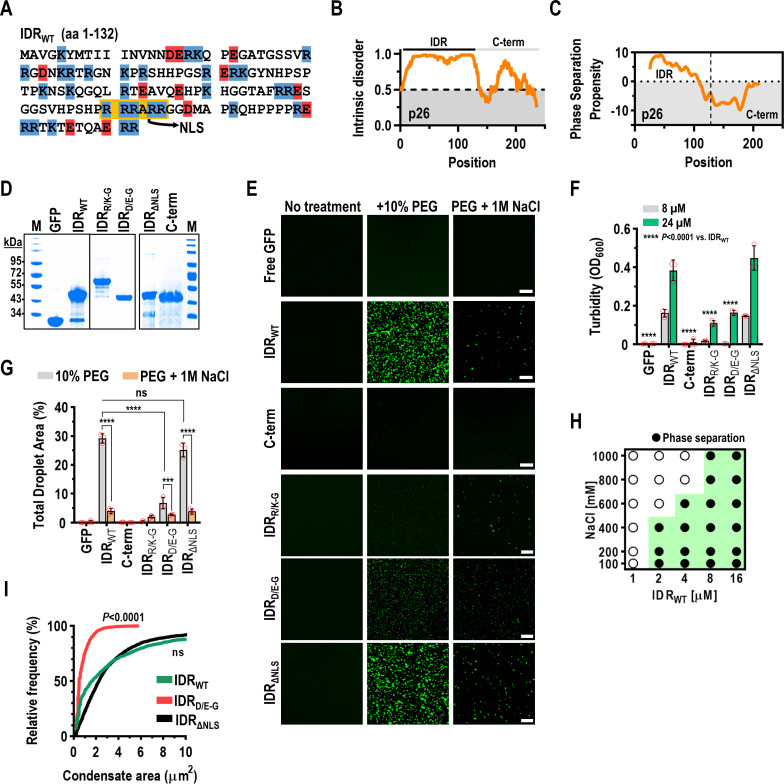
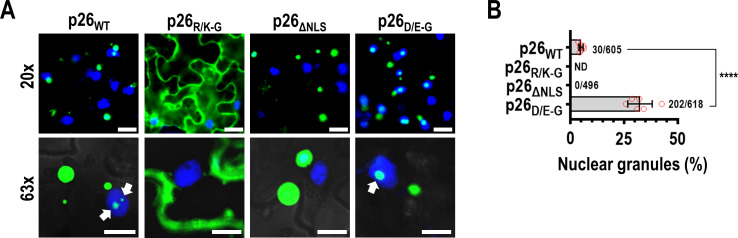
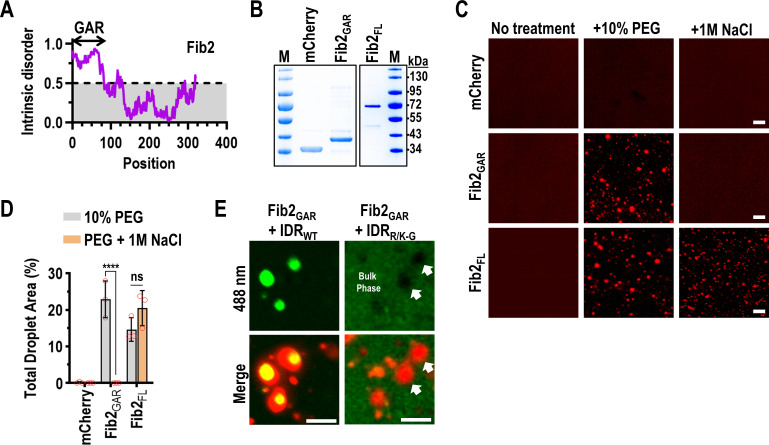
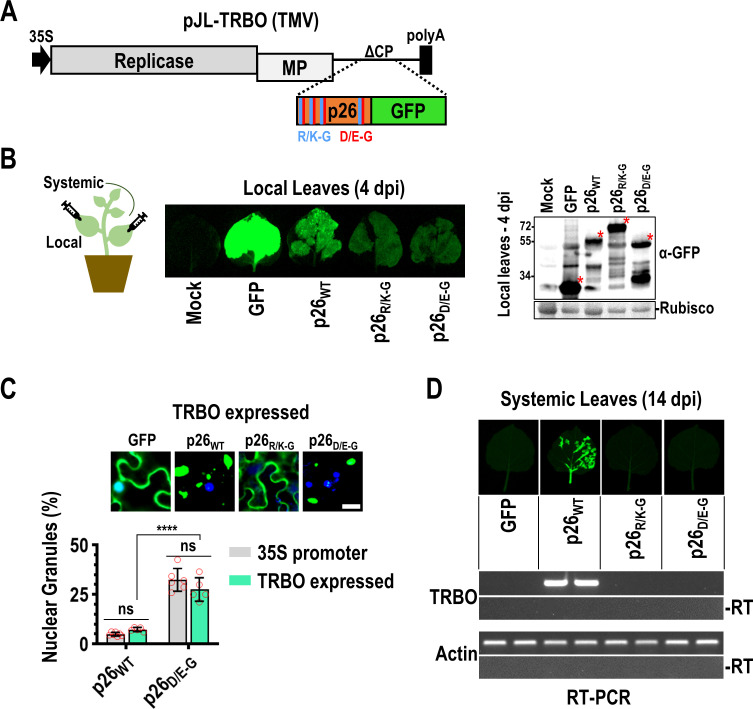
Both cellular and viral proteins can undergo phase separation and form membraneless compartments that concentrate biomolecules. The p26 movement protein from single-stranded, positive-sense Pea enation mosaic virus 2 (PEMV2) separates into a dense phase in nucleoli where p26 and related orthologues must interact with fibrillarin (Fib2) as a pre-requisite for systemic virus movement. Using in vitro assays, viral ribonucleoprotein complexes containing p26, Fib2, and PEMV2 genomic RNAs formed droplets that may provide the basis for self-assembly in planta. Mutating basic p26 residues (R/K-G) blocked droplet formation and partitioning into Fib2 droplets or the nucleolus and prevented systemic movement of a Tobacco mosaic virus (TMV) vector in Nicotiana benthamiana. Mutating acidic residues (D/E-G) reduced droplet formation in vitro, increased nucleolar retention 6.5-fold, and prevented systemic movement of TMV, thus demonstrating that p26 requires electrostatic interactions for droplet formation and charged residues are critical for nucleolar trafficking and virus movement. p26 readily partitioned into stress granules (SGs), which are membraneless compartments that assemble by clustering of the RNA binding protein G3BP following stress. G3BP is upregulated during PEMV2 infection and over-expression of G3BP restricted PEMV2 RNA accumulation >20-fold. Deletion of the NTF2 domain that is required for G3BP condensation restored PEMV2 RNA accumulation >4-fold, demonstrating that phase separation enhances G3BP antiviral activity. These results indicate that p26 partitions into membraneless compartments with either proviral (Fib2) or antiviral (G3BP) factors.
细胞和病毒蛋白都可以发生相分离,形成无膜隔间,从而浓缩生物分子。来自单链、正链 Pea enation mosaic virus 2(PEMV2)的 p26 运动蛋白在核仁中分离成致密相,在核仁中 p26 和相关同源物必须与纤维蛋白(Fib2)相互作用,这是病毒系统运动的先决条件。使用体外测定法,含有 p26、Fib2 和 PEMV2 基因组 RNA 的病毒核糖核蛋白复合物形成液滴,这些液滴可能为植物体内的自组装提供基础。突变碱性 p26 残基(R/K-G)阻断液滴形成和与 Fib2 液滴或核仁的分配,并阻止烟草花叶病毒(TMV)载体在 Nicotiana benthamiana 中的系统性运动。突变酸性残基(D/E-G)减少了体外液滴的形成,核仁保留增加了 6.5 倍,并阻止了 TMV 的系统性运动,这表明 p26 形成液滴需要静电相互作用,带电荷的残基对于核仁运输和病毒运动至关重要。p26 容易分配到应激颗粒(SGs)中,这是无膜隔间,通过应激下 RNA 结合蛋白 G3BP 的聚集而组装。在 PEMV2 感染期间,G3BP 上调,过表达 G3BP 限制 PEMV2 RNA 积累超过 20 倍。删除 G3BP 凝聚所需的 NTF2 结构域,使 PEMV2 RNA 积累恢复超过 4 倍,这表明相分离增强了 G3BP 的抗病毒活性。这些结果表明,p26 与促病毒(Fib2)或抗病毒(G3BP)因子一起分配到无膜隔间中。