Mannheim Centre for European Social Research, University of Mannheim, 68131 Mannheim, Germany;
Mannheim Centre for European Social Research, University of Mannheim, 68131 Mannheim, Germany.
Proc Natl Acad Sci U S A. 2021 Sep 28;118(39). doi: 10.1073/pnas.2103913118.
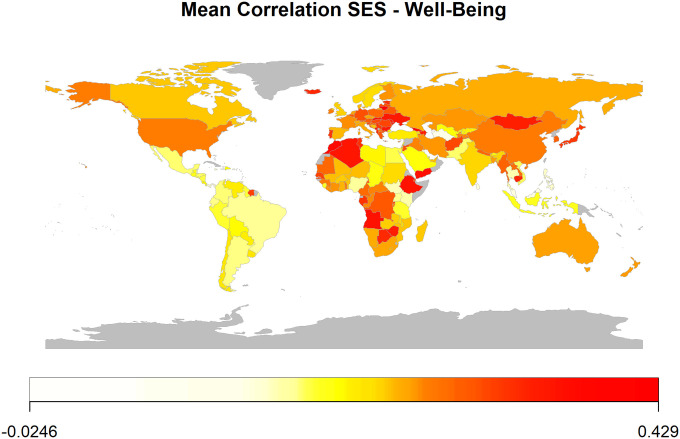
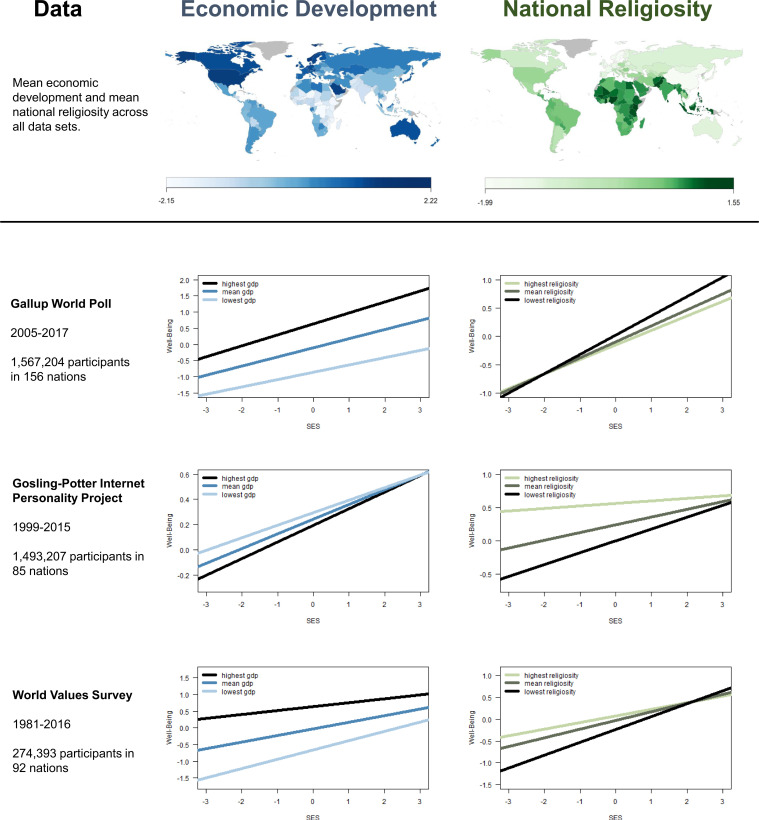
Lower socioeconomic status (SES) harms psychological well-being, an effect responsible for widespread human suffering. This effect has long been assumed to weaken as nations develop economically. Recent evidence, however, has contradicted this fundamental assumption, finding instead that the psychological burden of lower SES is even greater in developed nations than in developing ones. That evidence has elicited consternation because it suggests that economic development is no cure for the psychological burden of lower SES. So, why is that burden greatest in developed nations? Here, we test whether national religiosity can explain this puzzle. National religiosity is particularly low in developed nations. Consequently, developed nations lack religious norms that may ease the burden of lower SES. Drawing on three different data sets of 1,567,204, 1,493,207, and 274,393 people across 156, 85, and 92 nations, we show that low levels of national religiosity can account for the greater burden of lower SES in developed nations. This finding suggests that, as national religiosity continues to decline, lower SES will become increasingly harmful for well-being-a societal change that is socially consequential and demands political attention.
较低的社会经济地位(SES)会损害心理健康,这种影响导致了广泛的人类苦难。长期以来,人们一直认为,随着国家经济的发展,这种影响会减弱。然而,最近的证据却与这一基本假设相悖,反而发现,在发达国家,较低 SES 带来的心理负担比发展中国家更大。这一证据引起了人们的惊愕,因为它表明,经济发展并不能治愈较低 SES 带来的心理负担。那么,为什么这种负担在发达国家最大呢?在这里,我们检验了国家宗教信仰是否可以解释这个谜团。在发达国家,国家宗教信仰特别低。因此,发达国家缺乏可能减轻较低 SES 负担的宗教规范。我们利用来自 156 个国家的三个人口数据集,分别有 1,567,204 人、1,493,207 人和 274,393 人,以及来自 85 个国家和 92 个国家的另外两个数据集,展示了低水平的国家宗教信仰可以解释为什么在发达国家,较低 SES 的负担更大。这一发现表明,随着国家宗教信仰的持续下降,较低 SES 对幸福感的危害将越来越大——这种社会变化具有社会意义,需要引起政治关注。