Department of Psychiatry, Hsin-Chu Mackay Memorial Hospital, Hsin-Chu, Taiwan.
Department of Health Services Administration, College of Public Health, China Medical University, Taichung, Taiwan.
Sci Rep. 2021 Sep 20;11(1):18605. doi: 10.1038/s41598-021-98169-4.
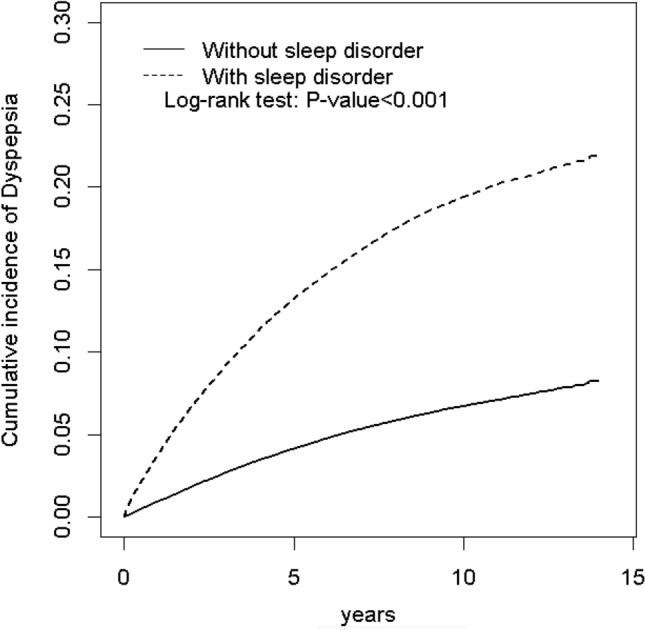
Increased prevalence of sleep disorders has been found in patients with functional dyspepsia; however, direction of causality remains unclear. Our aim was to compare the risk of incident functional dyspepsia between patients with and without sleep disturbance from a large population-based sample. Utilizing a nation-wide health insurance administrative dataset, we assembled an 11-year historic cohort study to compare subsequent incidence of diagnosed functional dyspepsia between adult patients with any diagnosis of sleep disturbance and age- and gender-matched controls. Hazard ratios adjusted for other relevant comorbidities and medications were calculated using Cox regression models. 45,310 patients with sleep disorder and 90,620 controls were compared. Patients with sleep apnea had a 3.3-fold (95% confidence interval: 2.82 ~ 3.89) increased hazard of functional dyspepsia compared with controls. This increased risk persisted regardless of previously diagnosed depression coexisted. Sleep disturbance was associated with an increased risk of subsequent functional dyspepsia. Potential mechanisms are discussed.
研究发现,功能性消化不良患者的睡眠障碍患病率增加;然而,因果关系尚不清楚。我们的目的是从一个大型基于人群的样本中比较有和无睡眠障碍的患者中功能性消化不良的发病风险。利用全国性医疗保险管理数据集,我们进行了一项为期 11 年的历史性队列研究,比较了有任何睡眠障碍诊断的成年患者与年龄和性别匹配的对照组之间随后诊断为功能性消化不良的发病率。使用 Cox 回归模型计算了调整其他相关合并症和药物的风险比。比较了 45310 例睡眠障碍患者和 90620 例对照。与对照组相比,睡眠呼吸暂停患者患功能性消化不良的风险增加了 3.3 倍(95%置信区间:2.82~3.89)。即使先前诊断的抑郁症并存,这种风险增加仍然持续存在。睡眠障碍与随后发生功能性消化不良的风险增加有关。讨论了潜在的机制。