Gustavo Duarte Pimentel, Universidade Federal de Goiás, Goiânia, Goiás, 74605-080, Brasil. E-mail:
J Nutr Health Aging. 2021;25(8):1028-1029. doi: 10.1007/s12603-021-1663-x.
This study aimed to screen for a one year Brazilian elderly women who were physically active before of COVID-19 pandemic-induced lockdown and to assess the consequences of physical inactivity on body weight and muscle function loss.
A cohort study of one-year was conducted with twenty-nine physically active elderly (65.5±5.6y) women. Pre-assessment was took in December 2019 and post (a year later) was performed in January 2021, during the lockdown induced by COVID-19 pandemic. Body mass (kg) was obtained using the digital scale. Handgrip strength (HGS) of the non-dominant hand was determined using an electronic dynamometer. Muscle function loss was assessed using the SARC-F questionnaire.
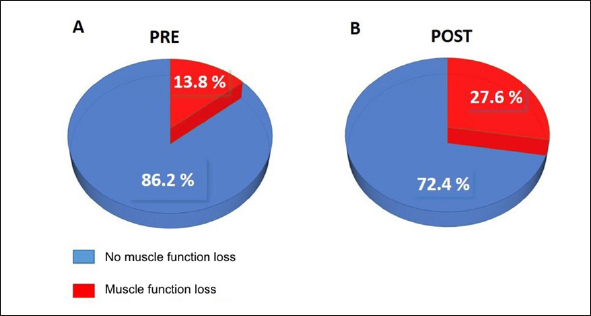
After one year, body weight (p=0.002) and BMI (p=0.001) increased significantly, with an average percentage of change in body mass of +3.0±5.2%. Consequently, there was a change in classification of BMI pre- and post-one year (malnutrition: 17.2% to 17.2%, normal weight: 41.4% to 37.9%, and overweight: 41.4% to 44.9%). Additionally, was found increased muscle function loss (SARC-F≥4) of 13.8% to 27.6% of elderly women.
In Brazilian physically active elderly women, we found that the physical inactivity imposed by during the lockdown increased the body mass and muscle function loss.
本研究旨在筛选出在 COVID-19 大流行封锁之前身体活跃的巴西老年女性,并评估身体活动减少对体重和肌肉功能丧失的影响。
对 29 名身体活跃的老年女性(65.5±5.6 岁)进行了为期一年的队列研究。预评估于 2019 年 12 月进行,而在 COVID-19 大流行引起的封锁期间,于 2021 年 1 月进行了为期一年的随访。使用数字秤测量体重。非优势手的握力(HGS)使用电子测力计测定。肌肉功能丧失通过 SARC-F 问卷进行评估。
一年后,体重(p=0.002)和 BMI(p=0.001)显著增加,体重平均变化百分比为+3.0±5.2%。因此,BMI 在预随访和随访一年后的分类发生了变化(营养不良:17.2%变为 17.2%,正常体重:41.4%变为 37.9%,超重:41.4%变为 44.9%)。此外,还发现老年女性肌肉功能丧失(SARC-F≥4)增加了 13.8%至 27.6%。
在巴西身体活跃的老年女性中,我们发现封锁期间的身体不活动导致体重增加和肌肉功能丧失。