Rydzewski Nicholas R, Peterson Erik, Lang Joshua M, Yu Menggang, Laura Chang S, Sjöström Martin, Bakhtiar Hamza, Song Gefei, Helzer Kyle T, Bootsma Matthew L, Chen William S, Shrestha Raunak M, Zhang Meng, Quigley David A, Aggarwal Rahul, Small Eric J, Wahl Daniel R, Feng Felix Y, Zhao Shuang G
Department of Human Oncology, University of Wisconsin, Madison, WI, USA.
Department of Radiation Oncology, University of Michigan, Ann Arbor, MI, USA.
NPJ Genom Med. 2021 Sep 21;6(1):76. doi: 10.1038/s41525-021-00239-z.
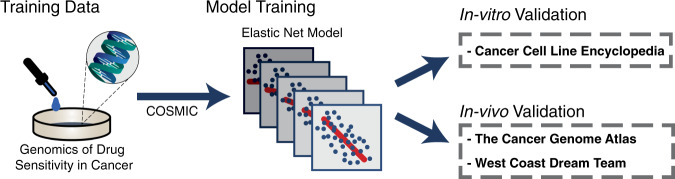
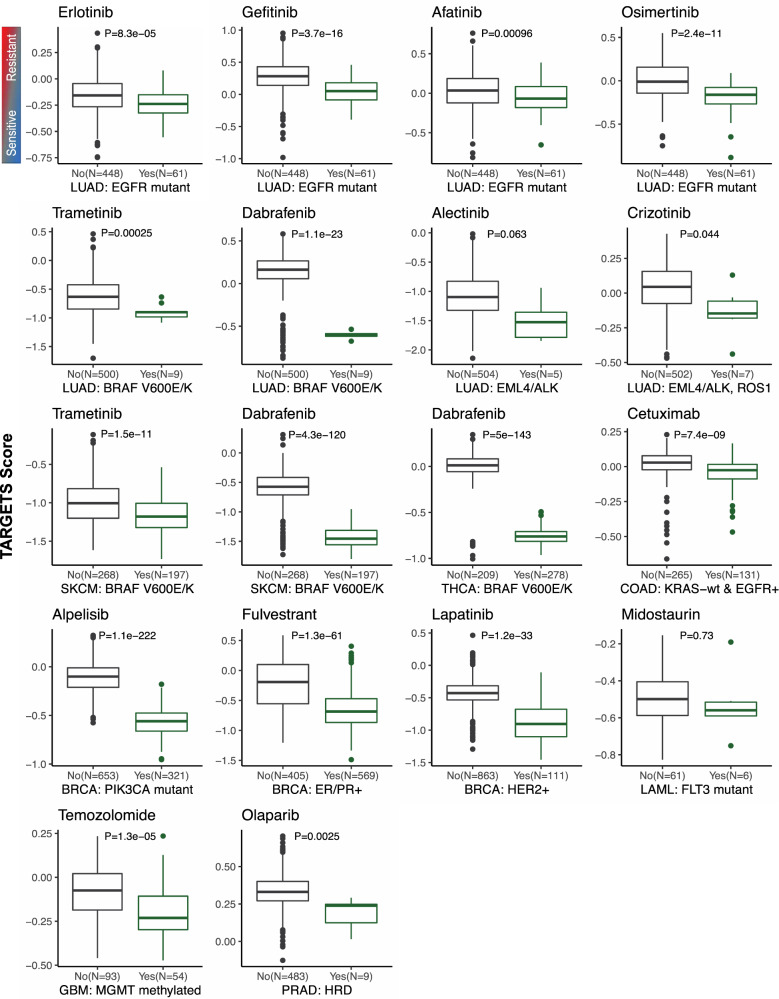
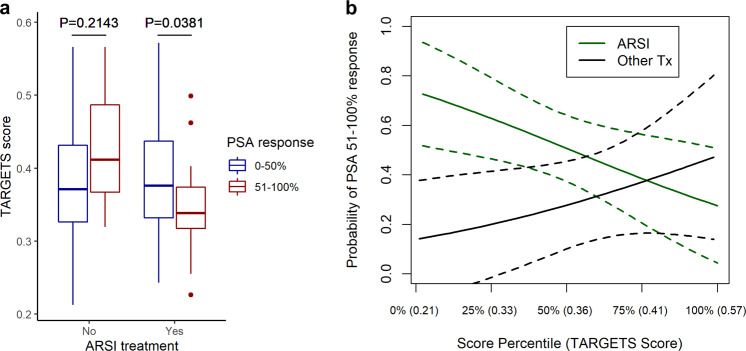
We are now in an era of molecular medicine, where specific DNA alterations can be used to identify patients who will respond to specific drugs. However, there are only a handful of clinically used predictive biomarkers in oncology. Herein, we describe an approach utilizing in vitro DNA and RNA sequencing and drug response data to create TreAtment Response Generalized Elastic-neT Signatures (TARGETS). We trained TARGETS drug response models using Elastic-Net regression in the publicly available Genomics of Drug Sensitivity in Cancer (GDSC) database. Models were then validated on additional in-vitro data from the Cancer Cell Line Encyclopedia (CCLE), and on clinical samples from The Cancer Genome Atlas (TCGA) and Stand Up to Cancer/Prostate Cancer Foundation West Coast Prostate Cancer Dream Team (WCDT). First, we demonstrated that all TARGETS models successfully predicted treatment response in the separate in-vitro CCLE treatment response dataset. Next, we evaluated all FDA-approved biomarker-based cancer drug indications in TCGA and demonstrated that TARGETS predictions were concordant with established clinical indications. Finally, we performed independent clinical validation in the WCDT and found that the TARGETS AR signaling inhibitors (ARSI) signature successfully predicted clinical treatment response in metastatic castration-resistant prostate cancer with a statistically significant interaction between the TARGETS score and PSA response (p = 0.0252). TARGETS represents a pan-cancer, platform-independent approach to predict response to oncologic therapies and could be used as a tool to better select patients for existing therapies as well as identify new indications for testing in prospective clinical trials.
我们现在处于分子医学时代,特定的DNA改变可用于识别对特定药物有反应的患者。然而,肿瘤学中临床上使用的预测生物标志物却寥寥无几。在此,我们描述了一种利用体外DNA和RNA测序以及药物反应数据来创建治疗反应广义弹性网络特征(TARGETS)的方法。我们在公开可用的癌症药物敏感性基因组学(GDSC)数据库中使用弹性网络回归训练了TARGETS药物反应模型。然后,在来自癌症细胞系百科全书(CCLE)的额外体外数据以及来自癌症基因组图谱(TCGA)和“勇敢面对癌症/前列腺癌基金会西海岸前列腺癌梦想团队”(WCDT)的临床样本上对模型进行了验证。首先,我们证明了所有TARGETS模型都成功预测了单独的体外CCLE治疗反应数据集中的治疗反应。接下来,我们评估了TCGA中所有基于FDA批准的生物标志物的癌症药物适应症,并证明TARGETS预测与既定的临床适应症一致。最后,我们在WCDT中进行了独立的临床验证,发现TARGETS雄激素受体信号抑制剂(ARSI)特征成功预测了转移性去势抵抗性前列腺癌的临床治疗反应,且TARGETS评分与PSA反应之间存在具有统计学意义的相互作用(p = 0.0252)。TARGETS代表了一种泛癌、独立于平台的方法来预测对肿瘤治疗的反应,可作为一种工具,更好地为现有治疗选择患者,并识别在前瞻性临床试验中进行测试的新适应症。