Department of Cardiothoracic and Vascular Surgery, German Heart Center Berlin, Augustenburger Platz 1, 13353, Berlin, Germany.
Hylomorph AG, Technoparkstrasse 1, 8005, Zurich, Switzerland.
Sci Rep. 2021 Sep 21;11(1):18776. doi: 10.1038/s41598-021-98220-4.
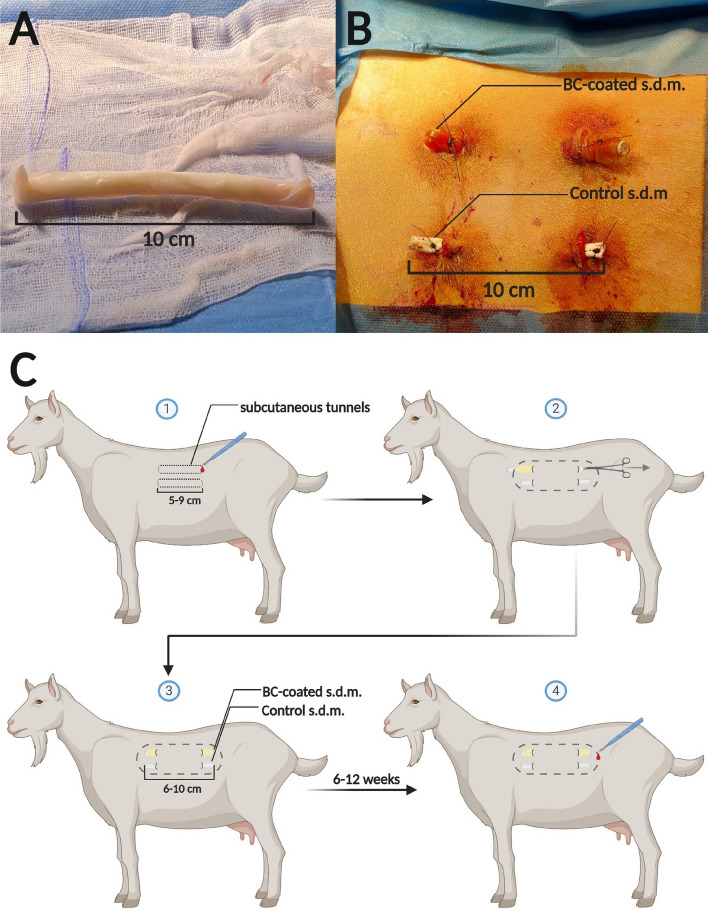
Bacterial colonization of drivelines represents a major adverse event in the implantation of left ventricular assist devices (L-VADs) for the treatment of congestive heart failure. From the external driveline interface and through the skin breach, pathogens can ascend to the pump pocket, endangering the device function and the patient's life. Surface Micro-Engineered Biosynthesized cellulose (BC) is an implantable biomaterial, which minimizes fibrotic tissue deposition and promotes healthy tissue regeneration. The topographic arrangement of cellulose fibers and the typical material porosity support its potential protective function against bacterial permeation; however, this application has not been tested in clinically relevant animal models. Here, a goat model was adopted to evaluate the barrier function of BC membranes. The external silicone mantle of commercial L-VAD drivelines was implanted percutaneously with an intervening layer of BC to separate them from the surrounding soft tissue. End-point evaluation at 6 and 12 weeks of two separate animal groups revealed the local bacterial colonization at the different interfaces in comparison with unprotected driveline mantle controls. The results demonstrate that the BC membranes established an effective barrier against the bacterial colonization of the outer driveline interface. The containment of pathogen infiltration, in combination with the known anti-fibrotic effect of BC, may promote a more efficient immune clearance upon driveline implantation and support the efficacy of local antibiotic treatments, therefore mitigating the risk connected to their percutaneous deployment.
细菌定植于血运重建线是左心室辅助装置(LVAD)植入术后的一个主要不良事件,该并发症会导致充血性心力衰竭患者的治疗失败。从外部血运重建线接口,经皮肤切口,病原体可逆行至泵体口袋,从而危及装置功能和患者生命。表面微观工程化生物合成纤维素(BC)是一种可植入的生物材料,可最大限度地减少纤维组织沉积,并促进健康组织再生。纤维素纤维的拓扑排列和典型的材料孔隙率支持其对细菌渗透的潜在保护功能;然而,这种应用尚未在临床相关的动物模型中进行测试。在这里,采用山羊模型来评估 BC 膜的屏障功能。商业 LVAD 血运重建线的外部硅橡胶外套经皮植入 BC 中间层,使它们与周围软组织隔开。两组动物在 6 周和 12 周的终点评估中,与未保护的血运重建线外套对照相比,比较了不同界面处的局部细菌定植情况。结果表明,BC 膜对外血运重建线界面的细菌定植建立了有效的屏障。病原体渗透的遏制,结合 BC 已知的抗纤维化作用,可能会促进血运重建线植入后更有效的免疫清除,并支持局部抗生素治疗的效果,从而降低经皮植入的风险。