1 Faculty of Education, Universidad Internacional de La Rioja (UNIR), Avenida de la Paz, 137, 26006, Logroño, Spain.
2 Faculty of Psychology, University of the Basque Country (UPV/EHU), Avenida de Tolosa, 70, 20018, Donostia, Spain.
J Behav Addict. 2021 Sep 16;10(3):566-586. doi: 10.1556/2006.2021.00055.
Despite its illegality among adolescents, online gambling is a common practice, which puts their mental health and well-being at serious risk. This systematic review summarises international scientific literature from the last 20 years on problematic online gambling among adolescents (11-21 years old) to determine its prevalence and to analyse related measurement issues.
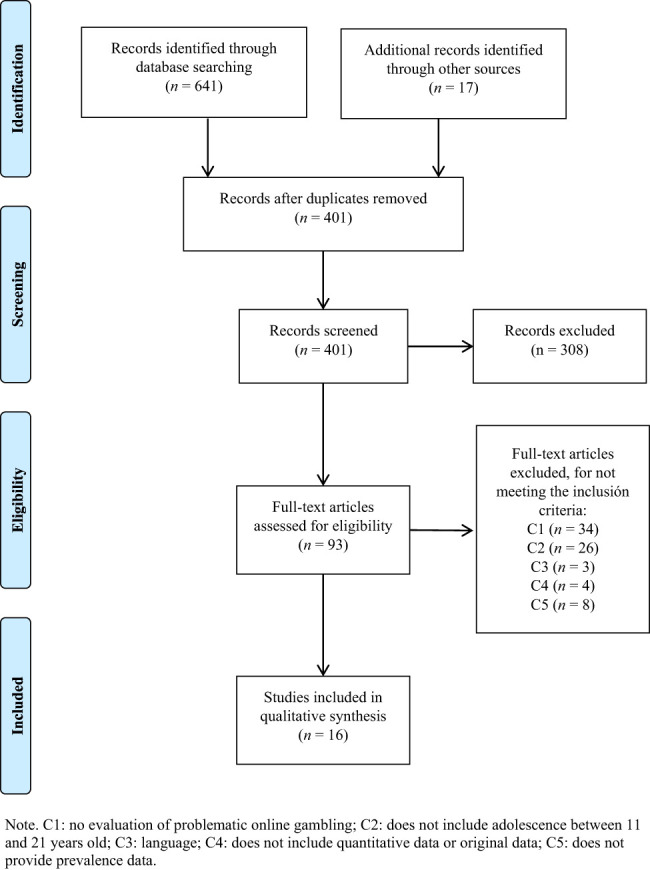
The Preferred Reporting Items for Systematic Reviews and Meta-Analyses (PRISMA) guidelines were followed and a protocol was registered in the International Prospective Register of Systematic Reviews (PROSPERO, IC: CRD42020162932). Five academic databases were consulted, which resulted in an initial sample of 658 papers.
Sixteen studies met the inclusion criteria for this review. All studies were cross-sectional and targeted students from elementary school, secondary school or university. Most followed a convenience sampling procedure. The primary measurement instruments used were the DSM-IV-MR-J and SOGS-RA. Between 0.77% and 57.5% of adolescents present some degree of problematic online gambling (problem, pathological or disordered) depending on the instruments used, the study samples and the timeframe analysed. Between 0.89% and 1% of adolescents exhibited an online gambling disorder.
There is a great heterogeneity in the methodology of the reviewed studies (samples, measurement instruments, cut-off points and criteria applied). The limited number of studies and the limited generalizability of their results suggest the need for further research and for development of specific instruments to assess different levels of problematic online gambling in representative samples of adolescents based on clinical 'gold standard' criteria and more accurate cut-off points.
尽管青少年参与网络赌博是非法的,但这是一种常见行为,会严重威胁他们的心理健康和幸福感。本系统综述总结了过去 20 年国际科学界关于青少年(11-21 岁)网络赌博问题的文献,以确定其普遍性,并分析相关测量问题。
本研究遵循系统评价和荟萃分析的首选报告项目(PRISMA)指南,并在国际前瞻性系统评价登记处(PROSPERO,注册号:CRD42020162932)注册了一份方案。共查阅了 5 个学术数据库,初步获得了 658 篇论文。
16 项研究符合本综述的纳入标准。所有研究均为横断面研究,以小学生、中学生或大学生为研究对象。大多数研究采用方便抽样程序。主要的测量工具包括 DSM-IV-MR-J 和 SOGS-RA。根据所使用的工具、研究样本和分析的时间框架,0.77%-57.5%的青少年存在不同程度的网络赌博问题(问题、病理性或障碍性)。0.89%-1%的青少年表现出网络赌博障碍。
综述研究的方法存在很大的异质性(样本、测量工具、截止值和应用标准)。研究数量有限,结果的普遍性有限,这表明需要进一步研究,并开发专门的工具,以根据临床“金标准”标准和更准确的截止值,在具有代表性的青少年样本中评估不同程度的网络赌博问题。