Coit Patrick, Ruffalo Lacy, Sawalha Amr H
Division of Rheumatology, Department of Pediatrics, University of Pittsburgh, Pittsburgh, PA, USA;Graduate Program in Immunology, University of Michigan, Ann Arbor, MI, USA.
Lupus Center of Excellence, University of Pittsburgh School of Medicine, Pittsburgh, PA, USA.
Eur J Rheumatol. 2022 Jan;9(1):3-7. doi: 10.5152/eurjrheum.2020.21225.
Systemic lupus erythematosus (SLE) is a complex heterogenous autoimmune disease that can affect multiple organs. We performed clinical clustering analysis to describe a lupus cohort from the University of Pittsburgh Medical Center.
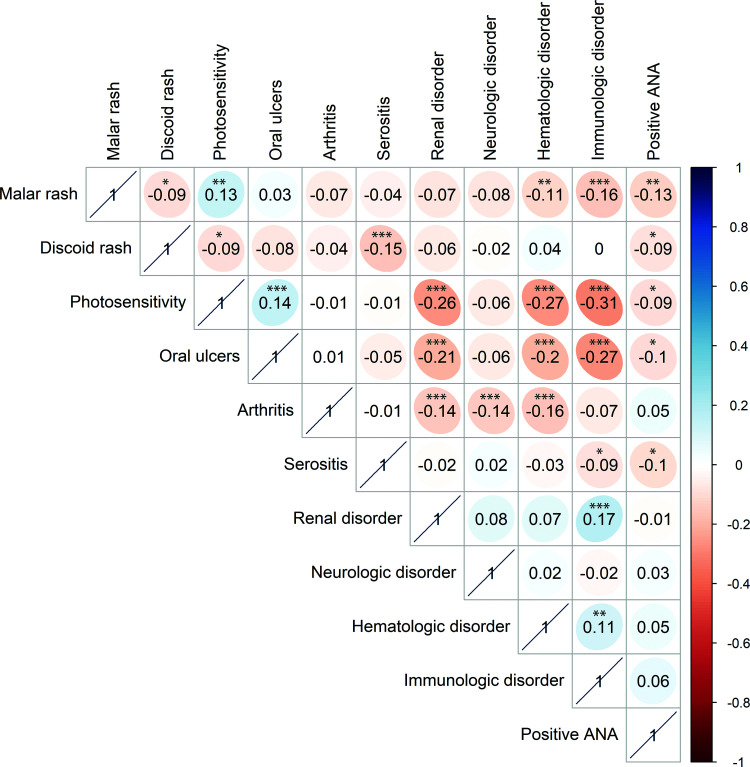
A total of 724 patients who met the American College of Rheumatology (ACR) classification criteria for SLE were included in this study. Clustering was performed using the ACR classification criteria and the partitioning around medoid method. Correlation analysis was performed using the Spearman's Rho test.
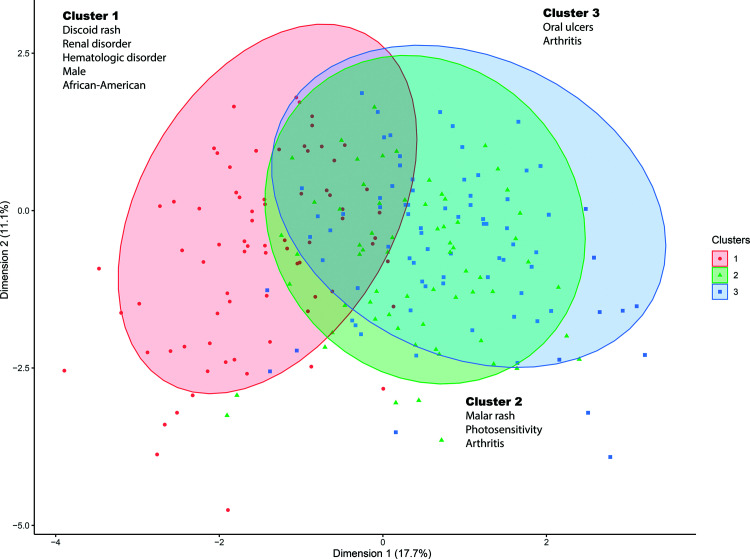
Patients with SLE in our cohort identify three district clinical disease subsets. Patients in cluster 1 were significantly more likely to develop renal and hematologic involvement, and had overrepresentation in African-American and male lupus patients. Clusters 2 and 3 identified a milder disease, with a significantly less likelihood of organ complications. Patients in cluster 2 are characterized by malar rash and photosensitivity, while patients in cluster 3 are characterized by oral ulcers, which is present in ~90% of patients within this cluster. The presence of photosensitivity or oral ulcers appears to be protective against the development of lupus nephritis in our cohort.
We describe a large cohort of SLE from Western Pennsylvania and identify three distinct clinical disease subgroups. Clustering analysis might help to better manage and predict disease complications in heterogenous diseases like lupus.
系统性红斑狼疮(SLE)是一种复杂的异质性自身免疫性疾病,可累及多个器官。我们进行了临床聚类分析,以描述匹兹堡大学医学中心的狼疮队列。
本研究纳入了724例符合美国风湿病学会(ACR)SLE分类标准的患者。使用ACR分类标准和围绕中心点划分法进行聚类。使用Spearman秩相关检验进行相关性分析。
我们队列中的SLE患者可分为三个不同的临床疾病亚组。第1组患者发生肾脏和血液系统受累的可能性显著更高,且在非裔美国人和男性狼疮患者中占比过高。第2组和第3组为病情较轻的疾病,器官并发症的可能性显著更低。第2组患者的特征为颊部皮疹和光敏性,而第3组患者的特征为口腔溃疡,该组约90%的患者存在口腔溃疡。在我们的队列中,光敏性或口腔溃疡的存在似乎对狼疮性肾炎的发生有保护作用。
我们描述了来自宾夕法尼亚西部的一大群SLE患者,并确定了三个不同的临床疾病亚组。聚类分析可能有助于更好地管理和预测狼疮等异质性疾病的疾病并发症。