Department of Intensive Care Medicine, General Hospital of Thessaloniki Papageorgiou, Thessaloniki, Greece
Department of Intensive Care Medicine, General Hospital of Thessaloniki Papageorgiou, Thessaloniki, Greece.
BMJ Open Respir Res. 2021 Sep;8(1). doi: 10.1136/bmjresp-2021-001006.
Transdiaphragmatic (Pdi) and oesophageal pressures (Pes) are useful in understanding the pathophysiology of the respiratory system. They provide insight into respiratory drive, intrinsic positive end-expiratory pressure, diaphragmatic fatigue and weaning failure.
The use of Pdi and Pes in clinical practice is restricted due to the invasiveness of the technique and the cumbersome equipment needed. On the other hand, diaphragmatic displacement is non-invasively and easily assessed with M-mode ultrasound.
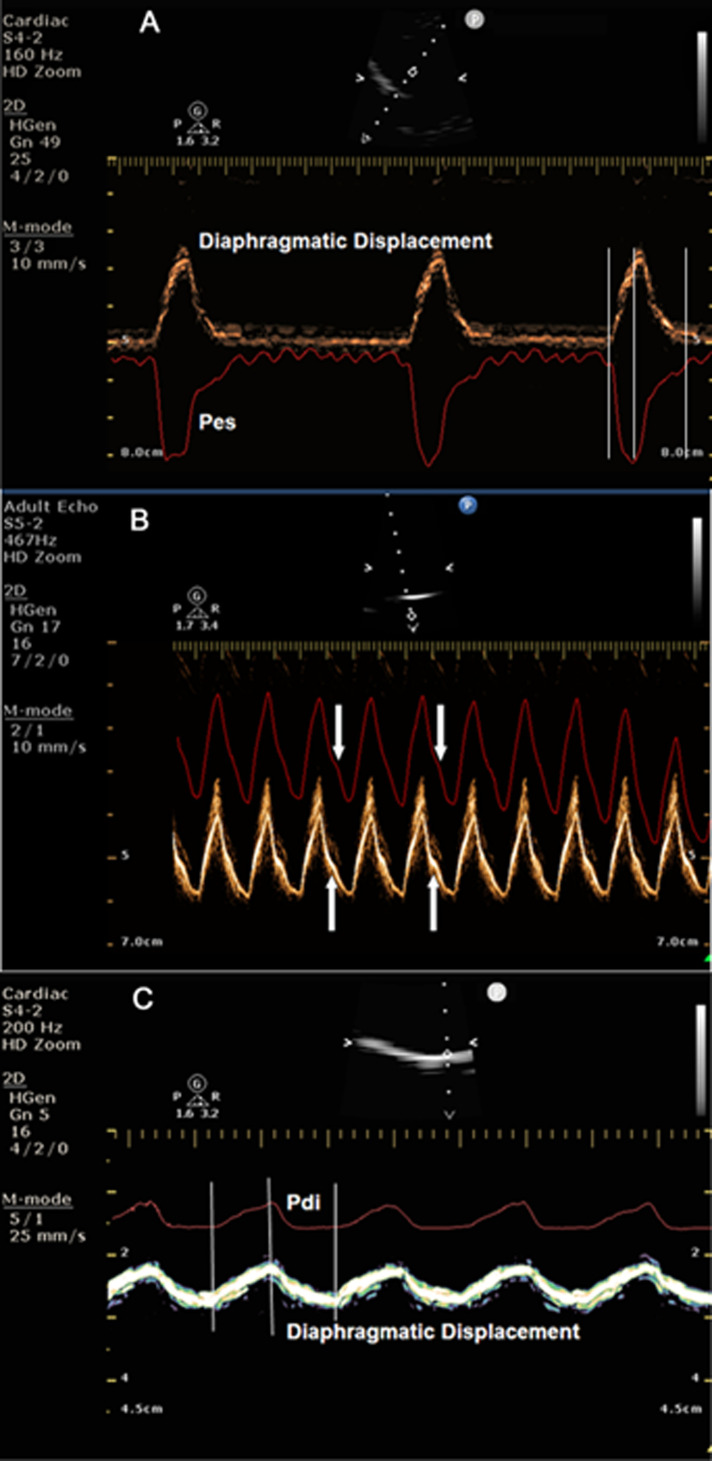
We observed striking similarities in shape and magnitude between M-mode diaphragmatic displacement, Pes and Pdi pressures. The study aimed to evaluate if the information provided by these two pressures could be obtained non-invasively from the diaphragmatic displacement curve.
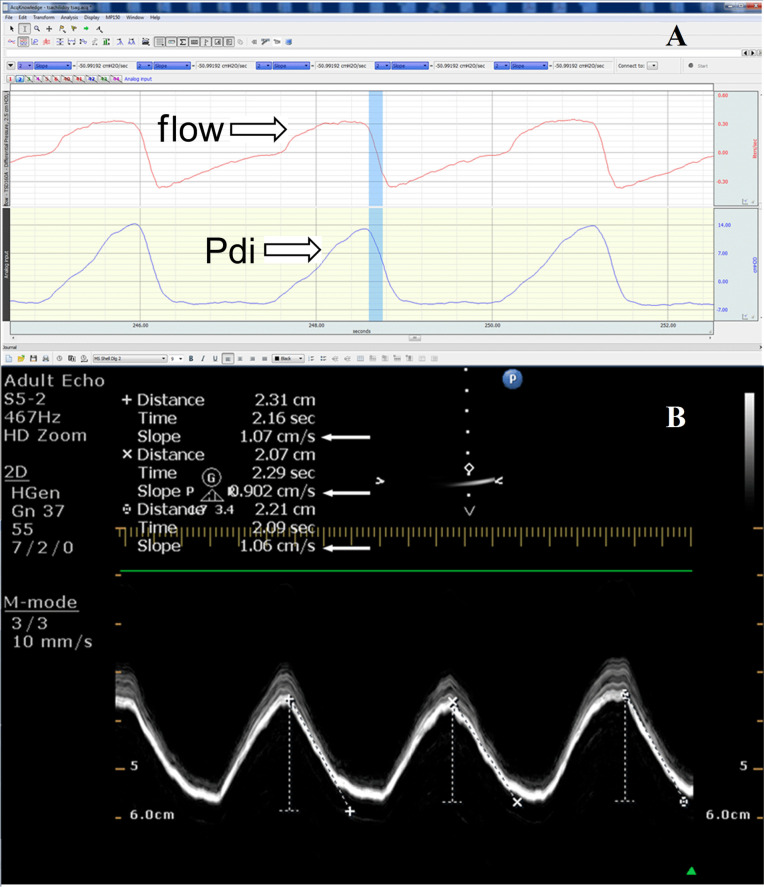
In 14 consecutive intubated patients undergoing a weaning trial, simultaneous recordings of Pes and Pdi pressures and the diaphragmatic displacement were assessed while breathing spontaneously and during a sniff-like manoeuvre. Moreover, the slope of the diaphragmatic displacement curve during relaxation was compared with the maximal relaxation rate (MRR) obtained from the Pdi curve.
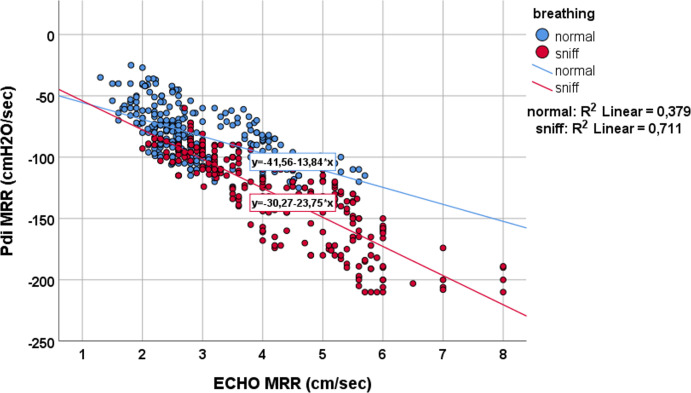
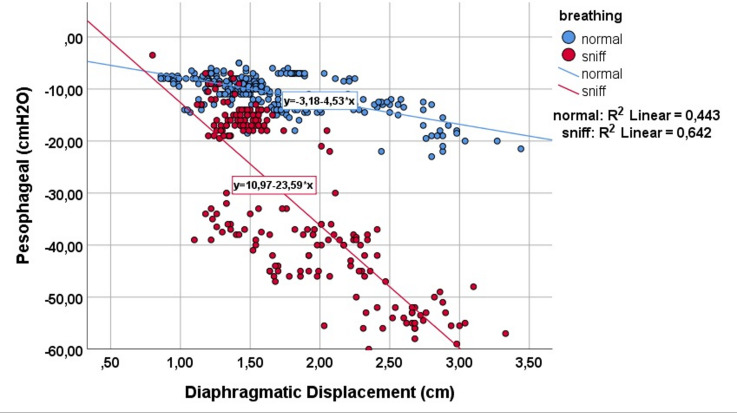
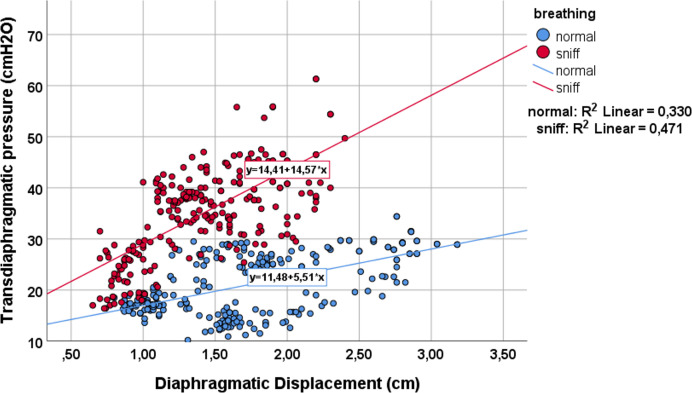
More than 200 breaths were analysed in pairs. Diaphragmatic displacement significantly correlated with Pdi (R=0.33, p<0.001) and Pes (R=0.44, p<0.001), and this correlation further improved during sniff (R=0.47, p<0.001) and (R=0.64, p<0.001), respectively. Additionally, a significant correlation was found between the relaxation slope derived from the diaphragmatic displacement curve and the MRR derived from the Pdi curve, both in normal breathing (R=0.379, p<0.001) and during the sniff manoeuvre (R=0.71, p<0.001).
M-mode diaphragmatic displacement parameters correlate well with the ones obtained from oesophageal pressure and Pdi, particularly during sniffing. Diaphragmatic displacement assessment possibly offers an alternative non-invasive solution for understanding and clinically monitoring the diaphragmatic contractile properties and weaning failure due to diaphragmatic fatigue.
我们观察到 M 模式膈肌位移、Pes 和 Pdi 压力之间在形状和幅度上存在显著相似性。本研究旨在评估是否可以从膈肌位移曲线无创地获得这些两种压力提供的信息。
在 14 例连续接受撤机试验的插管患者中,在自主呼吸和嗅探样动作期间评估了 Pes 和 Pdi 压力以及膈肌位移的同步记录。此外,比较了膈肌位移曲线在松弛期间的斜率与从 Pdi 曲线获得的最大松弛率 (MRR)。
对超过 200 对呼吸进行了分析。膈肌位移与 Pdi(R=0.33,p<0.001)和 Pes(R=0.44,p<0.001)显著相关,并且在嗅探时相关性进一步提高(R=0.47,p<0.001)和(R=0.64,p<0.001)。此外,在正常呼吸(R=0.379,p<0.001)和嗅探动作期间(R=0.71,p<0.001),从膈肌位移曲线得出的松弛斜率与从 Pdi 曲线得出的 MRR 之间存在显著相关性。
M 模式膈肌位移参数与从食管压力和 Pdi 获得的参数相关性良好,特别是在嗅探时。膈肌位移评估可能为理解和临床监测膈肌收缩特性以及由于膈肌疲劳导致的撤机失败提供了一种替代的无创解决方案。