Division of Intensive Care Medicine, Department of Internal Medicine, Erciyes University School of Medicine, Kayseri, Turkey.
Division of Intensive Care Medicine, Department of Internal Medicine, Pamukkale University School of Medicine, Denizli, Turkey.
Balkan Med J. 2021 Sep;38(5):296-303. doi: 10.5152/balkanmedj.2021.21188.
There are limited data on the long-term outcomes of COVID-19 from different parts of the world.
To determine risk factors of 90-day mortality in critically ill patients in Turkish intensive care units (ICUs), with respiratory failure.
Retrospective, observational cohort.
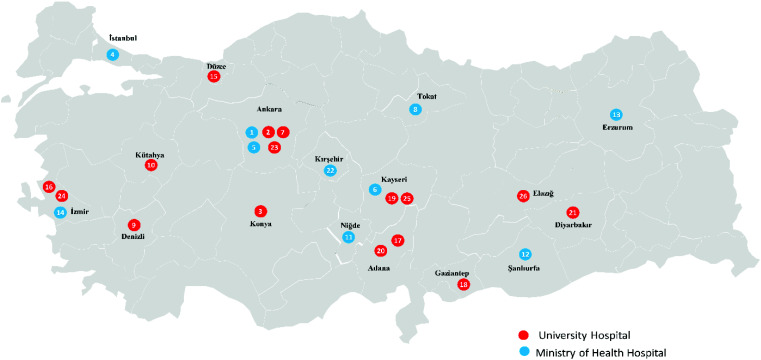
Patients with laboratory-confirmed COVID-19 and who had been followed up in the ICUs with respiratory failure for more than 24 hours were included in the study. Their demographics, clinical characteristics, laboratory variables, treatment protocols, and survival data were recorded.
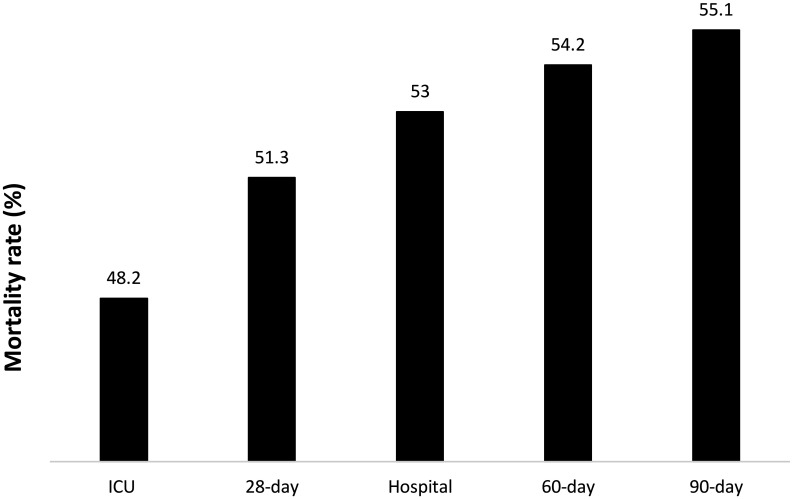
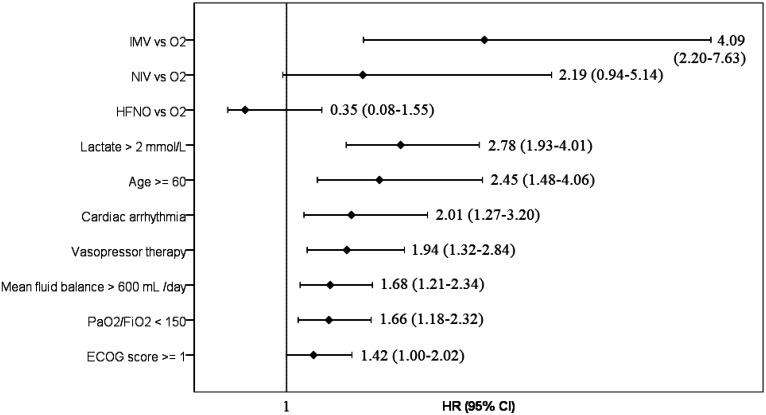
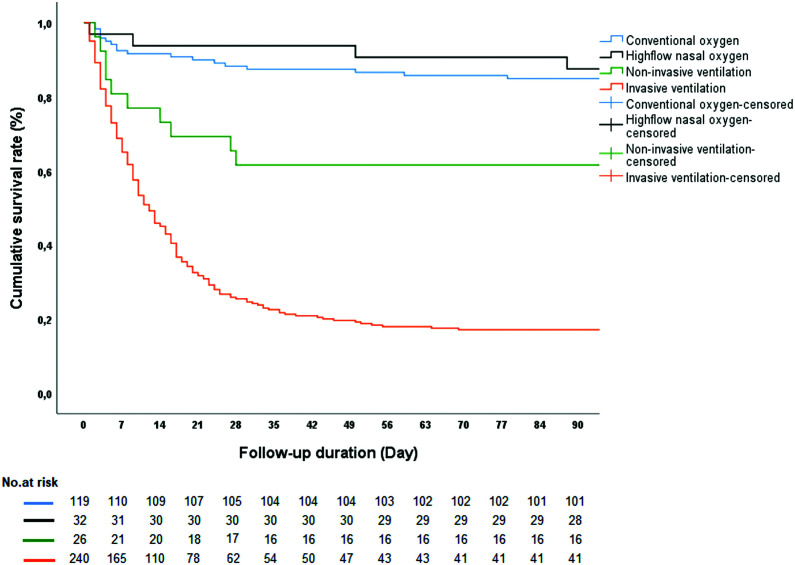
A total of 421 patients were included. The median age was 67 (IQR: 57-76) years, and 251 patients (59.6%) were men. The 90-day mortality rate was 55.1%. The factors independently associated with 90-day mortality were invasive mechanical ventilation (IMV) (HR 4.09 [95% CI: [2.20-7.63], P < .001), lactate level >2 mmol/L (2.78 [1.93-4.01], P < .001), age ≥60 years (2.45 [1.48-4.06)], P < .001), cardiac arrhythmia during ICU stay (2.01 [1.27-3.20], P = .003), vasopressor treatment (1.94 [1.32-2.84], P = .001), positive fluid balance of ≥600 mL/day (1.68 [1.21-2.34], P = .002), PaO2/FiO2 ratio of ≤150 mmHg (1.66 [1.18-2.32], P = .003), and ECOG score ≥1 (1.42 [1.00-2.02], P = .050).
Long-term mortality was high in critically ill patients with COVID-19 hospitalized in intensive care units in Turkey. Invasive mechanical ventilation, lactate level, age, cardiac arrhythmia, vasopressor therapy, positive fluid balance, severe hypoxemia and ECOG score were the independent risk factors for 90-day mortality.
关于 COVID-19 在世界不同地区的长期结局,数据有限。
确定在土耳其重症监护病房(ICU)中患有呼吸衰竭的危重症 COVID-19 患者 90 天死亡率的危险因素。
回顾性、观察性队列研究。
纳入在 ICU 中因呼吸衰竭接受治疗且持续时间超过 24 小时的实验室确诊 COVID-19 患者。记录他们的人口统计学、临床特征、实验室变量、治疗方案和生存数据。
共纳入 421 名患者。中位年龄为 67(IQR:57-76)岁,251 名患者(59.6%)为男性。90 天死亡率为 55.1%。与 90 天死亡率独立相关的因素包括有创机械通气(IMV)(HR 4.09[95%CI:[2.20-7.63],P<0.001)、乳酸水平>2mmol/L(2.78[1.93-4.01],P<0.001)、年龄≥60 岁(2.45[1.48-4.06],P<0.001)、ICU 期间出现心律失常(2.01[1.27-3.20],P=0.003)、血管加压素治疗(1.94[1.32-2.84],P=0.001)、每日正性液体平衡量≥600mL(1.68[1.21-2.34],P=0.002)、PaO2/FiO2 比值≤150mmHg(1.66[1.18-2.32],P=0.003)和 ECOG 评分≥1(1.42[1.00-2.02],P=0.050)。
在土耳其 ICU 住院的 COVID-19 危重症患者中,长期死亡率较高。有创机械通气、乳酸水平、年龄、心律失常、血管加压素治疗、正性液体平衡、严重低氧血症和 ECOG 评分是 90 天死亡率的独立危险因素。