Department of Perioperative Medicine and Intensive Care, Karolinska University Hospital, 171 76, Stockholm, Sweden.
Department of Physiology and Pharmacology, Karolinska Institutet, Stockholm, Sweden.
Crit Care. 2021 Feb 25;25(1):86. doi: 10.1186/s13054-021-03511-x.
Questions remain about long-term outcome for COVID-19 patients in general, and differences between men and women in particular given the fact that men seem to suffer a more dramatic course of the disease. We therefore analysed outcome beyond 90 days in ICU patients with COVID-19, with special focus on differences between men and women.
We identified all patient ≥ 18 years with COVID-19 admitted between March 6 and June 30, 2020, in the Swedish Intensive Care Registry. Patients were followed until death or study end-point October 22, 2020. Association with patient sex and mortality, in addition to clinical variables, was estimated using Cox regression. We also performed a logistic regression model estimating factors associated with 90-day mortality.
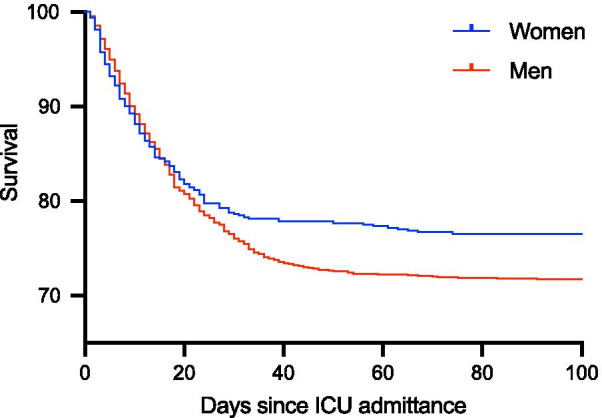
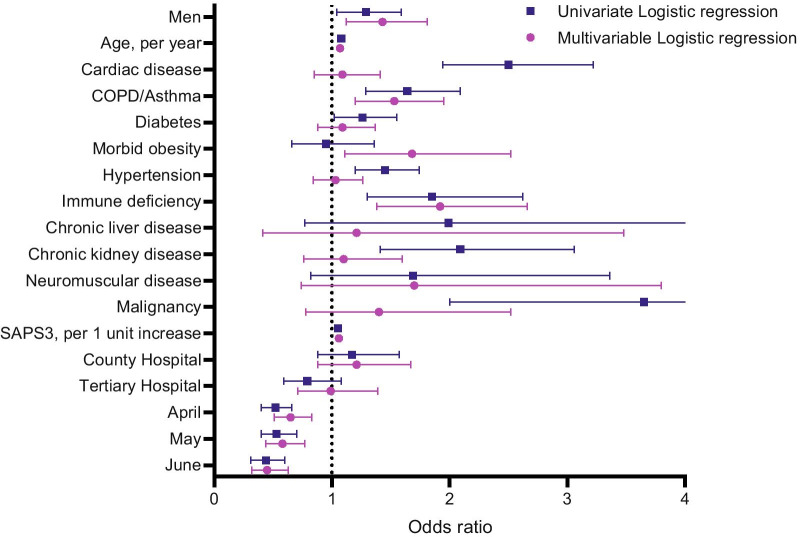
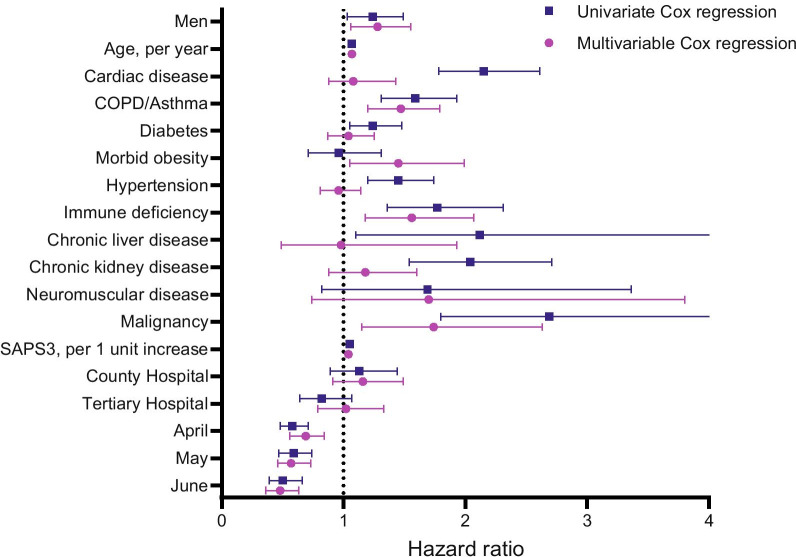
In total, 2354 patients with COVID-19 were included. Four patients were still in the ICU at study end-point. Median follow-up time was 183 days. Mortality at 90-days was 26.9%, 23.4% in women and 28.2% in men. After 90 days until end of follow-up, only 11 deaths occurred. On multivariable Cox regression analysis, male sex (HR 1.28, 95% CI 1.06-1.54) remained significantly associated with mortality even after adjustments. Additionally, age, COPD/asthma, immune deficiency, malignancy, SAPS3 and admission month were associated with mortality. The logistic regression model of 90-day mortality showed almost identical results.
In this nationwide study of ICU patients with COVID-19, men were at higher risk of poor long-term outcome compared to their female counterparts. The underlying mechanisms for these differences are not fully understood and warrant further studies.
关于 COVID-19 患者的长期预后仍存在疑问,特别是鉴于男性似乎患有更严重的疾病,因此需要特别关注男性和女性之间的差异。因此,我们分析了 COVID-19 重症监护病房(ICU)患者 90 天后的预后,并特别关注男性和女性之间的差异。
我们在瑞典重症监护登记处中确定了所有 2020 年 3 月 6 日至 6 月 30 日期间≥18 岁的 COVID-19 患者。患者的随访时间直至死亡或研究终点 2020 年 10 月 22 日。使用 Cox 回归估计患者性别与死亡率以及临床变量之间的关联。我们还进行了逻辑回归模型,以估计与 90 天死亡率相关的因素。
共纳入 2354 例 COVID-19 患者。4 例患者在研究终点仍在 ICU。中位随访时间为 183 天。90 天死亡率为 26.9%,女性为 23.4%,男性为 28.2%。90 天后至随访结束时,仅发生了 11 例死亡。多变量 Cox 回归分析显示,男性(HR 1.28,95%CI 1.06-1.54)在调整后仍与死亡率显著相关。此外,年龄、COPD/哮喘、免疫缺陷、恶性肿瘤、SAPS3 和入院月份与死亡率相关。90 天死亡率的逻辑回归模型显示出几乎相同的结果。
在这项针对 COVID-19 ICU 患者的全国性研究中,与女性相比,男性的长期预后较差的风险更高。这些差异的潜在机制尚不完全清楚,需要进一步研究。