Department of Plant Pathology and Weed Research, Agricultural Research Organization, The Volcani Center, 68 HaMaccabim Road, P.O.B 15159, 7505101, Rishon LeZion, Israel.
The Robert H. Smith Faculty of Agriculture, Food and Environment, The Hebrew University of Jerusalem, 761001, Rehovot, Israel.
Sci Rep. 2021 Sep 24;11(1):19060. doi: 10.1038/s41598-021-98595-4.
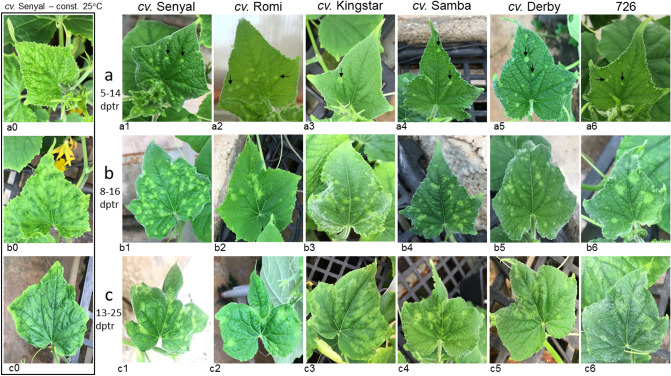
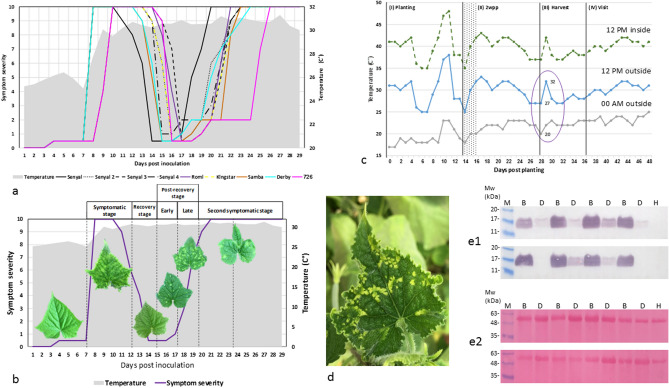
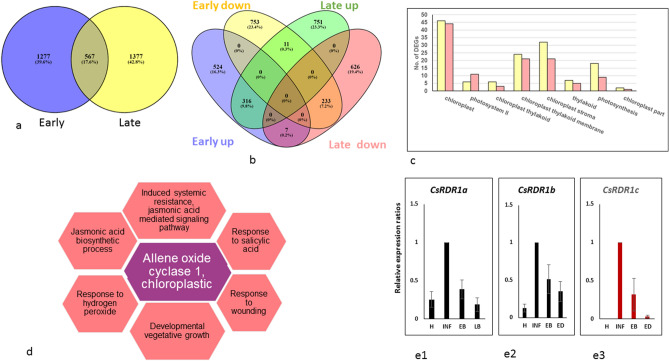
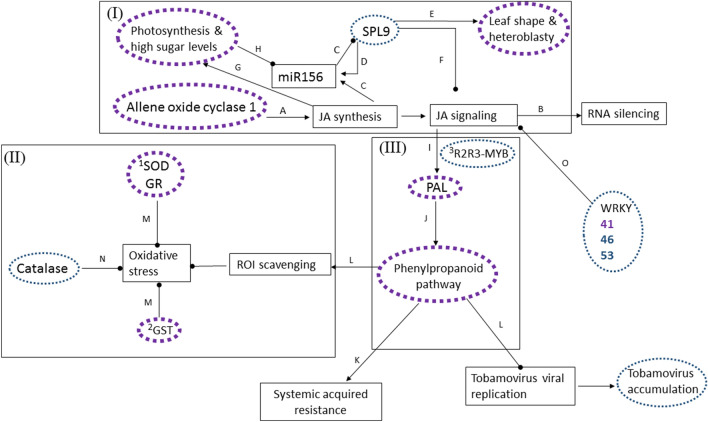
Studies of early stages of cucumber green mottle mosaic virus (CGMMV) disease have been recently focused on plant molecular responses. However, extreme diurnal environmental temperatures, characteristic of global climate changes, could affect plant susceptibility and disease phenotype progression. Our studies of CGMMV disease progression, under simulated extreme temperature waves, have revealed two new disease initiation phenotypes that developed gradually, preceding severe symptom manifestations of post-recovery CGMMV systemic infections. 'Early post-recovery stage' bright yellow islands (BYIs) with defined boundaries amid asymptomatic leaf blades were first emerging followed by 'late post-recovery stage' BYIs with diffused boundaries. A deduced CGMMV disease progression scheme, postulating BYI symptom occurrence time-windows, revealed BYIs in field grown cucumber plants exposed to extreme diurnal temperatures. Profiling ontology of cucumber differentially expressed genes in BYIs vs the associated dark-green surrounding tissues disclosed activation of jasmonic acid (JA) pathway in 'early post-recovery stage' BYIs. JA signaling was inactivated in 'late post-recovery stage' BYIs concomitant with increasing expressions of JA signaling inhibitors and downregulation of JA responsive phenylpropanoid pathway. Our results disclosed a new phenotypic description of CGMMV disease initiation, characteristic of cucumbers grown under extreme environmental temperature fluctuations. The BYI phenotypes could define a time-window for CGMMV disease management applications.
近期,黄瓜绿斑驳花叶病毒(CGMMV)疾病的早期阶段研究主要集中在植物分子反应上。然而,全球气候变化所特有的极端日温度可能会影响植物的易感性和疾病表型的进展。我们对 CGMMV 疾病在模拟极端温度波下的进展研究,揭示了两种新的疾病起始表型,它们逐渐发展,先于 CGMMV 系统性感染后的严重症状表现。在无症状叶片中出现边界分明的“早期恢复期亮黄色岛(BYIs)”,随后是“晚期恢复期亮黄色岛(BYIs)”,边界扩散。一个推测的 CGMMV 疾病进展方案,假设 BYI 症状发生的时间窗口,揭示了在暴露于极端日温度的田间生长的黄瓜植物中的 BYIs。在 BYIs 与相关的深绿色周围组织中黄瓜差异表达基因的本体论分析揭示了在“早期恢复期 BYIs”中茉莉酸(JA)途径的激活。在“晚期恢复期 BYIs”中 JA 信号被失活,同时 JA 信号抑制剂的表达增加,JA 响应的苯丙烷途径下调。我们的研究结果揭示了 CGMMV 疾病起始的一种新的表型描述,其特征是在极端环境温度波动下生长的黄瓜。BYI 表型可以为 CGMMV 疾病管理应用定义一个时间窗口。