United States Department of Agriculture - Agricultural Research Service, U.S. Vegetable Laboratory, Charleston, SC, 29414, USA.
USDA-Agricultural Research Service, Edward T. Schafer Agricultural Research Center, Fargo, ND, 58102-2765, USA.
Virol J. 2021 Jan 6;18(1):7. doi: 10.1186/s12985-020-01479-8.
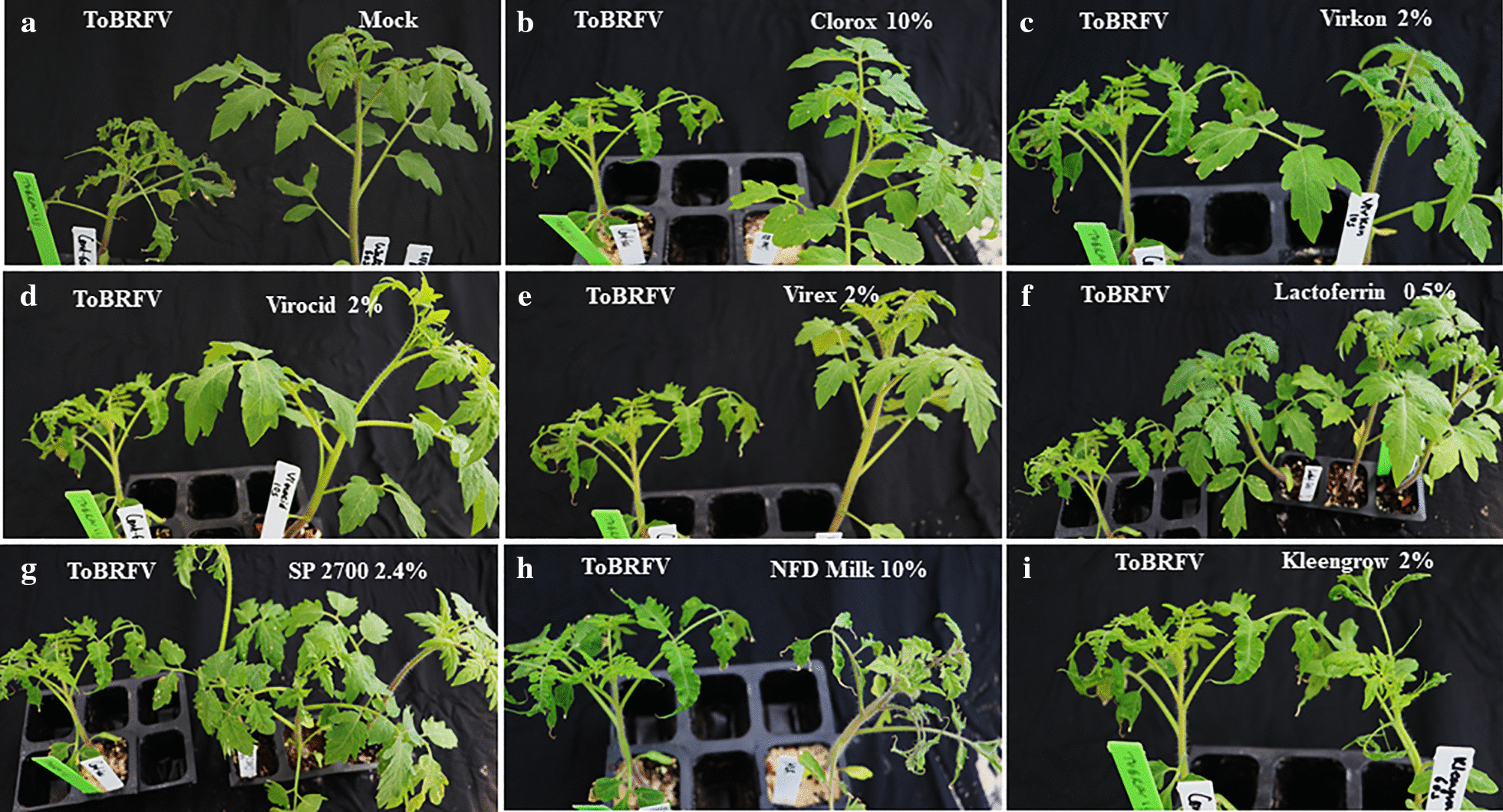
Tobamoviruses, including tomato brown rugose fruit virus (ToBRFV) on tomato and pepper, and cucumber green mottle mosaic virus (CGMMV) on cucumber and watermelon, have caused many disease outbreaks around the world in recent years. With seed-borne, mechanical transmission and resistant breaking traits, tobamoviruses pose serious threat to vegetable production worldwide. With the absence of a commercial resistant cultivar, growers are encouraged to take preventative measures to manage those highly contagious viral diseases. However, there is no information available on which disinfectants are effective to deactivate the virus infectivity on contaminated hands, tools and equipment for these emerging tobamoviruses. The purpose of this study was to evaluate a collection of 16 chemical disinfectants for their effectiveness against mechanical transmission of two emerging tobamoviruses, ToBRFV and CGMMV.
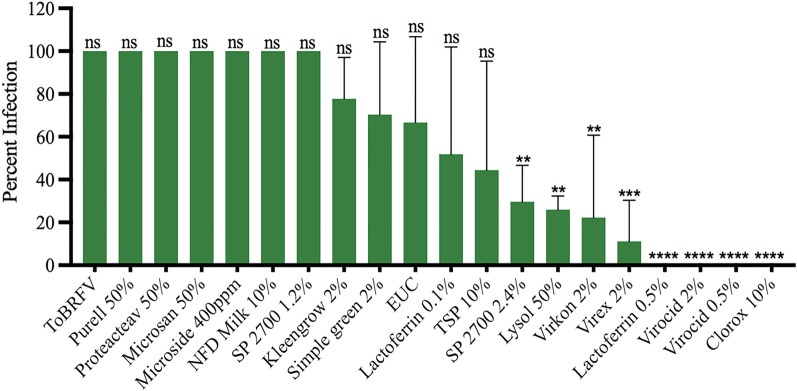
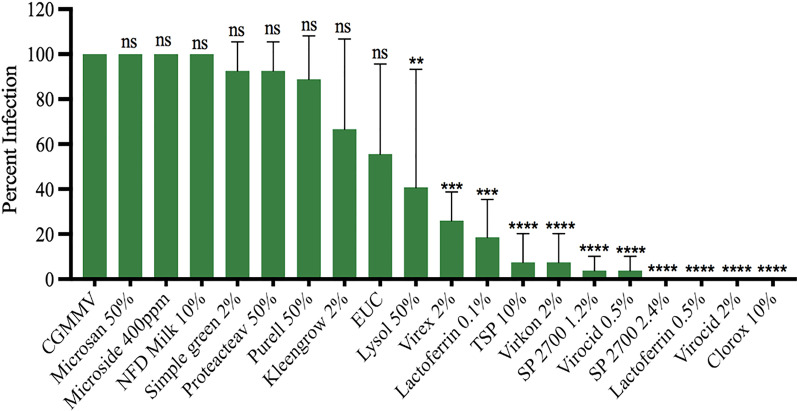
Bioassay was used to evaluate the efficacy of each disinfectant based on virus infectivity remaining in a prepared virus inoculum after three short exposure times (10 s, 30 s and 60 s) to the disinfectant and inoculated mechanically on three respective test plants (ToBRFV on tomato and CGMMV on watermelon). Percent infection of plants was measured through symptom observation on the test plants and the presence of the virus was confirmed through an enzyme-linked immunosorbent assay with appropriate antibodies. Statistical analysis was performed using one-way ANOVA based on data collected from three independent experiments.
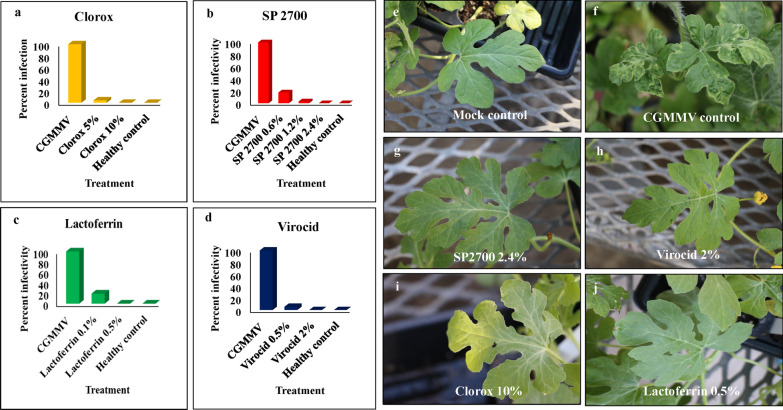
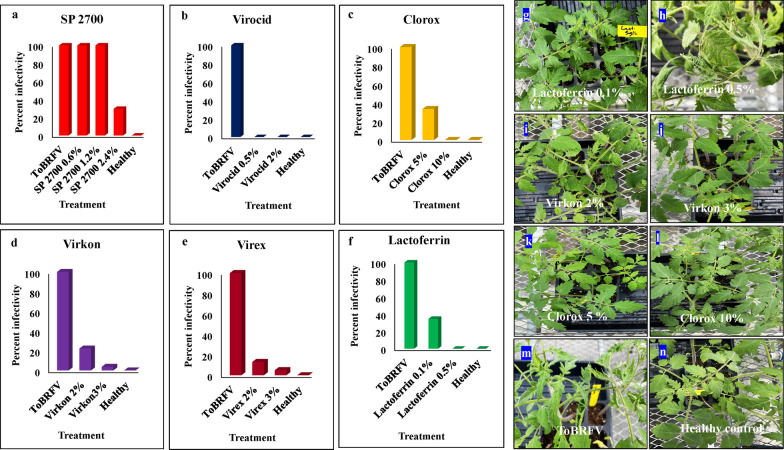
Through comparative analysis of percent infection of test plants, a similar trend of efficacy among 16 disinfectants was observed between the two pathosystems. Four common disinfectants with broad spectrum activities against two different tobamoviruses were identified. Those effective disinfectants with 90-100% efficacy against both tobamoviruses were 0.5% Lactoferrin, 2% Virocid, and 10% Clorox, plus 2% Virkon against CGMMV and 3% Virkon against ToBRFV. In addition, SP2700 generated a significant effect against CGMMV, but poorly against ToBRFV.
Identification of common disinfectants against ToBRFV and CGMMV, two emerging tobamoviruses in two different pathosystems suggest their potential broader effects against other tobamoviruses or even other viruses.
近年来,包括番茄褐色皱果病毒(ToBRFV)、辣椒,以及黄瓜绿斑驳花叶病毒(CGMMV)、西瓜在内的多种烟草花叶病毒(Tobamoviruses)在全球范围内引发了多次病害爆发。这些病毒具有种传、机械传播和抗药性突破等特点,对全球蔬菜生产构成了严重威胁。由于缺乏商业抗性品种,种植者被鼓励采取预防措施来管理这些具有高度传染性的病毒性疾病。然而,目前尚无关于哪些消毒剂可有效灭活受污染的手部、工具和设备上的这些新兴烟草花叶病毒的信息。本研究的目的是评估 16 种化学消毒剂对两种新兴烟草花叶病毒(ToBRFV 和 CGMMV)机械传播的效果。
采用生物测定法,根据消毒剂处理 3 个短时间(10s、30s 和 60s)后制备的病毒接种物中残留的病毒感染力,以及接种于 3 种不同测试植物(番茄上的 ToBRFV 和西瓜上的 CGMMV)上的病毒机械传播效率,评估每种消毒剂的效果。通过对测试植物的症状观察和适当抗体的酶联免疫吸附试验(ELISA)来测量植物的感染率。基于来自 3 个独立实验的数据,采用单因素方差分析进行统计分析。
通过对测试植物感染率的比较分析,在两个病害系统中观察到 16 种消毒剂对烟草花叶病毒的功效具有相似的趋势。确定了四种对两种不同烟草花叶病毒具有广谱活性的常见消毒剂。对两种烟草花叶病毒均具有 90-100%功效的有效消毒剂为 0.5%乳铁蛋白、2% Virocid 和 10% Clorox,以及 2% Virkon 对 CGMMV 和 3% Virkon 对 ToBRFV。此外,SP2700 对 CGMMV 产生了显著效果,但对 ToBRFV 效果较差。
在两个不同病害系统中发现了针对 ToBRFV 和 CGMMV(两种新兴烟草花叶病毒)的常见消毒剂,这表明它们可能对其他烟草花叶病毒甚至其他病毒具有更广泛的作用。