School of Psychology, Faculty of Arts and Social Sciences, University of Waikato, Private Bag 3105, Hamilton, 3240, New Zealand.
Auckland University of Technology, School of Clinical Sciences, Auckland, New Zealand.
Sci Rep. 2021 Sep 24;11(1):19064. doi: 10.1038/s41598-021-98591-8.
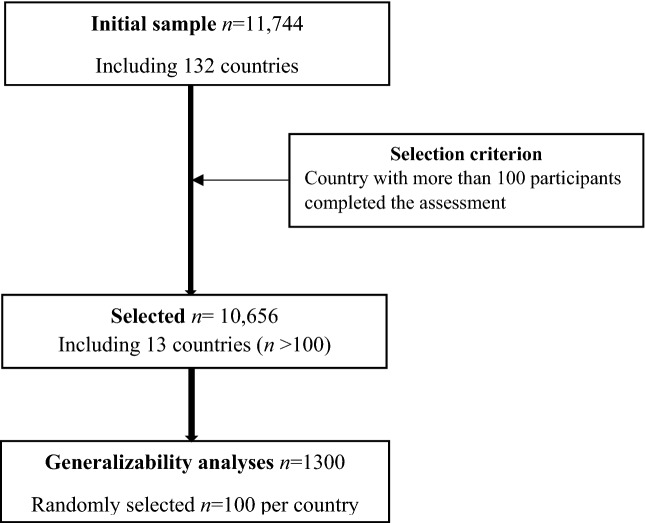
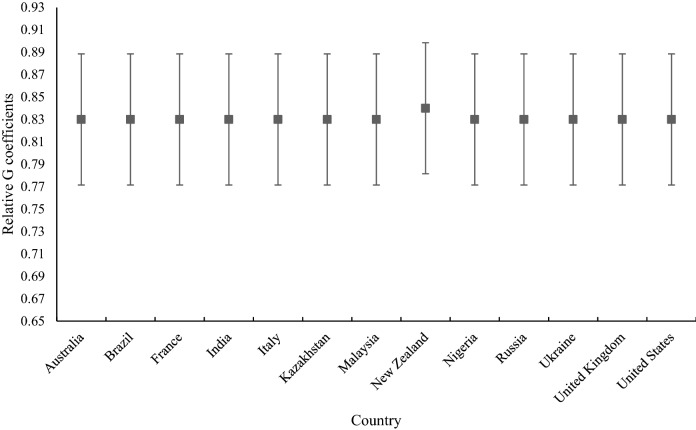
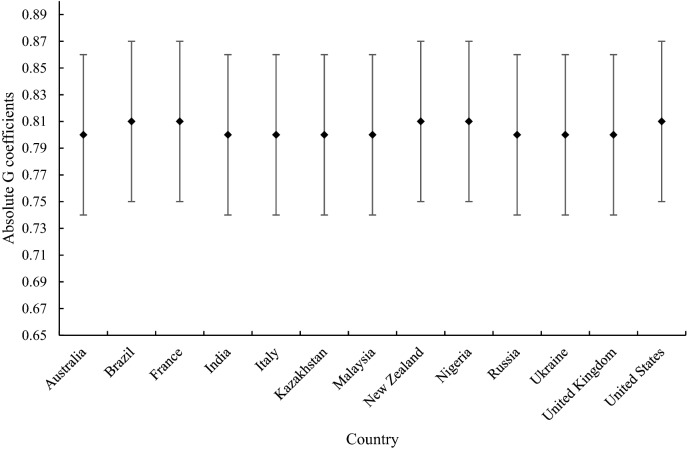
The Stroke Riskometer mobile application is a novel, validated way to provide personalized stroke risk assessment for individuals and motivate them to reduce their risks. Although this app is being used worldwide, its reliability across different countries has not yet been rigorously investigated using appropriate methodology. The Generalizability Theory (G-Theory) is an advanced statistical method suitable for examining reliability and generalizability of assessment scores across different samples, cultural and other contexts and for evaluating sources of measurement errors. G-Theory was applied to the Stroke Riskometer data sampled from 1300 participants in 13 countries using two-facet nested observational design (person by item nested in the country). The Stroke Riskometer demonstrated strong reliability in measuring stroke risks across the countries with coefficients G relative and absolute of 0.84, 95%CI [0.79; 0.89] and 0.82, 95%CI [0.76; 0.88] respectively. D-study analyses revealed that the Stroke Riskometer has optimal reliability in its current form in measuring stroke risk for each country and no modifications are required. These results suggest that the Stroke Riskometer's scores are generalizable across sample population and countries permitting cross-cultural comparisons. Further studies investigating reliability of the Stroke Riskometer over time in longitudinal study design are warranted.
Stroke Riskometer 移动应用程序是一种新颖且经过验证的方法,可针对个人提供个性化的中风风险评估,并激励他们降低风险。尽管该应用程序在全球范围内使用,但尚未使用适当的方法对其在不同国家的可靠性进行严格调查。概化理论(G 理论)是一种高级统计方法,适用于检查不同样本、文化和其他环境下评估分数的可靠性和可推广性,并评估测量误差的来源。使用两因素嵌套观测设计(个体嵌套在国家内),对来自 13 个国家的 1300 名参与者的 Stroke Riskometer 数据应用了 G 理论。Stroke Riskometer 在测量中风风险方面具有很强的可靠性,国家间的可靠性系数 G 相对和绝对分别为 0.84、95%CI [0.79; 0.89]和 0.82、95%CI [0.76; 0.88]。D 研究分析表明,在目前的形式下,Stroke Riskometer 在测量每个国家的中风风险方面具有最佳的可靠性,无需进行修改。这些结果表明,Stroke Riskometer 的分数在样本人群和国家之间具有可推广性,允许进行跨文化比较。进一步研究需要在纵向研究设计中调查 Stroke Riskometer 的可靠性随时间的变化。