Department of Public Health, East Carolina University, Greenville, NC, USA.
USDA/ARS Children's Nutrition Research Center, Department of Pediatrics, Baylor College of Medicine, Houston, TX, USA.
J Nutr. 2022 Jan 11;152(1):107-116. doi: 10.1093/jn/nxab349.
Valid biomarkers of fruit and vegetable (FV) intake are needed for field-based nutrition research.
To examine criterion-related validity of pressure-mediated reflection spectroscopy as a proxy measure of FV intake, using plasma carotenoids and self-reported FV and carotenoid intake as primary and secondary criterion measures, respectively.
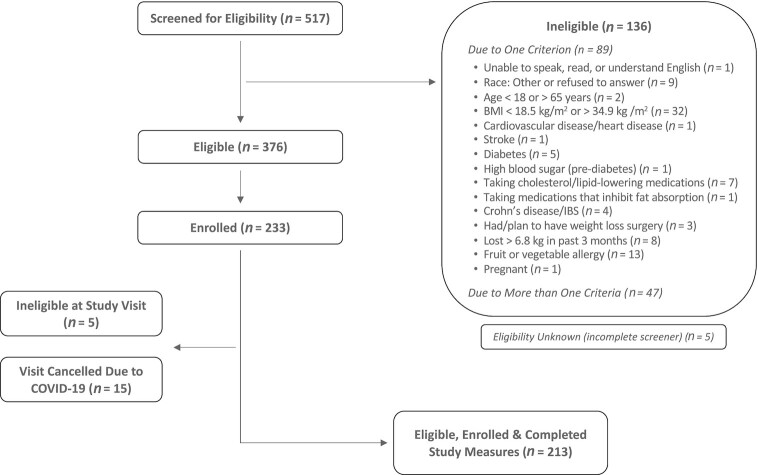
Healthy adults 18-65 y of age, self-identifying as African American/black (n = 61), Asian (n = 53), white (n = 70), or Hispanic (n = 29), in North Carolina and Minnesota were recruited. Skin carotenoids were assessed via pressure-mediated reflection spectroscopy (Veggie Meter), skin melanin via spectrophotometer, and total plasma carotenoid concentration by HPLC-photodiode array detection. Self-reported carotenoid and FV intake was assessed using a semiquantitative FFQ. Relations between skin carotenoids, plasma carotenoids, FV, and carotenoid intake, with differences by race or ethnicity, age, sex, weight status, cholesterol, and melanin index, were examined by bivariate correlations and adjusted multivariate linear regressions.
The overall unadjusted correlation between skin and total plasma carotenoids was r = 0.71 and ranged from 0.64 (non-Hispanic black) to 0.80 (Hispanic). Correlations between skin carotenoids and self-reported FV intake ranged from 0.24 (non-Hispanic black) to 0.53 (non-Hispanic white), with an overall correlation of r = 0.35. In models adjusted for age, sex, racial or ethnic group, and BMI, skin carotenoids were associated with plasma carotenoids (R2 = 0.55), FV (R2 = 0.17), and carotenoid intake (R2 = 0.20). For both plasma carotenoid and FV measures, associations with skin carotenoids did not vary by race, but these relations did differ by skin melanin-those with lower melanin had a lower correlation between skin and plasma carotenoids.
Reflection spectroscopy-assessed skin carotenoids may be a reasonable alternative to measurement of plasma carotenoids, a biomarker used to approximate FV intake.
需要有效的水果和蔬菜(FV)摄入量生物标志物来进行基于现场的营养研究。
使用血浆类胡萝卜素和自我报告的 FV 和类胡萝卜素摄入量作为主要和次要标准测量,分别检查压力介导反射光谱作为 FV 摄入量替代测量的标准相关有效性。
招募年龄在 18-65 岁之间的自我认定为非裔美国人/黑人(n = 61)、亚洲人(n = 53)、白人(n = 70)或西班牙裔(n = 29)的健康成年人,来自北卡罗来纳州和明尼苏达州。通过压力介导反射光谱(Veggie Meter)评估皮肤类胡萝卜素,通过分光光度计评估皮肤黑色素,通过高效液相色谱-光电二极管阵列检测评估总血浆类胡萝卜素浓度。使用半定量 FFQ 评估自我报告的类胡萝卜素和 FV 摄入量。通过二元相关和调整后的多元线性回归,检查皮肤类胡萝卜素、血浆类胡萝卜素、FV 和类胡萝卜素摄入量之间的关系,并按种族或民族、年龄、性别、体重状况、胆固醇和黑色素指数的差异进行分析。
皮肤和总血浆类胡萝卜素之间的总体未调整相关性为 r = 0.71,范围从 0.64(非西班牙裔黑人)到 0.80(西班牙裔)。皮肤类胡萝卜素与自我报告的 FV 摄入量之间的相关性范围从 0.24(非西班牙裔黑人)到 0.53(非西班牙裔白人),总体相关性 r = 0.35。在调整年龄、性别、种族或民族群体和 BMI 的模型中,皮肤类胡萝卜素与血浆类胡萝卜素(R2 = 0.55)、FV(R2 = 0.17)和类胡萝卜素摄入量(R2 = 0.20)相关。对于血浆类胡萝卜素和 FV 测量,与皮肤类胡萝卜素的关联不因种族而异,但这些关系确实因皮肤黑色素而异-黑色素较低的人皮肤和血浆类胡萝卜素之间的相关性较低。
反射光谱评估的皮肤类胡萝卜素可能是测量血浆类胡萝卜素的合理替代方法,血浆类胡萝卜素是一种用于估计 FV 摄入量的生物标志物。