Unit for Social and Community Psychiatry, Queen Mary University of London, London, E13 8SP, UK.
Department of Psychology, University of Pristina, 10000, Pristina, Kosovo.
BMC Psychiatry. 2021 Sep 25;21(1):468. doi: 10.1186/s12888-021-03466-x.
Implementation of psychosocial interventions in mental health services has the potential to improve the treatment of psychosis spectrum disorders (PSD) in low- and middle-income countries (LMICs) where care is predominantly focused on pharmacotherapy. The first step is to understand the views of key stakeholders. We conducted a multi-language qualitative study to explore the contextual barriers and facilitators to implementation of a cost-effective, digital psychosocial intervention, called DIALOG+, for treating PSD. DIALOG+ builds on existing clinician-patient relationships without requiring development of new services, making it well-fitting for healthcare systems with scarce resources.
Thirty-two focus groups were conducted with 174 participants (patients, clinicians, policymakers and carers), who were familiarized with DIALOG+ through a presentation. The Southeast European LMICs included in this research were: Bosnia and Herzegovina, Kosovo, (Kosovo is referred throughout the text by United Nations resolution) North Macedonia, Montenegro and Serbia. Framework analysis was used to analyse the participants' accounts.
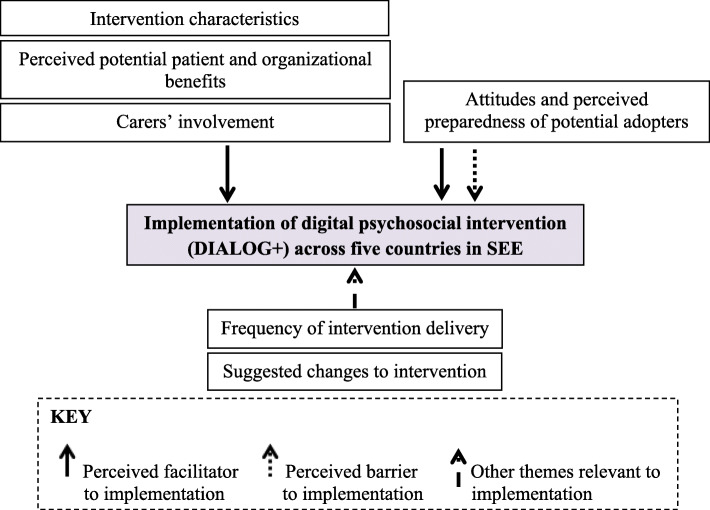
Six major themes were identified. Three themes (Intervention characteristics; Carers' involvement; Patient and organisational benefits) were interpreted as perceived implementation facilitators. The theme Attitudes and perceived preparedness of potential adopters comprised of subthemes that were interpreted as both perceived implementation facilitators and barriers. Two other themes (Frequency of intervention delivery; Suggested changes to the intervention) were more broadly related to the intervention's implementation. Participants were exceedingly supportive of the implementation of a digital psychosocial intervention such as DIALOG+. Attractive intervention characteristics, efficient use of scarce resources for its implementation and potential to improve mental health services were seen as the main implementation facilitators. The major implementation barrier identified was psychiatrists' time constrains.
This study provided important insights regarding implementation of digital psychosocial interventions for people with PSD in low-resource settings by including perspectives from four stakeholder groups in five LMICs in Southeast Europe - a population and region rarely explored in the literature. The perceived limited availability of psychiatrists could be potentially resolved by increased inclusion of other mental health professionals in service delivery for PSD. These findings will be used to inform the implementation strategy of DIALOG+ across the participating countries. The study also offers insights into multi-country qualitative research.
在精神卫生服务中实施心理社会干预有可能改善精神分裂谱系障碍(PSD)的治疗,在这些国家,护理主要集中在药物治疗上。第一步是了解主要利益相关者的观点。我们进行了一项多语言定性研究,以探讨在资源匮乏的医疗保健系统中实施一种具有成本效益的数字心理社会干预措施,即 DIALOG+,以治疗 PSD 的背景障碍和促进因素。DIALOG+建立在现有的医患关系之上,而无需开发新的服务,因此非常适合资源匮乏的医疗保健系统。
与 174 名参与者(患者、临床医生、政策制定者和护理人员)进行了 32 个焦点小组,他们通过演示熟悉了 DIALOG+。本研究纳入的东南欧中等收入国家包括:波斯尼亚和黑塞哥维那、科索沃(文本通篇中科索沃均指代根据联合国决议建立的实体)、北马其顿、黑山和塞尔维亚。使用框架分析对参与者的说法进行分析。
确定了六个主要主题。三个主题(干预特征;护理人员的参与;患者和组织效益)被解释为感知到的实施促进因素。主题“潜在采用者的态度和感知准备”包含了被解释为感知到的实施促进因素和障碍的子主题。另外两个主题(干预交付的频率;对干预的建议变更)更广泛地与干预的实施相关。参与者非常支持数字心理社会干预措施(如 DIALOG+)的实施。具有吸引力的干预特征、为其实施高效利用稀缺资源以及改善精神卫生服务的潜力被视为主要的实施促进因素。确定的主要实施障碍是精神科医生的时间限制。
本研究通过纳入来自东南欧五个中等收入国家/地区的四个利益相关者群体的观点,为在资源匮乏的环境中为 PSD 患者实施数字心理社会干预措施提供了重要的见解,这是文献中很少探讨的人群和地区。可以通过增加其他心理健康专业人员参与 PSD 的服务提供来潜在解决精神科医生数量有限的问题。这些发现将用于为 DIALOG+在参与国家的实施提供信息。该研究还提供了对多国定性研究的见解。