Center for American Indian Health, Johns Hopkins Bloomberg School of Public Health, Tuba City, AZ, 86045, USA.
Center for American Indian Health, Johns Hopkins Bloomberg School of Public Health, Baltimore, MD, 21231, USA.
BMC Womens Health. 2021 Sep 25;21(1):341. doi: 10.1186/s12905-021-01473-4.
The inclusion of protective factors ("assets") are increasingly supported in developing culturally grounded interventions for American Indian (AI) populations. This study sought to explore AI women's cultural assets, perspectives, and teachings to inform the development of a culturally grounded, intergenerational intervention to prevent substance abuse and teenage pregnancy among AI females.
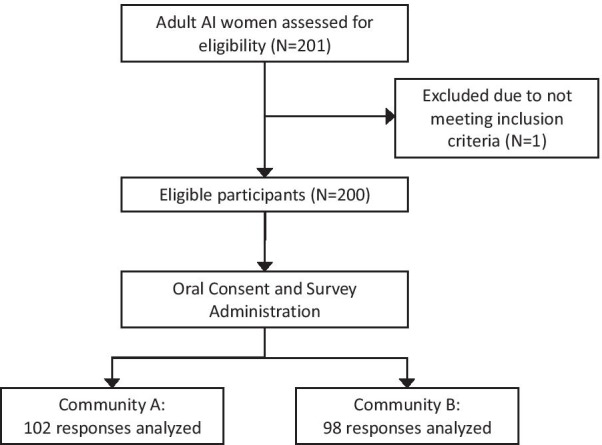
Adult self-identified AI women (N = 201) who reside on the Navajo Nation completed a cross-sectional survey between May and October 2018. The 21-question survey explored health communication around the transition to womanhood, cultural assets, perceptions of mother-daughter reproductive health communication, and intervention health topics. Univariate descriptive analyses, chi squared, and fisher's exact tests were conducted.
Respondents ranged in age from 18 to 82 years, with a mean age of 44 ± 15.5 years. Women self-identified as mothers (95; 48%), aunts (59; 30%), older sisters (55; 28%), grandmothers (37; 19%), and/or all of the aforementioned (50; 25%). 66% (N = 95) of women admired their mother/grandmother most during puberty; 29% (N = 58) of women were 10-11 years old when someone first spoke to them about menarche; and 86% (N=172) felt their culture was a source of strength. 70% (N = 139) would have liked to learn more about reproductive health when they were a teenager; 67% (N = 134) felt Diné mothers are able to provide reproductive health education; 51% (N = 101) reported having a rite of passage event, with younger women desiring an event significantly more than older women. Responses also indicate a disruption of cultural practices due to government assimilation policies, as well as the support of male relatives during puberty.
Results informed intervention content and delivery, including target age group, expanded caregiver eligibility criteria, lesson delivery structure and format, and protective cultural teachings. Other implications include the development of a complementary fatherhood and/or family-based intervention to prevent Native girls' substance use and teen pregnancy.
在为美洲原住民(AI)群体开发具有文化根基的干预措施时,越来越多地纳入保护因素(“资产”)。本研究旨在探讨 AI 女性的文化资产、观点和教义,以为开发一种具有文化根基的、代际干预措施提供信息,以预防 AI 女性的药物滥用和少女怀孕。
2018 年 5 月至 10 月期间,201 名成年自认为是 AI 女性的人完成了一项横断面调查。该 21 个问题的调查探讨了与女性过渡到成年期相关的健康交流、文化资产、对母女生殖健康交流的看法以及干预健康主题。进行了单变量描述性分析、卡方检验和 Fisher 精确检验。
受访者年龄在 18 至 82 岁之间,平均年龄为 44 ± 15.5 岁。女性自我认同为母亲(95;48%)、阿姨(59;30%)、姐姐(55;28%)、祖母(37;19%)以及上述所有身份(50;25%)。66%(N=95)的女性在青春期最崇拜自己的母亲/祖母;29%(N=58)的女性在 10-11 岁时第一次有人与她们谈论初潮;86%(N=172)认为自己的文化是力量的源泉。70%(N=139)表示希望在青少年时期更多地了解生殖健康;67%(N=134)认为 Diné 母亲能够提供生殖健康教育;51%(N=101)报告有成年礼事件,年轻女性比年长女性更希望有这样的事件。调查结果还表明,由于政府同化政策,文化习俗受到干扰,以及在青春期得到男性亲属的支持。
研究结果为干预内容和实施提供了信息,包括目标年龄组、扩大照顾者资格标准、课程交付结构和形式以及保护性文化教义。其他影响包括开发补充的父亲和/或家庭为基础的干预措施,以预防本土女孩的药物使用和少女怀孕。