Translational Research in Respiratory Medicine, Hospital Universitari Arnau de Vilanova-Santa Maria, IRBLleida, Lleida, Spain.
Centro de Investigación Biomédica en Red de Enfermedades Respiratorias (CIBERES), Madrid, Spain.
Alzheimers Res Ther. 2021 Sep 25;13(1):161. doi: 10.1186/s13195-021-00903-7.
Alterations in circadian rhythms are present in the presymptomatic stage of Alzheimer's disease (AD), possibly contributing to its pathogenesis. However, it is unknown whether such alterations are associated with worse outcomes once individuals are diagnosed with symptomatic disease. We aimed to evaluate the association between the circadian rest-activity pattern and AD-related features in patients with mild-moderate AD.
We assessed the circadian rest-activity pattern of consecutive patients with mild-moderate AD through actigraphy for 14 days. Cerebrospinal fluid was obtained to determine the levels of important pathological markers including amyloid-beta protein (Aβ42), phosphorylated tau (P-tau), total tau (T-tau), and neurofilament light (NF-L). Neuropsychological evaluation was conducted at the beginning of the study and after 12 months of follow-up. Linear regression models were performed considering the global population and Aβ42+ patients only.
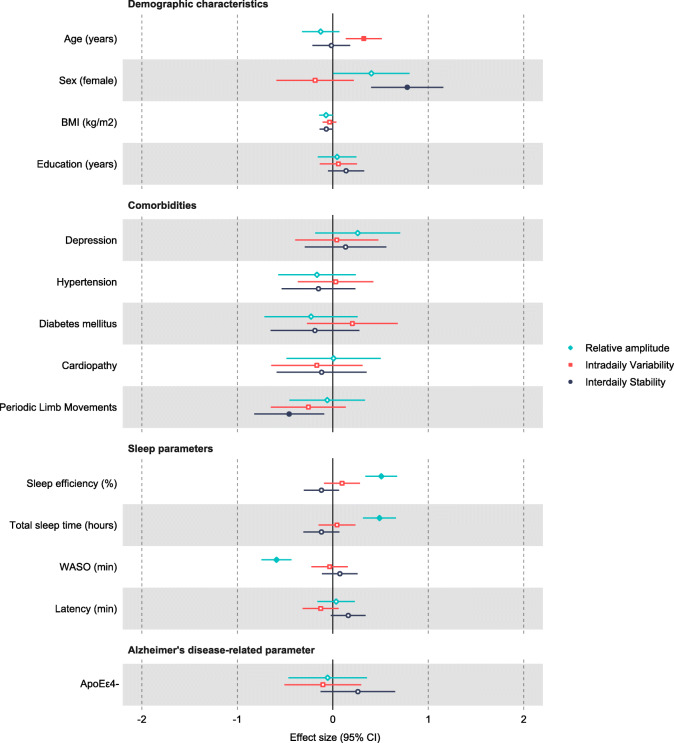
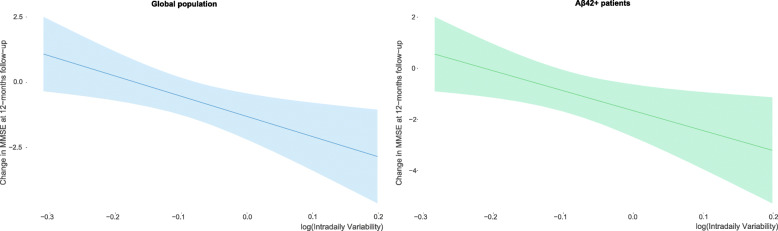
The cohort included 100 patients with mild-moderate AD. The median age [p;p] was 76.0 [73.0;80.0] years and 63.0% were female. Older age (effect size [SE] of 0.324 [0.096]; p = 0.001) and male sex (0.780 [0.193]; p = 0.001) were associated with increased fragmentation and decreased synchronization of the rhythm, respectively. After adjusting for age, sex, and season of the year, increased levels of T-tau (effect size [95% CI] of 0.343 [0.139 to 0.547]; p = 0.001) and NF-L (0.444 [0.212 to 0.676]; p = 0.001) were associated with a higher amplitude of the rest-activity rhythm. Increased fragmentation of the rhythm at baseline was associated with greater cognitive decline after one year of follow-up independent of age, sex, T-tau/Aβ42 ratio, educational level, and season of the year (- 0.715 [- 1.272 to - 0.157]; p = 0.013). Similar findings were obtained considering only the Aβ42+ patients.
Our results suggest a potential role of the circadian rest-activity pattern in predicting the cognitive decline of patients with mild-moderate AD. Further studies are warranted to confirm these findings and to elucidate whether there is causality among the observed associations.
阿尔茨海默病(AD)的无症状期就存在昼夜节律改变,这可能促成了其发病机制。然而,目前尚不清楚这些改变是否与患者被诊断为有症状疾病后的不良结局有关。我们旨在评估 AD 患者轻度至中度 AD 中昼夜节律休息-活动模式与 AD 相关特征之间的关联。
我们通过活动记录仪评估连续 100 例轻度至中度 AD 患者的昼夜节律休息-活动模式,持续 14 天。获取脑脊液以确定重要病理标志物的水平,包括淀粉样β蛋白(Aβ42)、磷酸化 tau(P-tau)、总 tau(T-tau)和神经丝轻链(NF-L)。在研究开始时和 12 个月的随访时进行神经心理学评估。仅考虑整体人群和 Aβ42+患者进行线性回归模型。
该队列包括 100 例轻度至中度 AD 患者。中位年龄 [p;p]为 76.0 [73.0;80.0]岁,63.0%为女性。年龄较大(效应大小 [SE]为 0.324 [0.096];p = 0.001)和男性(0.780 [0.193];p = 0.001)分别与节律的碎片化增加和同步性降低相关。在调整年龄、性别和当年季节后,T-tau(效应大小 [95%CI]为 0.343 [0.139 至 0.547];p = 0.001)和 NF-L(0.444 [0.212 至 0.676];p = 0.001)水平升高与休息-活动节律的振幅更高相关。基线时节律的碎片化增加与一年随访后的认知下降独立于年龄、性别、T-tau/Aβ42 比值、教育程度和当年季节相关(-0.715 [-1.272 至 -0.157];p = 0.013)。仅考虑 Aβ42+患者也得到了类似的发现。
我们的结果表明昼夜节律休息-活动模式在预测轻度至中度 AD 患者的认知下降方面可能具有潜在作用。需要进一步研究来证实这些发现,并阐明观察到的关联之间是否存在因果关系。