Nutrition and Bromatology Group, Analytical and Food Chemistry Department, Faculty of Food Science and Technology, Ourense Campus, University of Vigo, E-32004 Ourense, Spain.
Centro de Investigação de Montanha (CIMO), Instituto Politécnico de Bragança, Campus de Santa Apolonia, 5300-253 Bragança, Portugal.
Mar Drugs. 2021 Aug 31;19(9):500. doi: 10.3390/md19090500.
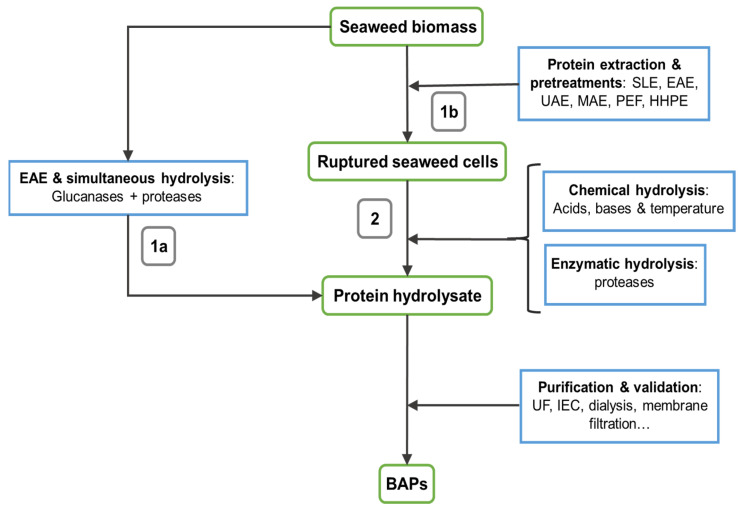
Seaweeds are industrially exploited for obtaining pigments, polysaccharides, or phenolic compounds with application in diverse fields. Nevertheless, their rich composition in fiber, minerals, and proteins, has pointed them as a useful source of these components. Seaweed proteins are nutritionally valuable and include several specific enzymes, glycoproteins, cell wall-attached proteins, phycobiliproteins, lectins, or peptides. Extraction of seaweed proteins requires the application of disruptive methods due to the heterogeneous cell wall composition of each macroalgae group. Hence, non-protein molecules like phenolics or polysaccharides may also be co-extracted, affecting the extraction yield. Therefore, depending on the macroalgae and target protein characteristics, the sample pretreatment, extraction and purification techniques must be carefully chosen. Traditional methods like solid-liquid or enzyme-assisted extraction (SLE or EAE) have proven successful. However, alternative techniques as ultrasound- or microwave-assisted extraction (UAE or MAE) can be more efficient. To obtain protein hydrolysates, these proteins are subjected to hydrolyzation reactions, whether with proteases or physical or chemical treatments that disrupt the proteins native folding. These hydrolysates and derived peptides are accounted for bioactive properties, like antioxidant, anti-inflammatory, antimicrobial, or antihypertensive activities, which can be applied to different sectors. In this work, current methods and challenges for protein extraction and purification from seaweeds are addressed, focusing on their potential industrial applications in the food, cosmetic, and pharmaceutical industries.
海藻被广泛用于工业生产,以获取各种领域应用的色素、多糖或酚类化合物。然而,其富含纤维、矿物质和蛋白质,这使它们成为这些成分的有用来源。海藻蛋白具有营养价值,包括几种特定的酶、糖蛋白、细胞壁结合蛋白、藻胆蛋白、凝集素或肽。由于每种大型藻类的细胞壁组成具有异质性,因此需要采用破坏性方法来提取海藻蛋白。因此,多酚或多糖等非蛋白质分子也可能被共同提取,从而影响提取产率。因此,根据大型藻类和目标蛋白的特性,必须仔细选择样品预处理、提取和纯化技术。传统方法,如固液或酶辅助提取(SLE 或 EAE)已被证明是成功的。然而,替代技术,如超声或微波辅助提取(UAE 或 MAE)可能更有效。为了获得蛋白质水解物,这些蛋白质会经历水解反应,无论是使用蛋白酶还是物理或化学处理来破坏蛋白质的天然折叠。这些水解物和衍生的肽具有生物活性特性,如抗氧化、抗炎、抗菌或降压活性,可应用于不同领域。在这项工作中,我们探讨了从海藻中提取和纯化蛋白质的当前方法和挑战,重点关注它们在食品、化妆品和制药行业的潜在工业应用。