Hsu Chung-Yao, Chuang Yao-Chung, Chang Fang-Chia, Chuang Hung-Yi, Chiou Terry Ting-Yu, Lee Chien-Te
Department of Neurology, Kaohsiung Medical University Hospital, Kaohsiung 80708, Taiwan.
Department of Neurology, School of Medicine, College of Medicine, Kaohsiung Medical University, Kaohsiung 80708, Taiwan.
Toxics. 2021 Sep 10;9(9):217. doi: 10.3390/toxics9090217.
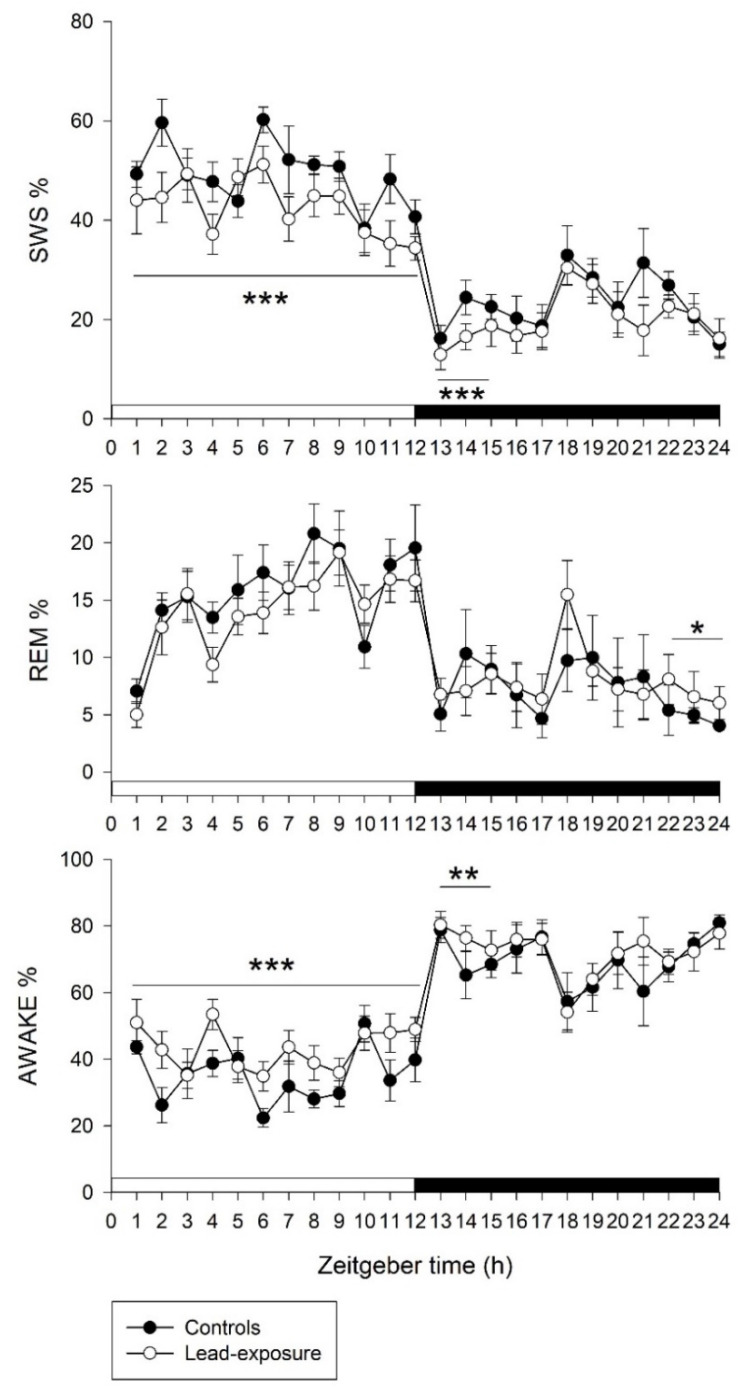
Sleep disturbance is one of the neurobehavioral complications of lead neurotoxicity. The present study evaluated the impacts of chronic lead exposure on alteration of the sleep-wake cycle in association with changes of clock gene expression in the hypothalamus. Sprague-Dawley rats with chronic lead exposure consumed drinking water that contained 250 ppm of lead acetate for five weeks. Electroencephalography and electromyography were recorded for scoring the architecture of the sleep-wake cycle in animals. At six Zeitgeber time (ZT) points (ZT2, ZT6, ZT10, ZT14, ZT18, and ZT22), three clock genes, including , , and , were analyzed. The rats with chronic lead exposure showed decreased slow wave sleep and increased wakefulness in the whole light period (ZT1 to ZT12) and the early dark period (ZT13 to ZT15) that was followed with a rebound of rapid-eye-movement sleep at the end of the dark period (ZT22 to ZT24). The disturbance of the sleep-wake cycle was associated with changes in clock gene expression that was characterized by the upregulation of and and the feedback repression of . We concluded that chronic lead exposure has a negative impact on the sleep-wake cycle in rats that predominantly disrupts sleep homeostasis. The disruption of sleep homeostasis was associated with a toxic effect of lead on the clock gene expression in the hypothalamus.
睡眠障碍是铅神经毒性的神经行为并发症之一。本研究评估了慢性铅暴露对睡眠 - 觉醒周期改变的影响,并探讨其与下丘脑生物钟基因表达变化的关系。慢性铅暴露的Sprague-Dawley大鼠饮用含250 ppm醋酸铅的饮用水,持续五周。记录脑电图和肌电图以评估动物睡眠 - 觉醒周期的结构。在六个时间geber时间(ZT)点(ZT2、ZT6、ZT10、ZT14、ZT18和ZT22),分析了三个生物钟基因,包括 、 和 。慢性铅暴露的大鼠在整个光照期(ZT1至ZT12)和早期黑暗期(ZT13至ZT15)慢波睡眠减少,觉醒增加,随后在黑暗期结束时(ZT22至ZT24)快速眼动睡眠出现反弹。睡眠 - 觉醒周期的紊乱与生物钟基因表达的变化有关,其特征是 和 的上调以及 的反馈抑制。我们得出结论,慢性铅暴露对大鼠的睡眠 - 觉醒周期有负面影响,主要破坏睡眠稳态。睡眠稳态的破坏与铅对下丘脑生物钟基因表达的毒性作用有关。