O'Neill Suzanne C, Hamilton Jada G, Conley Claire C, Peshkin Beth N, Sacca Rosalba, McDonnell Glynnis A, Isaacs Claudine, Robson Mark E, Tercyak Kenneth P
Georgetown Lombardi Comprehensive Cancer Center, Washington, D.C, USA.
Memorial Sloan Kettering Cancer Center, New York, USA.
Hered Cancer Clin Pract. 2021 Sep 26;19(1):40. doi: 10.1186/s13053-021-00198-7.
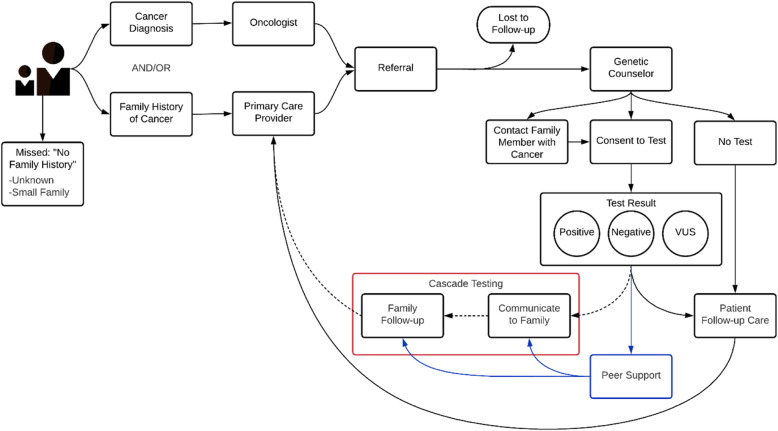
Consensus and evidence suggest that cascade testing is critical to achieve the promise of cancer genetic testing. However, barriers to cascade testing include effective family communication of genetic risk information and family members' ability to cope with genetic risk. These barriers are further complicated by the developmental needs of unaffected family members during critical windows for family communication and adaptation. Peer support could address these barriers. We provide two illustrative examples of ongoing BRCA1/2-related clinical trials that apply a peer support model to improve family communication and functioning. Peer support can augment currently available genetic services to facilitate adjustment to and effective use of cancer genetic risk information. Importantly, this scalable approach can address the presence of cancer risk within families across multiple developmental stages. This applies a family-centered perspective that accommodates all potentially at-risk relatives. This peer support model can be further applied to emerging topics in clinical genetics to expand reach and impact.
共识和证据表明,级联检测对于实现癌症基因检测的前景至关重要。然而,级联检测的障碍包括遗传风险信息在家庭中的有效沟通以及家庭成员应对遗传风险的能力。在家庭沟通和适应的关键时期,未受影响家庭成员的发展需求使这些障碍更加复杂。同伴支持可以解决这些障碍。我们提供了两个正在进行的与BRCA1/2相关的临床试验的示例,这些试验应用同伴支持模型来改善家庭沟通和功能。同伴支持可以增强现有的基因服务,以促进对癌症遗传风险信息的适应和有效利用。重要的是,这种可扩展的方法可以应对多个发育阶段家庭中癌症风险的存在。这采用了以家庭为中心的视角,涵盖所有潜在的高危亲属。这种同伴支持模型可以进一步应用于临床遗传学中的新出现的话题,以扩大覆盖范围和影响。