Ding Yudan, Wei Zirou, Yan Haohao, Guo Wenbin
National Clinical Research Center for Mental Disorders, Department of Psychiatry, The Second Xiangya Hospital of Central South University, Changsha, China.
Mental Health Center, The Second Affiliated Hospital, Guangxi Medical University, Nanning, China.
Front Pharmacol. 2021 Sep 10;12:732157. doi: 10.3389/fphar.2021.732157. eCollection 2021.
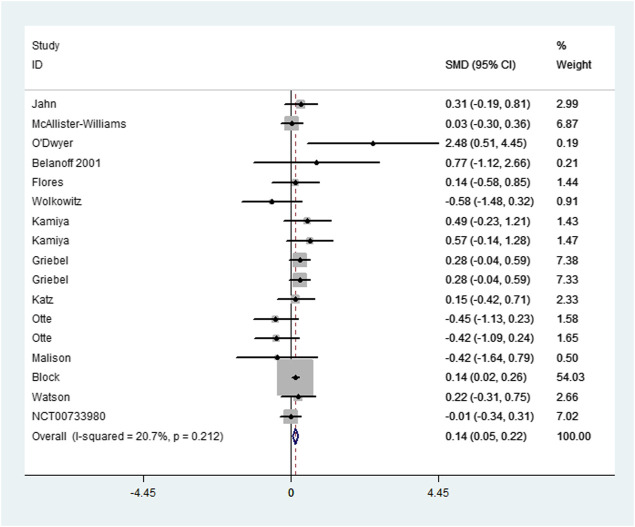
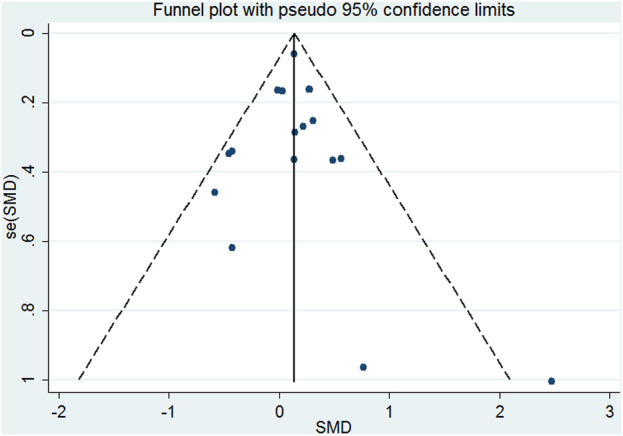
Abnormal hypothalamic-pituitary-adrenal (HPA) axis has been implicated in major depressive disorder (MDD). A number of studies have attempted to use HPA-modulating medications to treat depression. However, their results are inconsistent. The efficacy of these drugs for MDD remains uncertain. The aims of this meta-analysis were to determine the effect and safety profile of HPA-targeting medications for MDD. World of Science and PubMed databases were comprehensively searched up to March 2021. All randomized controlled trials (RCTs) and open-label trials exploring antiglucocorticoid and related medications in patients with depression were included. Standardized mean differences (SMDs) and risk ratios (RRs) with 95% confidence intervals (CIs) were calculated for continuous or dichotomous outcomes, respectively. In the meta-analysis, we identified 16 RCTs and seven open-label studies that included 2972 subjects. Pooling the change data that assessed the efficacy across all included HPA-targeting medications for depression showed a significant difference between interventions and controls with very small heterogeneity after influence analysis (SMD = 0.138, 95%CI = 0.052, 0.224, p = 0.002; I = 20.7%, p = 0.212). No obvious publication bias was observed (p = 0.127). Effectiveness remained significant in patients with MDD (SMD = 0.136, 95%CI = 0.049, 0.223, p = 0.002). Subgroup analysis showed a significant difference favoring mifepristone and vasopressin 1B (V) receptor antagonist treatment. Adverse events were reported by 14 studies and our analysis of high-quality studies showed a significant difference in favor of controls (RR = 1.283, 95%CI = 1.134, 1.452, p = 0). Our study suggested that patients with MDD may benefit from mifepristone and V receptor antagonist treatments that have tolerable side effects. HPA-based medications are promising for depression treatment. However, additional high-quality RCTs, including head-to-head trials, are needed. https://www.crd.york.ac.uk/PROSPERO/, identifier registration number: CRD42021247279.
下丘脑-垂体-肾上腺(HPA)轴异常与重度抑郁症(MDD)有关。许多研究试图使用调节HPA的药物来治疗抑郁症。然而,它们的结果并不一致。这些药物对MDD的疗效仍不确定。本荟萃分析的目的是确定针对HPA的药物治疗MDD的效果和安全性。全面检索了截至2021年3月的科学世界和PubMed数据库。纳入了所有探索抗糖皮质激素及相关药物治疗抑郁症患者的随机对照试验(RCT)和开放标签试验。分别针对连续或二分结局计算了标准化均数差(SMD)和风险比(RR)以及95%置信区间(CI)。在荟萃分析中,我们确定了16项RCT和7项开放标签研究,共纳入2972名受试者。汇总评估所有纳入的针对HPA的抑郁症治疗药物疗效的变化数据显示,干预组和对照组之间存在显著差异,影响分析后的异质性非常小(SMD = 0.138,95%CI = 0.052,0.224,p = 0.002;I² = 20.7%,p = 0.212)。未观察到明显的发表偏倚(p = 0.127)。在MDD患者中有效性仍然显著(SMD = 0.136,95%CI = 0.049,0.223,p = 0.002)。亚组分析显示米非司酮和血管加压素1B(V)受体拮抗剂治疗有显著差异。14项研究报告了不良事件,我们对高质量研究的分析显示对照组有显著差异(RR = 1.283,95%CI = 1.134,1.452,p = 0)。我们的研究表明,MDD患者可能从米非司酮和V受体拮抗剂治疗中获益,且副作用可耐受。基于HPA的药物治疗抑郁症很有前景。然而,还需要更多高质量的RCT,包括头对头试验。https://www.crd.york.ac.uk/PROSPERO/,标识符注册号:CRD42021247279。