Gan Nin, Martin Leisha, Xu Wei
Department of Life Sciences, College of Science and Engineering, Texas A&M University-Corpus Christi, Corpus Christi, TX, United States.
Front Physiol. 2021 Sep 10;12:734463. doi: 10.3389/fphys.2021.734463. eCollection 2021.
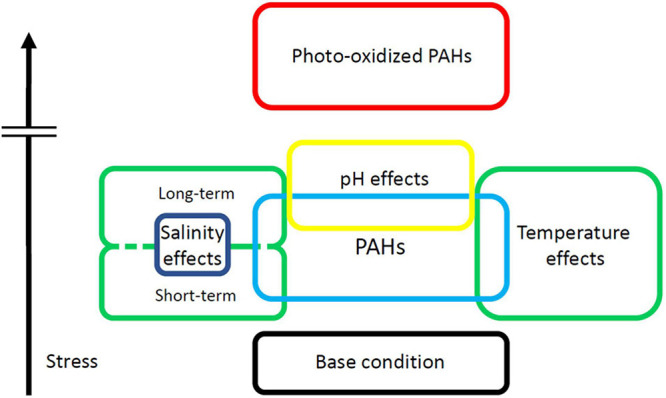
In the past decade, the Deepwater Horizon oil spill triggered a spike in investigatory effort on the effects of crude oil chemicals, most notably polycyclic aromatic hydrocarbons (PAHs), on marine organisms and ecosystems. Oysters, susceptible to both waterborne and sediment-bound contaminants due to their filter-feeding and sessile nature, have become of great interest among scientists as both a bioindicator and model organism for research on environmental stressors. It has been shown in many parts of the world that PAHs readily bioaccumulate in the soft tissues of oysters. Subsequent experiments have highlighted the negative effects associated with exposure to PAHs including the upregulation of antioxidant and detoxifying gene transcripts and enzyme activities such as Superoxide dismutase, Cytochrome P450 enzymes, and Glutathione S-transferase, reduction in DNA integrity, increased infection prevalence, and reduced and abnormal larval growth. Much of these effects could be attributed to either oxidative damage, or a reallocation of energy away from critical biological processes such as reproduction and calcification toward health maintenance. Additional abiotic stressors including increased temperature, reduced salinity, and reduced pH may change how the oyster responds to environmental contaminants and may compound the negative effects of PAH exposure. The negative effects of acidification and longer-term salinity changes appear to add onto that of PAH toxicity, while shorter-term salinity changes may induce mechanisms that reduce PAH exposure. Elevated temperatures, on the other hand, cause such large physiological effects on their own that additional PAH exposure either fails to cause any significant effects or that the effects have little discernable pattern. In this review, the oyster is recognized as a model organism for the study of negative anthropogenic impacts on the environment, and the effects of various environmental stressors on the oyster model are compared, while synergistic effects of these stressors to PAH exposure are considered. Lastly, the understudied effects of PAH photo-toxicity on oysters reveals drastic increases to the toxicity of PAHs photooxidation and the formation of quinones. The consequences of the interaction between local and global environmental stressors thus provide a glimpse into the differential response to anthropogenic impacts across regions of the world.
在过去十年中,“深水地平线”石油泄漏事件引发了对原油化学物质,尤其是多环芳烃(PAHs)对海洋生物和生态系统影响的调查力度激增。牡蛎由于其滤食性和固着性,易受水体和沉积物中污染物的影响,作为生物指示物和环境应激源研究的模式生物,已引起科学家的极大兴趣。在世界许多地方都已表明,多环芳烃很容易在牡蛎的软组织中生物累积。随后的实验突出了与接触多环芳烃相关的负面影响,包括抗氧化和解毒基因转录本的上调以及超氧化物歧化酶、细胞色素P450酶和谷胱甘肽S-转移酶等酶活性的增加,DNA完整性降低,感染患病率增加,幼虫生长减少和异常。这些影响大多可归因于氧化损伤,或能量从繁殖和钙化等关键生物过程重新分配到健康维持。包括温度升高、盐度降低和pH值降低在内的其他非生物应激源可能会改变牡蛎对环境污染物的反应方式,并可能加剧多环芳烃暴露的负面影响。酸化和长期盐度变化的负面影响似乎叠加了多环芳烃的毒性,而短期盐度变化可能会诱导减少多环芳烃暴露的机制。另一方面,温度升高本身会产生如此大的生理影响,以至于额外的多环芳烃暴露要么不会产生任何显著影响,要么影响几乎没有明显的模式。在本综述中,牡蛎被视为研究人为对环境负面影响的模式生物,比较了各种环境应激源对牡蛎模型的影响,同时考虑了这些应激源与多环芳烃暴露的协同效应。最后,多环芳烃光毒性对牡蛎的研究不足的影响揭示了多环芳烃光氧化毒性的急剧增加和醌的形成。因此,局部和全球环境应激源之间相互作用的后果让我们得以一窥世界各地对人为影响的不同反应。