Department of Clinical Neurosciences, University of Cambridge, Cambridge, UK; MRC Cognition and Brain Sciences Unit, University of Cambridge, Cambridge, UK.
Department of Clinical Neurosciences, University of Cambridge, Cambridge, UK; MRC Cognition and Brain Sciences Unit, University of Cambridge, Cambridge, UK.
Cortex. 2020 Jun;127:29-41. doi: 10.1016/j.cortex.2020.02.002. Epub 2020 Feb 18.
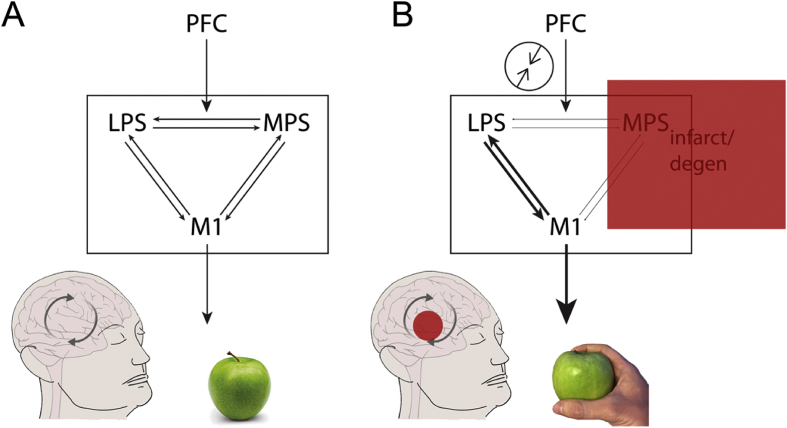
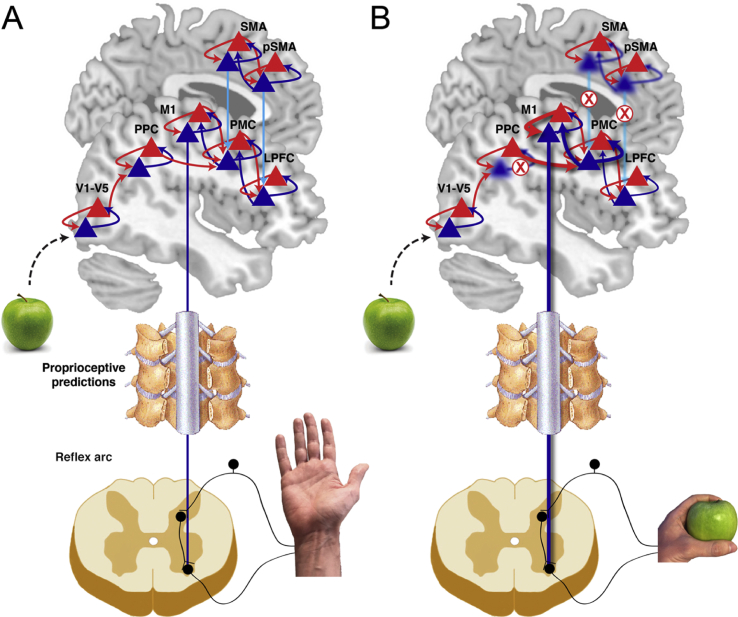
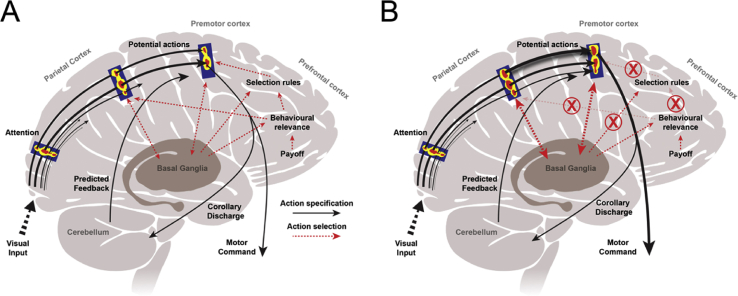
An alien limb is a debilitating disorder of volitional control. The core feature of alien limb is the performance of simple or complex semi-purposeful movements which the patient reports to be unintentional or unwanted, or occasionally in opposition to their intentions. Theories of the mechanism of alien limb phenomena have emphasised the role of disinhibition in the brain, and exaggerated action 'affordances'. However, despite advances in cognitive neuroscience research and a large public and media interest, there has been no unifying computational and anatomical account of the cause of alien limb movements. Here, we extend Bayesian brain principles to propose that alien limb is a disorder of 'predictive processing' in hierarchical sensorimotor brain networks. Specifically, we suggest that alien limb results from predictions about action outcomes that are afforded unduly high precision. The principal mechanism for this abnormally high precision is an impairment in the relay of input from medial regions, predominantly the supplementary motor area (SMA), which modulate the precision of lateral brain regions encoding the predicted action outcomes. We discuss potential implications of this model for future research and treatment of alien limb.
异物手是一种意志控制障碍的致残性疾病。异物手的核心特征是患者报告的简单或复杂的半目的性运动,这些运动是无意识的或不想要的,或者偶尔与他们的意图相反。异物手现象的机制理论强调了大脑抑制作用的作用,以及夸大的动作“可供性”。然而,尽管认知神经科学研究取得了进展,公众和媒体也对此产生了浓厚的兴趣,但对于异物手运动的原因,还没有一个统一的计算和解剖学解释。在这里,我们扩展贝叶斯大脑原理,提出异物手是层次化感觉运动脑网络中“预测处理”的一种障碍。具体来说,我们认为异物手是由于对动作结果的预测而产生的,这些预测赋予了过高的精度。这种异常高精度的主要机制是从中枢区域(主要是辅助运动区[SMA])输入的中继受损,这调节了编码预测动作结果的外侧脑区的精度。我们讨论了该模型对未来异物手研究和治疗的潜在影响。