Gong Lanqi, Kwong Dora Lai-Wan, Dai Wei, Wu Pingan, Wang Yan, Lee Anne Wing-Mui, Guan Xin-Yuan
Department of Clinical Oncology, Li Ka Shing Faculty of Medicine, The University of Hong Kong, Hong Kong, Hong Kong, SAR China.
Department of Clinical Oncology, The University of Hong Kong-Shenzhen Hospital, Shenzhen, China.
Front Oncol. 2021 Sep 10;11:744889. doi: 10.3389/fonc.2021.744889. eCollection 2021.
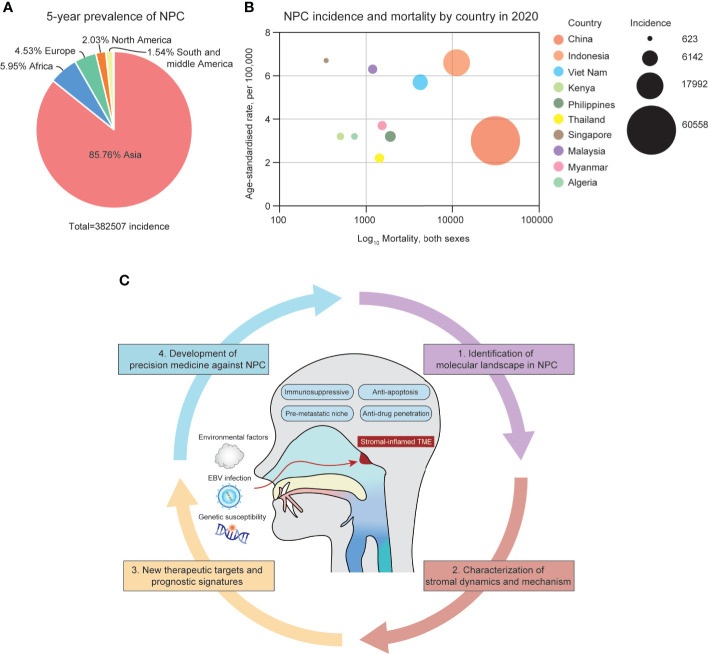
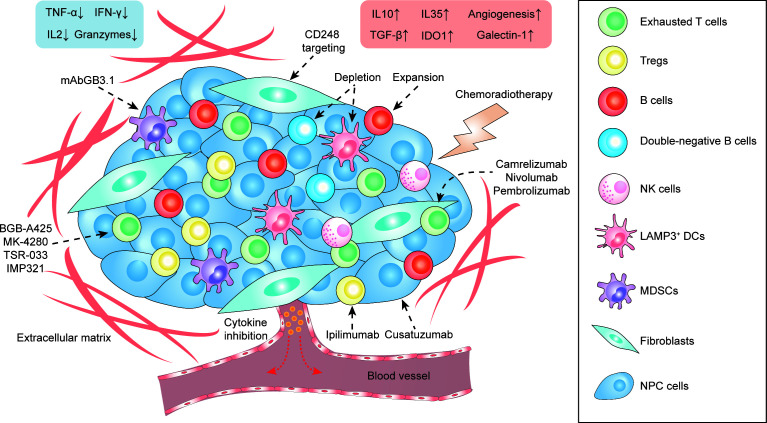
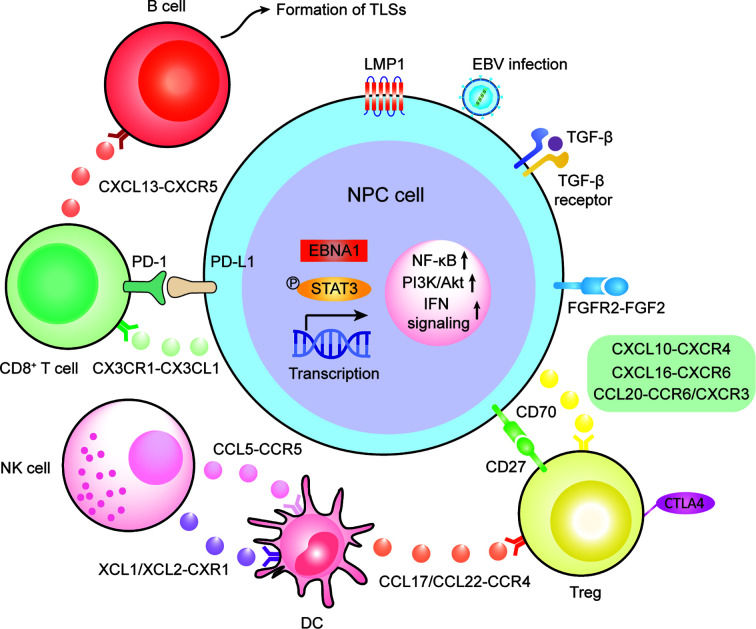
The evolution of the tumor microenvironment (TME) is a cancer-dependent and dynamic process. The TME is often a complex ecosystem with immunosuppressive and tumor-promoting functions. Conventional chemotherapy and radiotherapy, primarily focus on inducing tumor apoptosis and hijacking tumor growth, whereas the tumor-protective microenvironment cannot be altered or destructed. Thus, tumor cells can quickly escape from extraneous attack and develop therapeutic resistance, eventually leading to treatment failure. As an Epstein Barr virus (EBV)-associated malignancy, nasopharyngeal carcinoma (NPC) is frequently infiltrated with varied stromal cells, making its microenvironment a highly heterogeneous and suppressive harbor protecting tumor cells from drug penetration, immune attack, and facilitating tumor development. In the last decade, targeted therapy and immunotherapy have emerged as promising options to treat advanced, metastatic, recurrent, and resistant NPC, but lack of understanding of the TME had hindered the therapeutic development and optimization. Single-cell sequencing of NPC-infiltrating cells has recently deciphered stromal composition and functional dynamics in the TME and non-malignant counterpart. In this review, we aim to depict the stromal landscape of NPC in detail based on recent advances, and propose various microenvironment-based approaches for precision therapy.
肿瘤微环境(TME)的演变是一个依赖于癌症且动态变化的过程。TME通常是一个具有免疫抑制和肿瘤促进功能的复杂生态系统。传统的化疗和放疗主要侧重于诱导肿瘤细胞凋亡和抑制肿瘤生长,然而肿瘤保护性微环境却无法被改变或破坏。因此,肿瘤细胞能够迅速逃避外部攻击并产生治疗抗性,最终导致治疗失败。作为一种与爱泼斯坦-巴尔病毒(EBV)相关的恶性肿瘤,鼻咽癌(NPC)常常浸润有多种基质细胞,使其微环境成为一个高度异质性且具有抑制作用的庇护所,可保护肿瘤细胞免受药物渗透和免疫攻击,并促进肿瘤发展。在过去十年中,靶向治疗和免疫治疗已成为治疗晚期、转移性、复发性和耐药性NPC的有前景的选择,但对TME的了解不足阻碍了治疗的发展和优化。最近对NPC浸润细胞的单细胞测序已经解析了TME和非恶性对应物中的基质组成和功能动态。在本综述中,我们旨在根据最新进展详细描绘NPC的基质景观,并提出各种基于微环境的精准治疗方法。