Ying Lingwen, Shen Yun, Zhang Yang, Wang Yikun, Liu Yong, Yin Jun, Wang Yufei, Yin Jingrong, Zhu Wei, Bao Yuqian, Zhou Jian
Department of Endocrinology and Metabolism, Shanghai Jiao Tong University Affiliated Sixth People's Hospital, Shanghai Clinical Center for Diabetes, Shanghai Key Clinical Center for Metabolic Disease, Shanghai Diabetes Institute, Shanghai Key Laboratory of Diabetes Mellitus, Shanghai, China.
Anhui Institute of Optics and Fine Mechanics, Hefei Institutes of Physical Science, Chinese Academy of Sciences, Hefei, China.
Front Cardiovasc Med. 2021 Sep 10;8:696156. doi: 10.3389/fcvm.2021.696156. eCollection 2021.
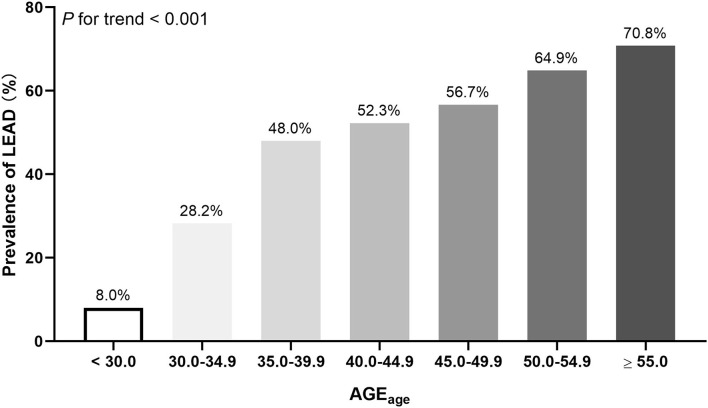
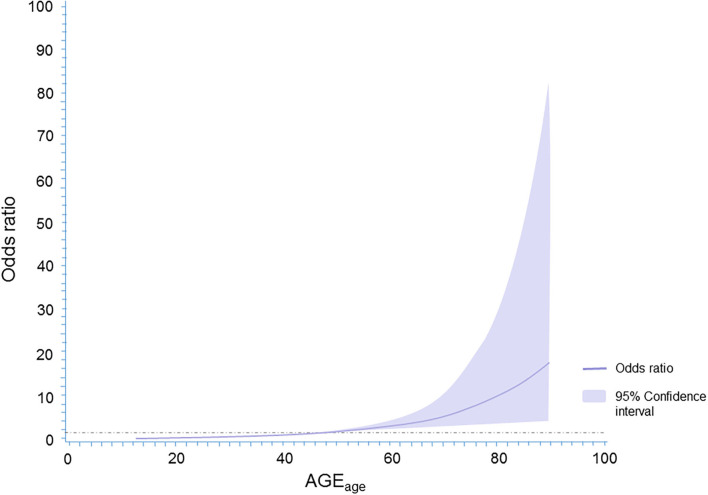
Advanced glycation end products (AGEs) were reported to be correlated with the development of diabetes, as well as diabetic vascular complications. Therefore, this study aimed at investigating the association between AGEs and lower-extremity atherosclerotic disease (LEAD). A total of 1,013 type 2 diabetes patients were enrolled. LEAD was measured through color Doppler ultrasonography. The non-invasive skin autofluorescence method was performed for AGEs measurement. Considering that age plays an important role in both AGEs and LEAD, age-combined AGEs, i.e., AGE index (define as AGEs × age/100) was used for related analysis. The overall prevalence of LEAD was 48.9% (495/1,013). Patients with LEAD showed a significantly higher AGE ( < 0.001), and the prevalence of LEAD increased with ascending AGE levels ( for trend < 0.001). Logistic regression analysis revealed that AGE was significantly positively associated with risk of LEAD, and the odds ratios of presence of LEAD across quartiles of AGE were 1.00, 1.72 [95% confidence interval (CI) = 1.14-2.61], 2.72 (95% CI = 1.76-4.22), 4.29 (95% CI = 2.69-6.85) for multivariable-adjusted model (both for trend < 0.001), respectively. The results were similar among patients of different sexes, body mass index, and with or without diabetes family history. Further, AGE presented a better predictive value for LEAD than glycated hemoglobin A (HbA), with its sensitivity, specificity, and area under the curve of 75.5% (95% CI = 71.6-79.2%), 59.3% (95% CI = 54.9-63.6%), and 0.731 (0.703-0.758), respectively. AGE, the non-invasive measured skin AGEs combined with age, seems to be a more promising approach than HbA in identifying patient at high risk of LEAD.
据报道,晚期糖基化终末产物(AGEs)与糖尿病的发生发展以及糖尿病血管并发症相关。因此,本研究旨在探讨AGEs与下肢动脉粥样硬化疾病(LEAD)之间的关联。共纳入1013例2型糖尿病患者。通过彩色多普勒超声测量LEAD。采用无创皮肤自发荧光法测量AGEs。考虑到年龄在AGEs和LEAD中均起重要作用,使用年龄结合AGEs,即AGE指数(定义为AGEs×年龄/100)进行相关分析。LEAD的总体患病率为48.9%(495/1013)。LEAD患者的AGEs显著更高(P<0.001),且LEAD的患病率随AGE水平升高而增加(趋势P<0.001)。逻辑回归分析显示,AGE与LEAD风险显著正相关,在多变量调整模型中,AGE四分位数中LEAD存在的比值比分别为1.00、1.72[95%置信区间(CI)=1.14 - 2.61]、2.72(95%CI = 1.76 - 4.22)、4.29(95%CI = 2.69 - 6.85)(趋势P均<0.001)。在不同性别、体重指数以及有无糖尿病家族史的患者中结果相似。此外,AGE对LEAD的预测价值优于糖化血红蛋白A(HbA),其敏感性、特异性和曲线下面积分别为75.5%(95%CI = 71.6 - 79.2%)、59.3%(95%CI = 54.9 - 63.6%)和0.731(0.703 - 0.758)。无创测量的皮肤AGEs结合年龄的AGE,在识别LEAD高危患者方面似乎比HbA更具前景。