
一种使用人工智能的原发性前交叉韧带损伤预测模型。
A Prediction Model for Primary Anterior Cruciate Ligament Injury Using Artificial Intelligence.
作者信息
Tamimi Iskandar, Ballesteros Joaquin, Lara Almudena Perez, Tat Jimmy, Alaqueel Motaz, Schupbach Justin, Marwan Yousef, Urdiales Cristina, Gomez-de-Gabriel Jesus Manuel, Burman Mark, Martineau Paul Andre
机构信息
Knee Division, Hospital Regional Universitario de Málaga, Málaga, Spain.
ITIS Software, Universidad de Málaga, Málaga, Spain.
出版信息
Orthop J Sports Med. 2021 Sep 21;9(9):23259671211027543. doi: 10.1177/23259671211027543. eCollection 2021 Sep.
BACKGROUND
Supervised machine learning models in artificial intelligence (AI) have been increasingly used to predict different types of events. However, their use in orthopaedic surgery has been limited.
HYPOTHESIS
It was hypothesized that supervised learning techniques could be used to build a mathematical model to predict primary anterior cruciate ligament (ACL) injuries using a set of morphological features of the knee.
STUDY DESIGN
Cross-sectional study; Level of evidence, 3.
METHODS
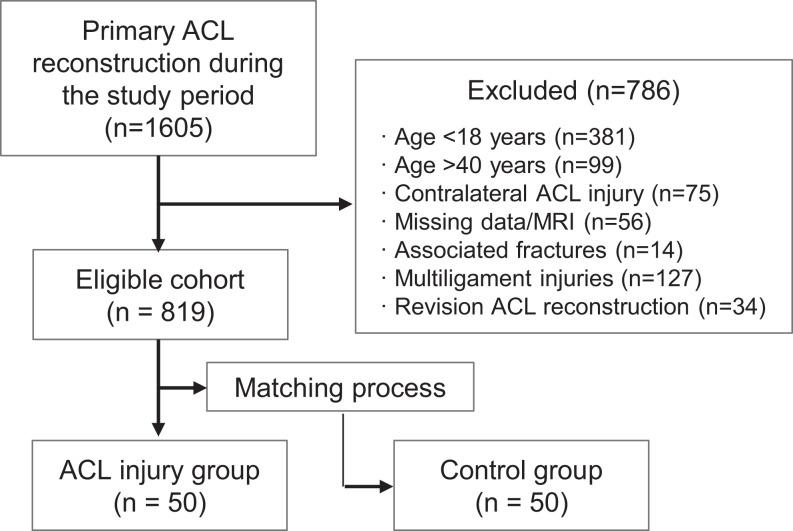
Included were 50 adults who had undergone primary ACL reconstruction between 2008 and 2015. All patients were between 18 and 40 years of age at the time of surgery. Patients with a previous ACL injury, multiligament knee injury, previous ACL reconstruction, history of ACL revision surgery, complete meniscectomy, infection, missing data, and associated fracture were excluded. We also identified 50 sex-matched controls who had not sustained an ACL injury. For all participants, we used the preoperative magnetic resonance images to measure the anteroposterior lengths of the medial and lateral tibial plateaus as well as the lateral and medial bone slope (LBS and MBS), lateral and medial meniscal height (LMH and MMH), and lateral and medial meniscal slope (LMS and MMS). The AI predictor was created using Matlab R2019b. A Gaussian naïve Bayes model was selected to create the predictor.
RESULTS
Patients in the ACL injury group had a significantly increased posterior LBS (7.0° ± 4.7° vs 3.9° ± 5.4°; = .008) and LMS (-1.7° ± 4.8° vs -4.0° ± 4.2°; = .002) and a lower MMH (5.5 ± 0.1 vs 6.1 ± 0.1 mm; = .006) and LMH (6.9 ± 0.1 vs 7.6 ± 0.1 mm; = .001). The AI model selected LBS and MBS as the best possible predictive combination, achieving 70% validation accuracy and 92% testing accuracy.
CONCLUSION
A prediction model for primary ACL injury, created using machine learning techniques, achieved a >90% testing accuracy. Compared with patients who did not sustain an ACL injury, patients with torn ACLs had an increased posterior LBS and LMS and a lower MMH and LMH.
背景
人工智能(AI)中的监督式机器学习模型已越来越多地用于预测不同类型的事件。然而,它们在骨科手术中的应用一直有限。
假设
假设可以使用监督学习技术来构建一个数学模型,利用一组膝关节的形态学特征来预测原发性前交叉韧带(ACL)损伤。
研究设计
横断面研究;证据等级,3级。
方法
纳入2008年至2015年间接受初次ACL重建的50名成年人。所有患者手术时年龄在18至40岁之间。排除既往有ACL损伤、膝关节多韧带损伤、既往ACL重建、ACL翻修手术史、全半月板切除术、感染、数据缺失及相关骨折的患者。我们还确定了50名未发生ACL损伤的性别匹配对照。对于所有参与者,我们使用术前磁共振成像测量内侧和外侧胫骨平台的前后长度以及外侧和内侧骨坡度(LBS和MBS)、外侧和内侧半月板高度(LMH和MMH)以及外侧和内侧半月板坡度(LMS和MMS)。使用Matlab R2019b创建AI预测器。选择高斯朴素贝叶斯模型来创建预测器。
结果
ACL损伤组患者的后LBS(7.0°±4.7°对3.9°±5.4°;P = 0.008)和LMS(-1.7°±4.8°对-4.0°±4.2°;P = 0.002)显著增加,MMH(5.5±0.1对6.1±0.1mm;P = 0.006)和LMH(6.9±0.1对7.6±0.1mm;P = 0.001)较低。AI模型选择LBS和MBS作为最佳预测组合,验证准确率达到70%,测试准确率达到92%。
结论
使用机器学习技术创建的原发性ACL损伤预测模型测试准确率>90%。与未发生ACL损伤的患者相比,ACL撕裂患者的后LBS和LMS增加,MMH和LMH降低。



 Zotero 插件