Dong Hui, Liu Mingfei, Wang Li, Liu Yankai, Lu Xuxiu, Stagos Dimitrios, Lin Xiukun, Liu Ming
Key Laboratory of Marine Drugs, Ministry of Education, School of Medicine and Pharmacy, Ocean University of China, Qingdao 266003, China.
Laboratory for Marine Drugs and Bioproducts of Qingdao National Laboratory for Marine Science and Technology, Qingdao 266237, China.
Antioxidants (Basel). 2021 Sep 9;10(9):1436. doi: 10.3390/antiox10091436.
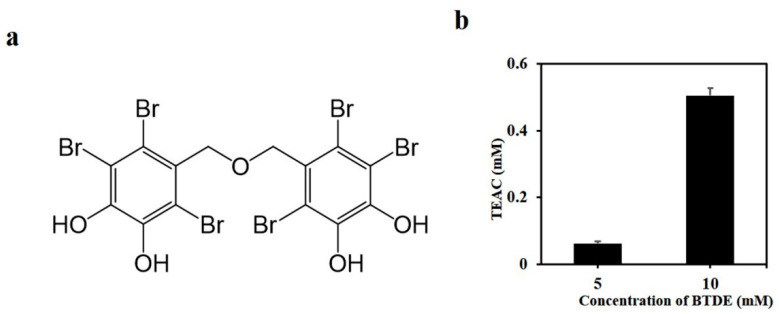
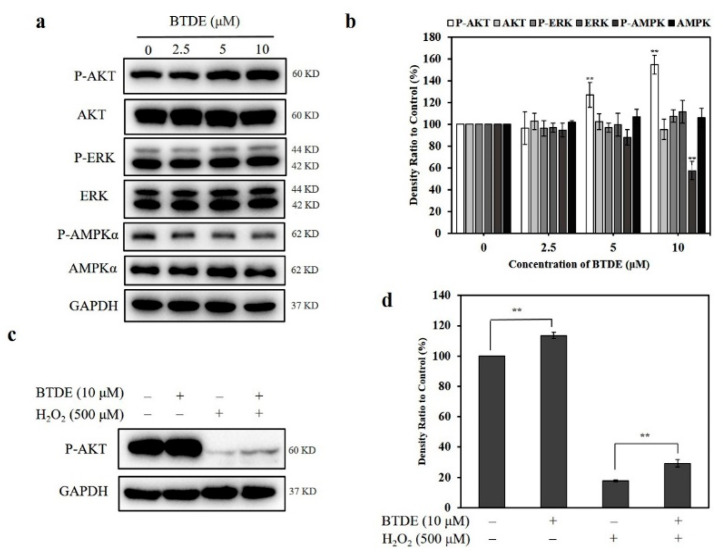
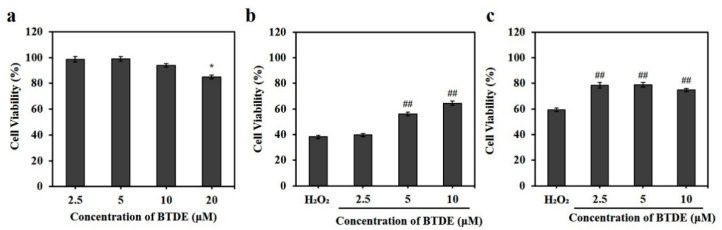
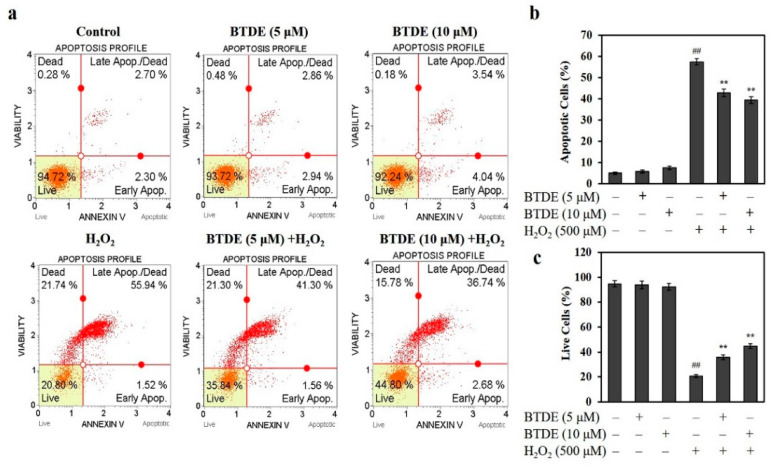
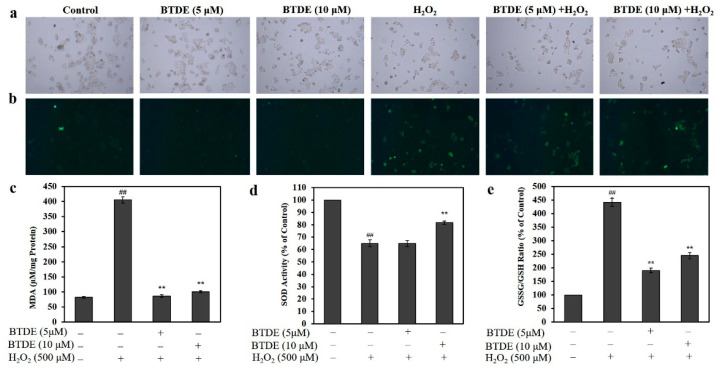
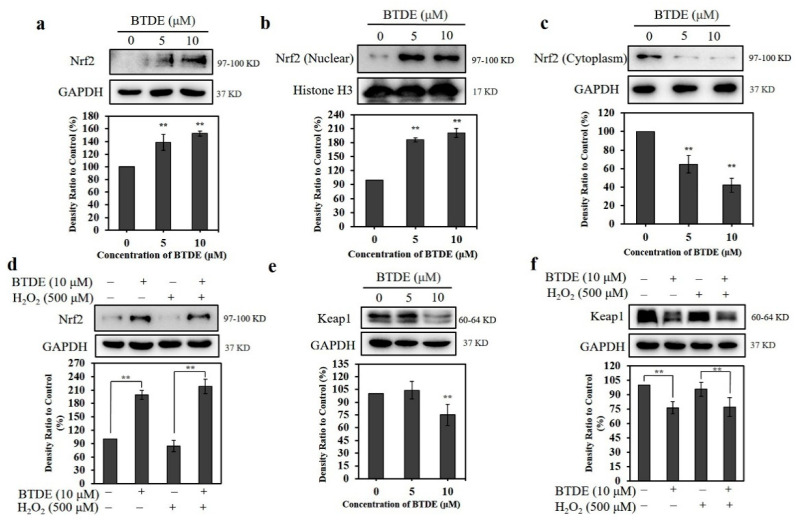
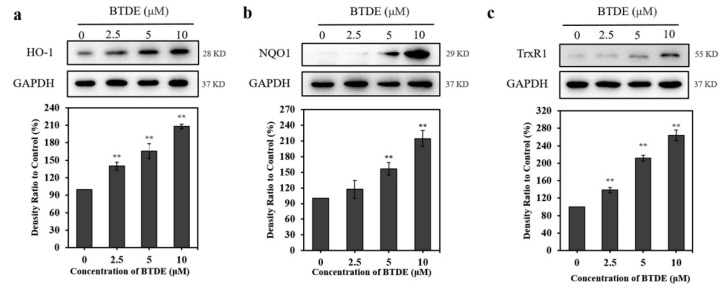
Excessive reactive oxygen species (ROS) promotes the oxidative stress of keratinocytes, eventually causing cell damage. The natural bromophenol bis (2,3,6-tribromo-4,5-dihydroxybenzyl) ether (BTDE) from marine red algae has been reported to have a varied bioactivity; however, its antioxidant effect has yet to be investigated systemically. Our present work aimed to explore the antioxidant effect of BTDE both on the molecular and cellular models and also to illustrate the antioxidant mechanisms. Our results showed that BTDE could effectively scavenge ABTS free radicals and protect HaCaT cells from damage induced by HO. Mechanism studies in HaCaT cells demonstrated that BTDE attenuated hydrogen peroxide (HO)-induced ROS production, reduced the malondialdehyde (MDA) level, decreased the oxidized glutathione (GSSG)/glutathione (GSH) ratio, and increased the antioxidant enzyme superoxide dismutase (SOD). Moreover, BTDE could inhibit the expression of Kelch-like epichlorohydrin-associated protein 1 (Keap1) and increase the expression of both nuclear factor erythroid 2-related factor 2 (Nrf2) and its downstream proteins TrXR1, HO-1, and NQO1. BTDE also activated the upstream signaling pathway of Nrf2 such as AKT pathway, while not activating the ERK or AMPKα pathways. In general, BTDE is a promising antioxidant to protect HaCaT cells against oxidative damage via Nrf2-mediated pathways.
过量的活性氧(ROS)会加剧角质形成细胞的氧化应激,最终导致细胞损伤。据报道,来自海洋红藻的天然溴酚双(2,3,6-三溴-4,5-二羟基苄基)醚(BTDE)具有多种生物活性;然而,其抗氧化作用尚未得到系统研究。我们目前的工作旨在探讨BTDE在分子和细胞模型上的抗氧化作用,并阐明其抗氧化机制。我们的结果表明,BTDE可以有效清除ABTS自由基,并保护HaCaT细胞免受HO诱导的损伤。在HaCaT细胞中的机制研究表明,BTDE可减弱过氧化氢(HO)诱导的ROS产生,降低丙二醛(MDA)水平,降低氧化型谷胱甘肽(GSSG)/谷胱甘肽(GSH)比值,并增加抗氧化酶超氧化物歧化酶(SOD)。此外,BTDE可抑制kelch样环氧氯丙烷相关蛋白1(Keap1)的表达,并增加核因子红细胞2相关因子2(Nrf2)及其下游蛋白TrXR1、HO-1和NQO1的表达。BTDE还激活了Nrf2的上游信号通路,如AKT通路,而未激活ERK或AMPKα通路。总体而言,BTDE是一种有前景的抗氧化剂,可通过Nrf2介导的途径保护HaCaT细胞免受氧化损伤。