Pruccoli Jacopo, Pelusi Martina, Romagnoli Giorgia, Malaspina Elisabetta, Moscano Filomena, Parmeggiani Antonia
IRCCS Istituto delle Scienze Neurologiche di Bologna, Centro Regionale per i Disturbi della Nutrizione e dell'Alimentazione in Età Evolutiva, U.O. di Neuropsichiatria dell'Età Pediatrica, 40138 Bologna, Italy.
Dipartimento di Scienze Mediche e Chirurgiche (DIMEC), Università di Bologna, 40138 Bologna, Italy.
Brain Sci. 2021 Sep 19;11(9):1242. doi: 10.3390/brainsci11091242.
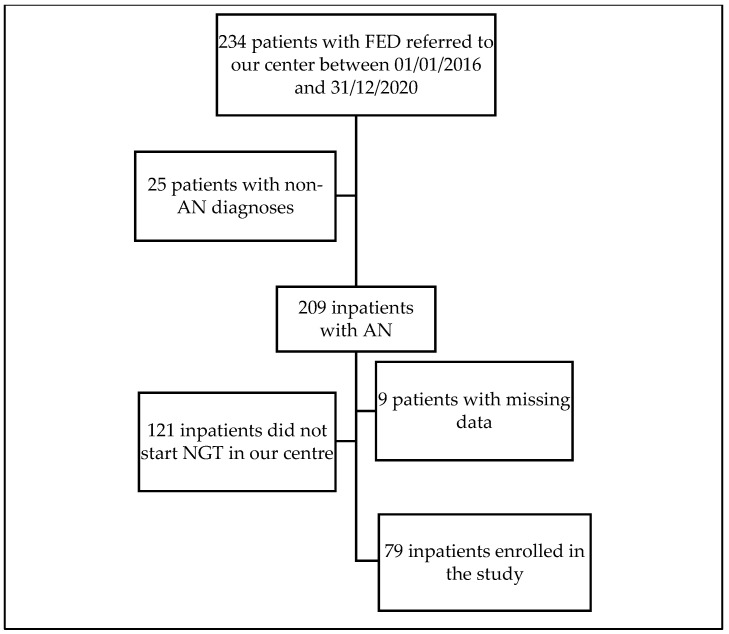
This study aims to investigate possible different outcomes in the inpatient treatment of anorexia nervosa (AN) related to different timings of psychopharmacological and nutritional interventions. A retrospective observational study was conducted, involving young patients hospitalized for AN, treated with naso-gastric tube feeding (NGT). Participants were divided into five groups according to early (0-7 days) or late (8+ days) introduction of atypical antipsychotics (AAP) and NGT: early AAP-early NGT (EE), early AAP-late NGT (EL), late AAP-early NGT (LE), late AAP-late NGT (LL) and a control group treated with NGT only (NGT). Concurrent clinical and treatment variables were analyzed. AN psychopathology was measured with the Eating Disorder Inventory-3 (EDI-3) EDRC score. Outcomes were assessed as admission-discharge body-mass index (BMI) improvement and length of hospital stay (LOS). Contributions of variables related to outcomes were assessed with multifactorial-analyses of variance (MANOVA). Seventy-nine patients were enrolled in the study. LOS was different among treatment groups (F (4, 75) = 5.993, < 0.001), and EE patients showed lower LOS than LE ( < 0.001) and LL ( = 0.025) patients. BMI improvement was not significantly different among treatment groups but correlated negatively with age (F (1, 72) = 10.130, = 0.002), and admission BMI (F (1, 72) = 14.681, < 0.001). In conclusion, patients treated with early AAP and early NGT showed lower LOS than those treated with late AAP. Prognostic treatment variables should be investigated in wider samples.
本研究旨在调查神经性厌食症(AN)住院治疗中,与精神药物和营养干预不同时机相关的可能不同结局。开展了一项回顾性观察研究,纳入因AN住院并接受鼻饲管喂养(NGT)治疗的年轻患者。参与者根据非典型抗精神病药物(AAP)和NGT的早期(0 - 7天)或晚期(8天及以后)引入分为五组:早期AAP - 早期NGT(EE)、早期AAP - 晚期NGT(EL)、晚期AAP - 早期NGT(LE)、晚期AAP - 晚期NGT(LL)以及仅接受NGT治疗的对照组(NGT)。分析了同时期的临床和治疗变量。用进食障碍问卷-3(EDI - 3)的进食障碍评定量表(EDRC)评分来衡量AN的精神病理学。结局评估为入院至出院时体重指数(BMI)的改善情况和住院时间(LOS)。通过多因素方差分析(MANOVA)评估与结局相关变量的作用。79名患者纳入本研究。治疗组之间的LOS存在差异(F(4, 75) = 5.993,P < 0.001),EE组患者的LOS低于LE组(P < 0.001)和LL组(P = 0.025)患者。治疗组之间BMI的改善无显著差异,但与年龄呈负相关(F(1, 72) = 10.130,P = 0.002),与入院时BMI呈负相关(F(1, 72) = 14.681,P < 0.001)。总之,早期使用AAP和早期使用NGT治疗的患者LOS低于晚期使用AAP治疗的患者。应在更大样本中研究预后治疗变量。