Castellanos-Reyes Katy, Villalobos-Carvajal Ricardo, Beldarrain-Iznaga Tatiana
Facultad de Ciencias Tecnológicas, Universidad Nacional de Agricultura, Carretera a Dulce Nombre de Culmí, km 215, Barrio El Espino, Catacamas 16201, Honduras.
Food Engineering Department, Universidad del Bío-Bío, Av. Andrés Bello 720, P.O. Box 447, Chillán 3780000, Chile.
Foods. 2021 Sep 9;10(9):2126. doi: 10.3390/foods10092126.
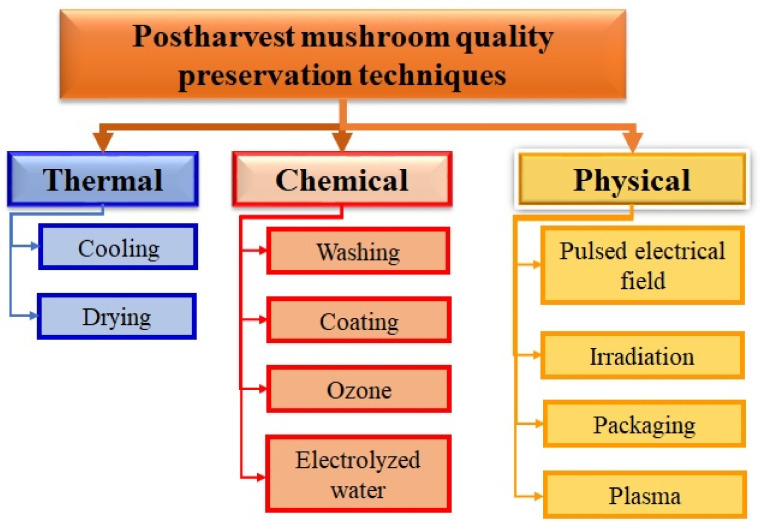
The production and consumption of fresh mushrooms has experienced a significant increase in recent decades. This trend has been driven mainly by their nutritional value and by the presence of bioactive and nutraceutical components that are associated with health benefits, which has led some to consider them a functional food. Mushrooms represent an attractive food for vegetarian and vegan consumers due to their high contents of high-biological-value proteins and vitamin D. However, due to their high respiratory rate, high water content, and lack of a cuticular structure, mushrooms rapidly lose quality and have a short shelf life after harvest, which limits their commercialization in the fresh state. Several traditional preservation methods are used to maintain their quality and extend their shelf life. This article reviews some preservation methods that are commonly used to preserve fresh mushrooms and promising new preservation techniques, highlighting the use of new packaging systems and regulations aimed at the development of more sustainable packaging.
近几十年来,新鲜蘑菇的生产和消费显著增加。这一趋势主要是由其营养价值以及与健康益处相关的生物活性和营养成分所推动的,这使得一些人将它们视为功能性食品。由于蘑菇富含高生物价值的蛋白质和维生素D,它们对素食者和纯素食消费者来说是一种有吸引力的食物。然而,由于蘑菇呼吸速率高、含水量高且缺乏表皮结构,收获后蘑菇会迅速变质且保质期较短,这限制了它们在新鲜状态下的商业化。人们使用了几种传统的保存方法来保持其品质并延长保质期。本文综述了一些常用于保存新鲜蘑菇的保存方法以及有前景的新保存技术,重点介绍了新包装系统的使用以及旨在开发更可持续包装的法规。