Yi Jian, Chen I-Hua, Lin Chung-Ying, Li Cheng-Chieh, Liao Xiao-Ling, Wei Zhi-Hui, Gamble Jeffrey Hugh
College of Education, Capital Normal University, Beijing 100048, China.
Chinese Academy of Education Big Data, Qufu Normal University, Qufu 273165, China.
Healthcare (Basel). 2021 Sep 11;9(9):1199. doi: 10.3390/healthcare9091199.
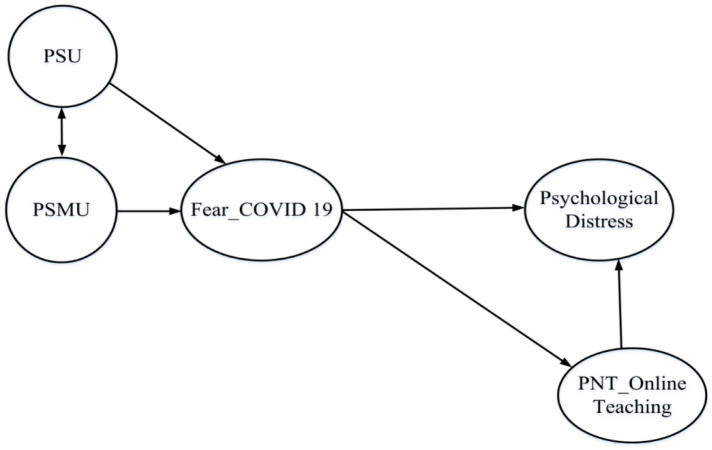
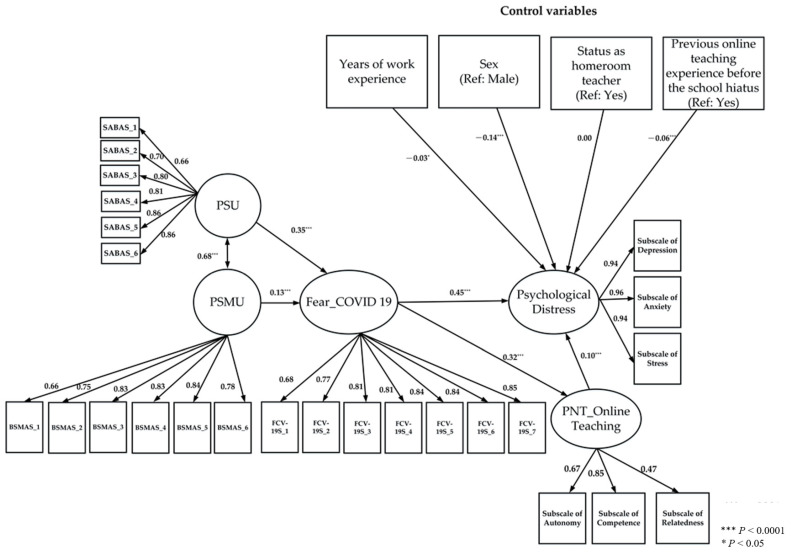
Problematic Internet use (PIU) is a risk factor for psychological distress during COVID-19, as teachers are a psychologically vulnerable population. We explored the role of PIU in terms of primary and middle school teachers' fear of COVID-19 and psychological need thwarting (PNT) of online teaching. We empirically evaluated the relationships among these research variables in explaining teachers' psychological distress during COVID-19. Online survey data were collected from 9030 teachers. A high proportion of participants demonstrated psychological distress: depression (20.4%), anxiety (26.4%), and stress (10.2%). Structural equation modeling was used to test our proposed conceptual model, wherein PIU behaviors served as predictors, mediated by fear of COVID-19 and PNT of online teaching, for teachers' psychological distress. With ideal model fit, the results of the path coefficients indicated that PIU behaviors were associated with fear of COVID-19 ( < 0.001); fear of COVID-19 and PNT of online teaching were associated with psychological distress ( < 0.001); and fear of COVID-19 was also positively associated with PNT of online teaching ( < 0.001). PSU and PSMU had an indirect positive effect on psychological distress through the mediator of fear of COVID-19 and PNT of online teaching. As such, we suggest that school administrators pay greater attention to teachers' psychological needs through efforts to enhance teachers' autonomy and relatedness from interpersonal relationships, alleviating PNT of online teaching. Our PNT of online teaching scale may also serve as a contribution for further research and practice.
问题性网络使用(PIU)是新冠疫情期间心理困扰的一个风险因素,因为教师是心理上易受伤害的群体。我们从小学和中学教师对新冠疫情的恐惧以及在线教学中的心理需求受挫(PNT)方面探讨了PIU的作用。我们实证评估了这些研究变量之间的关系,以解释新冠疫情期间教师的心理困扰。我们收集了9030名教师的在线调查数据。很大一部分参与者表现出心理困扰:抑郁(20.4%)、焦虑(26.4%)和压力(10.2%)。我们使用结构方程模型来检验我们提出的概念模型,其中PIU行为作为预测因素,通过对新冠疫情的恐惧和在线教学的PNT进行中介,来影响教师的心理困扰。在理想的模型拟合情况下,路径系数的结果表明,PIU行为与对新冠疫情的恐惧相关(<0.001);对新冠疫情的恐惧和在线教学的PNT与心理困扰相关(<0.001);对新冠疫情的恐惧也与在线教学的PNT呈正相关(<0.001)。问题性网络使用和病理性网络使用通过对新冠疫情的恐惧和在线教学的PNT这一中介对心理困扰产生间接的正向影响。因此,我们建议学校管理人员通过努力增强教师在人际关系中的自主性和关联性,关注教师的心理需求,减轻在线教学的PNT。我们的在线教学心理需求受挫量表也可能为进一步的研究和实践做出贡献。