Minetti Elio, Celko Martin, Contessi Marcello, Carini Fabrizio, Gambardella Ugo, Giacometti Edoardo, Santillana Jesus, Beca Campoy Tomas, Schmitz Johannes H, Libertucci Mauro, Ho Henrykim, Haan Simon, Mastrangelo Filiberto
Department of Biomedical, Surgical, Dental Science, University of Milan, 20161 Milan, Italy.
Independent Researcher, 500 02 Hradec Kralove, Czech Republic.
Materials (Basel). 2021 Sep 14;14(18):5292. doi: 10.3390/ma14185292.
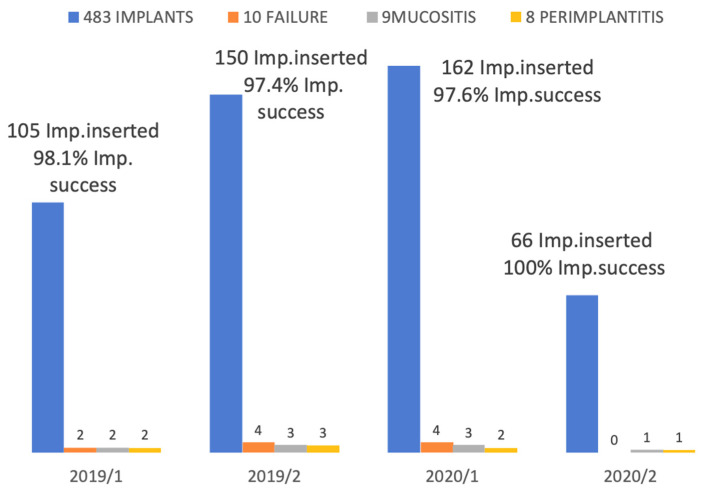
In thirteen different dental clinics in Singapore, Spain, Czech Republic and Italy, 504 patients were selected, and 483 dental implants were placed in maxillary sites after alveolar socket preservation (ASP) procedures with an autologous demineralized tooth extracted as graft material from an innovative Tooth Transformer device was obtained. All procedures used were reported in n°638 Ethical Committee surgical protocol of University of Chieti and approved. After 4 months, at dental implant placing, bone biopsies were performed to evaluate the histologic outcomes, and 12 months after implant loading, global implant survival rate, failure percentage and peri-implant bone loss were detected. After ASP, only 27 post-operative complications were observed and after 4 months, bone biopsy histomorphometric analysis showed a high percentage of bone volume (BV) 43.58 (±12.09), and vital new bone (NB) 32.38 (±17.15) with an absence of inflammation or necrosis areas. Twelve months after loading, only 10 dental implants failed (2.3%), with a 98.2% overall implant survival rate, nine cases showed mucositis (1.8%) and eight showed peri-implantitis (1.6%). At mesial sites, 0.43 mm (±0.83) of bone loss around the implants was detected and 0.23 mm (±0.38) at the distal sites with an average value of 0.37 mm (±0.68) ( > 0.568). Several studies with a longer follow-up will be necessary to confirm the preliminary data observed. However, clinical results seem to suggest that the post-extraction socket preservation procedure using innovative demineralized autologous tooth-derived biomaterial may be a predictable procedure to produce new vital bone able to support dental implant rehabilitation of maxilla edentulous sites.
在新加坡、西班牙、捷克共和国和意大利的13家不同牙科诊所,选取了504例患者,在进行牙槽窝保存(ASP)手术后,将483颗牙种植体植入上颌部位,其中自体脱矿牙作为移植材料从一种创新的牙齿转化器装置中获取。所有使用的手术程序均在基耶蒂大学伦理委员会第638号手术方案中报告并获得批准。4个月后,在植入牙种植体时进行骨活检以评估组织学结果,在种植体加载12个月后,检测整体种植体存活率、失败率和种植体周围骨丢失情况。ASP术后,仅观察到27例术后并发症,4个月后,骨活检组织形态计量学分析显示骨体积(BV)百分比很高,为43.58(±12.09),新生有活力骨(NB)为32.38(±17.15),且无炎症或坏死区域。加载12个月后,仅10颗牙种植体失败(2.3%),整体种植体存活率为98.2%,9例出现黏膜炎(1.8%),8例出现种植体周围炎(1.6%)。在近中部位,种植体周围骨丢失为0.43 mm(±0.83),远中部位为0.23 mm(±0.38),平均值为0.37 mm(±0.68)(>0.568)。需要进行几项随访时间更长的研究来证实观察到的初步数据。然而,临床结果似乎表明,使用创新的自体脱矿牙源性生物材料进行拔牙后牙槽窝保存程序可能是一种可预测的程序,能够产生新的有活力骨,以支持上颌无牙部位的牙种植体修复。