Filipczak Nina, Yalamarty Satya Siva Kishan, Li Xiang, Khan Muhammad Muzamil, Parveen Farzana, Torchilin Vladimir
Center for Pharmaceutical Biotechnology and Nanomedicine, Northeastern University, Boston, MA 02115, USA.
State Key Laboratory of Innovative Drug and Efficient Energy-Saving Pharmaceutical Equipment, Jiangxi University of Chinese Medicine, Nanchang 330006, China.
Materials (Basel). 2021 Sep 17;14(18):5371. doi: 10.3390/ma14185371.
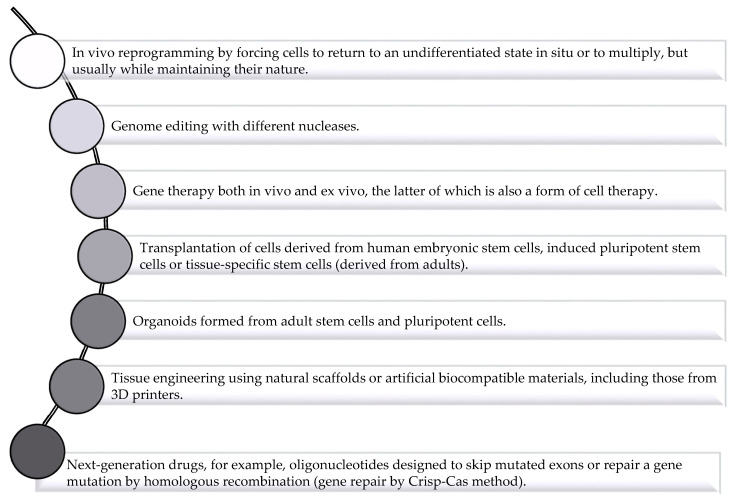
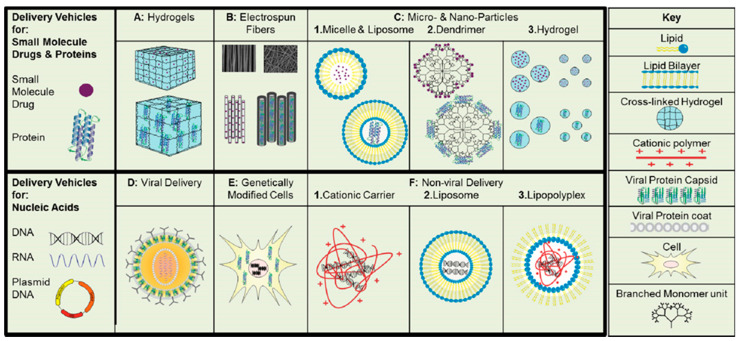
The most important goal of regenerative medicine is to repair, restore, and regenerate tissues and organs that have been damaged as a result of an injury, congenital defect or disease, as well as reversing the aging process of the body by utilizing its natural healing potential. Regenerative medicine utilizes products of cell therapy, as well as biomedical or tissue engineering, and is a huge field for development. In regenerative medicine, stem cells and growth factor are mainly used; thus, innovative drug delivery technologies are being studied for improved delivery. Drug delivery systems offer the protection of therapeutic proteins and peptides against proteolytic degradation where controlled delivery is achievable. Similarly, the delivery systems in combination with stem cells offer improvement of cell survival, differentiation, and engraftment. The present review summarizes the significance of biomaterials in tissue engineering and the importance of colloidal drug delivery systems in providing cells with a local environment that enables them to proliferate and differentiate efficiently, resulting in successful tissue regeneration.
再生医学的最重要目标是修复、恢复和再生因损伤、先天性缺陷或疾病而受损的组织和器官,以及通过利用身体的自然愈合潜力来逆转身体的衰老过程。再生医学利用细胞治疗产品以及生物医学或组织工程,是一个巨大的发展领域。在再生医学中,主要使用干细胞和生长因子;因此,正在研究创新的药物递送技术以改善递送效果。药物递送系统可保护治疗性蛋白质和肽免受蛋白水解降解,并实现可控递送。同样,与干细胞结合的递送系统可提高细胞存活率、分化能力和植入能力。本综述总结了生物材料在组织工程中的重要性,以及胶体药物递送系统在为细胞提供局部环境以使其能够有效增殖和分化从而实现成功组织再生方面的重要性。