Charles Perkins Centre, School of Life and Environmental Biosciences, University of Sydney, Sydney, NSW 2006, Australia.
Charles Perkins Centre, University of Sydney, Sydney, NSW 2006, Australia.
Nutrients. 2021 Sep 15;13(9):3200. doi: 10.3390/nu13093200.
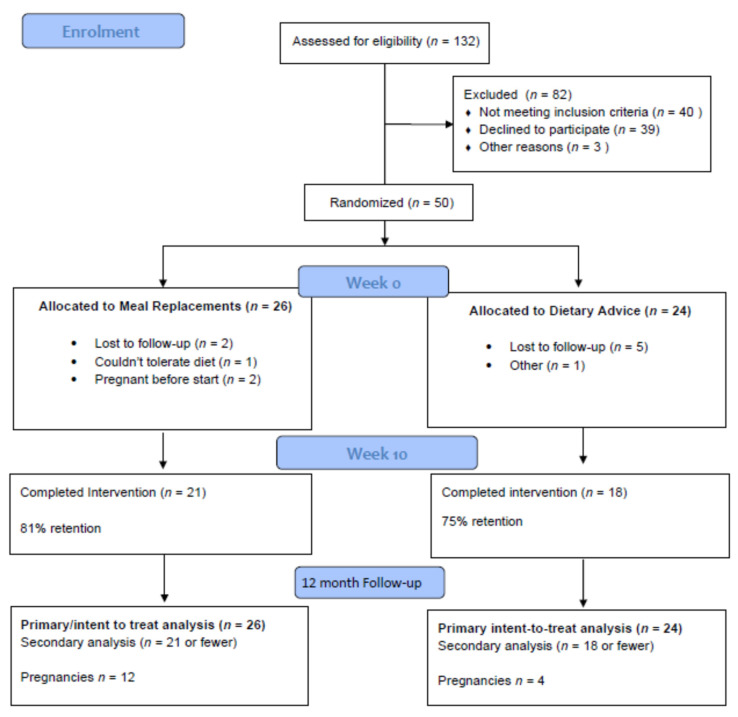
About half of Australian women have a body mass index in the overweight or obese range at the start of pregnancy, with serious consequences including preterm birth, gestational hypertension and diabetes, caesarean section, stillbirth, and childhood obesity. Trials to limit weight gain during pregnancy have had limited success and reducing weight before pregnancy has greater potential to improve outcomes. The PreBabe Pilot study was a randomised controlled pilot trial to assess the feasibility, acceptability and potential weight loss achieved using a commercial online partial meal replacement program, (MR) vs. telephone-based conventional dietary advice, (DA) for pre-conception weight-loss over a 10-week period. Women 18-40 years of age with a BMI ≥ 25 kg/m planning pregnancy within the next 6 to 12 months were included in the study. All participants had three clinic visits with a dietitian and one obstetric consultation. In total, 50 women were enrolled in the study between June 2018 and October 2019-26 in MR and 24 in DA. Study retention at the end of 10 week intervention 81% in the MR arm and 75% in the DA arm. In the-intention-to-treat analysis, women using meal replacements lost on average 5.4 ± 3.1% body weight compared to 2.3 ± 4.2% for women receiving conventional advice ( = 0.029). Over 80% of women in the MR arm rated the support received as excellent, compared to 39% in the DA arm ( < 0.001). Women assigned to the MR intervention were more likely to achieve pregnancy within 12 months of the 10 week intervention (57% (12 of 21) women assigned to MR intervention vs. 22% (4 of 18) assigned to the DA group ( = 0.049) became pregnant). The findings suggest that a weight loss intervention using meal replacements in the preconception period was acceptable and may result in greater weight loss than conventional dietary advice alone.
大约一半的澳大利亚女性在怀孕初期的体重指数处于超重或肥胖范围,这会导致严重后果,包括早产、妊娠高血压和糖尿病、剖腹产、死产和儿童肥胖。限制孕期体重增加的试验收效甚微,而在怀孕前减轻体重更有潜力改善妊娠结局。PreBabe Pilot 研究是一项随机对照试验,旨在评估使用商业在线部分代餐计划(MR)与电话为基础的传统饮食建议(DA)在 10 周内实现预孕期体重减轻的可行性、可接受性和潜在减肥效果。这项研究纳入了年龄在 18-40 岁之间、BMI≥25kg/m、计划在未来 6-12 个月内怀孕的女性。所有参与者都接受了营养师的三次临床就诊和一次产科就诊。共有 50 名女性参加了这项研究,MR 组有 26 名,DA 组有 24 名。10 周干预结束时,MR 组的研究保留率为 81%,DA 组为 75%。意向治疗分析中,使用代餐的女性平均体重减轻了 5.4%±3.1%,而接受传统建议的女性体重减轻了 2.3%±4.2%(=0.029)。MR 组超过 80%的女性对所接受的支持评价为优秀,而 DA 组只有 39%(<0.001)。在 10 周干预后的 12 个月内,被分配到 MR 干预组的女性更有可能怀孕(57%(21 名中的 12 名)被分配到 MR 干预组,而被分配到 DA 组的只有 22%(18 名中的 4 名)(=0.049)怀孕)。这些发现表明,在预孕期使用代餐的减肥干预措施是可以接受的,并且可能比单独使用传统饮食建议导致更大的体重减轻。