Department of Surgery, The University of Maryland School of Medicine, Baltimore, Md; Department of Surgery, The Johns Hopkins School of Medicine, Baltimore, Md.
Department of Surgery, The University of Maryland School of Medicine, Baltimore, Md.
J Thorac Cardiovasc Surg. 2023 Feb;165(2):e69-e81. doi: 10.1016/j.jtcvs.2021.07.051. Epub 2021 Sep 4.
Genetically engineered pigs are thought to be an alternative organ source for patients in end-stage heart failure unable to receive a timely allograft. However, cardiac xenografts exhibit growth and diastolic heart failure within 1 month after transplantation. Grafts function for up to 6 months, but only after administration of temsirolimus and afterload-reducing agents to reduce this growth. In this study we investigated the growth and hemodynamics of growth hormone receptor (GHR) knockout xenografts, without the use of adjuncts to prevent intrinsic graft growth after transplantation.
Genetically engineered pig hearts were transplanted orthotopically into weight-matched baboons between 15 and 30 kg, using continuous perfusion preservation before implantation (n = 5). Xenografts included knockout of carbohydrate antigens and knockin of human transgenes for thromboregulation, complement regulation, and inflammation reduction (grafts with intact growth hormone, n = 2). Three grafts contained the additional knockout of GHR (GHR knockout grafts; n = 3). Transthoracic echocardiograms were obtained twice monthly and comprehensively analyzed by a blinded cardiologist. Hemodynamics were measured longitudinally after transplantation.
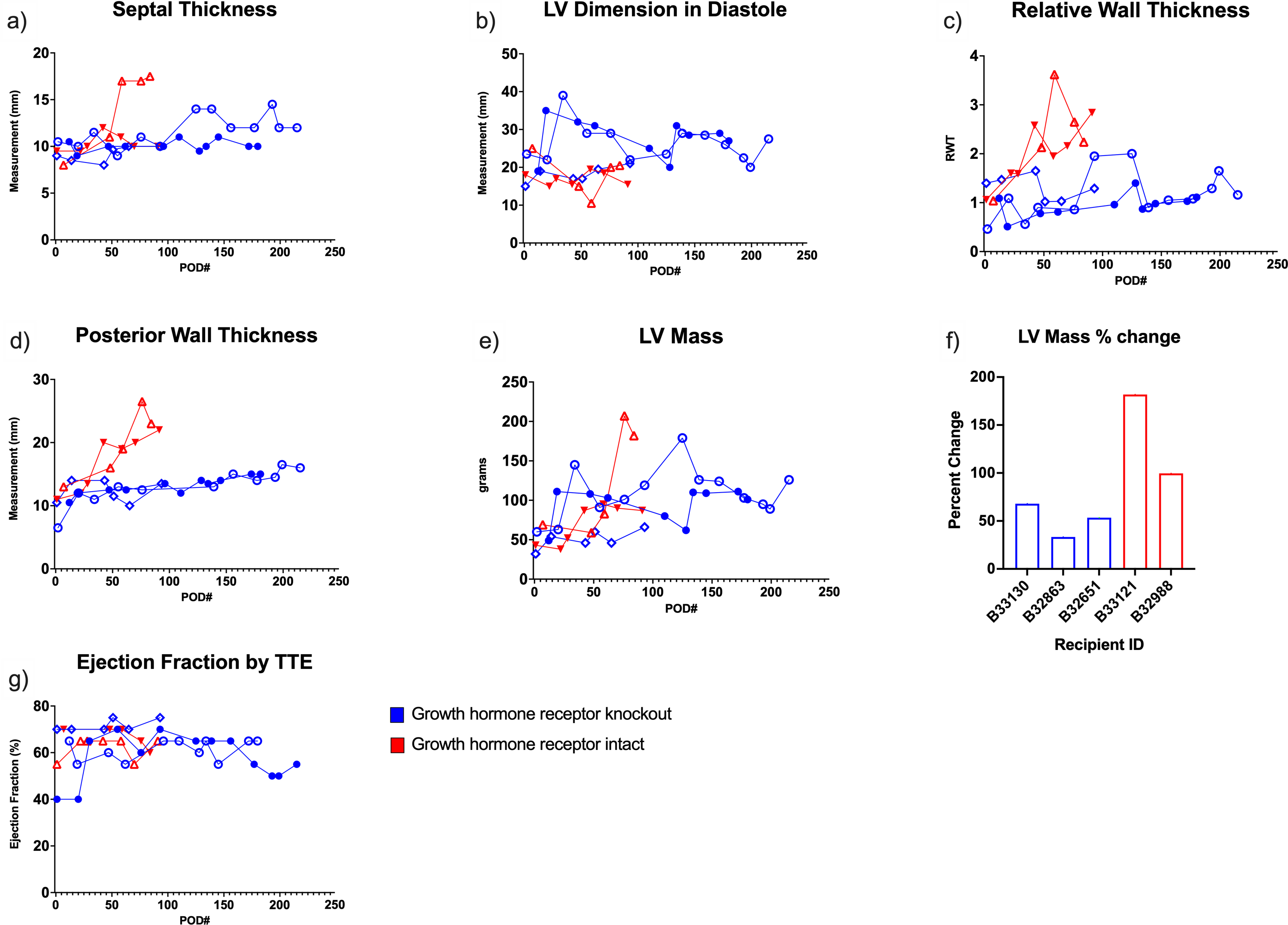
All xenografts demonstrated life-supporting function after transplantation. There was no difference in intrinsic growth, measured using septal and posterior wall thickness and left ventricular mass, on transthoracic echocardiogram out to 1 month in either GHR knockout or GHR intact grafts. However, hypertrophy of the septal and posterior wall was markedly elevated by 2 months post transplantation. There was minimal hypertrophy out to 6 months in GHR knockout grafts. Physiologic mismatch was present in all grafts after transplantation, which is largely independent of growth.
Xenografts with GHR knockout show reduced post-transplantation xenograft growth using echocardiography >6 months after transplantation, without the need for other adjuncts.
人们认为,对于那些无法及时接受同种异体移植的终末期心力衰竭患者来说,基因工程猪是一种可供选择的器官来源。然而,异种心脏移植物在移植后 1 个月内就会出现生长和舒张性心力衰竭。移植物的功能可持续 6 个月,但仅在给予替西罗莫司和后负荷降低剂以减少这种生长之后。在这项研究中,我们研究了生长激素受体 (GHR) 敲除异种移植物的生长和血液动力学,而无需使用辅助药物来防止移植后移植物的固有生长。
使用连续灌注保存,将基因工程猪心脏原位移植到体重匹配的 15 至 30 公斤重的狒狒体内(n=5)。异种移植物包括碳水化合物抗原的敲除和人类血栓调节、补体调节和炎症减少的转基因的敲入(具有完整生长激素的移植物,n=2)。3 个移植物含有额外的 GHR 敲除(GHR 敲除移植物,n=3)。每月两次通过经胸超声心动图获得图像,并由一位盲法心脏病专家进行全面分析。移植后进行纵向血流动力学测量。
所有异种移植物在移植后均具有支持生命的功能。在 GHR 敲除或 GHR 完整移植物中,通过超声心动图测量的室间隔和后壁厚度以及左心室质量,在 1 个月内没有观察到内在生长的差异。然而,在移植后 2 个月时,室间隔和后壁的肥厚明显升高。在 GHR 敲除移植物中,6 个月内肥厚程度最小。所有移植后都存在生理性不匹配,这在很大程度上与生长无关。
使用超声心动图,GHR 敲除的异种移植物在移植后 6 个月以上显示出减少的异种移植物生长,而无需其他辅助药物。