School of Kinesiology, The University of British Columbia, Vancouver, British Columbia, Canada
School of Kinesiology, The University of British Columbia, Vancouver, British Columbia, Canada.
Br J Sports Med. 2022 May;56(10):546-552. doi: 10.1136/bjsports-2021-104379. Epub 2021 Sep 27.
The number of adults across the globe with significant depressive symptoms has grown substantially during the COVID-19 pandemic. The extant literature supports exercise as a potent behaviour that can significantly reduce depressive symptoms in clinical and non-clinical populations.
Using a suite of mobile applications, at-home exercise, including high intensity interval training (HIIT) and/or yoga, was completed to reduce depressive symptoms in the general population in the early months of the pandemic.
A 6-week, parallel, multiarm, pragmatic randomised controlled trial was completed with four groups: (1) HIIT, (2) Yoga, (3) HIIT+yoga, and (4) waitlist control (WLC). Low active, English-speaking, non-retired Canadians aged 18-64 years were included. Depressive symptoms were measured at baseline and weekly following randomisation.
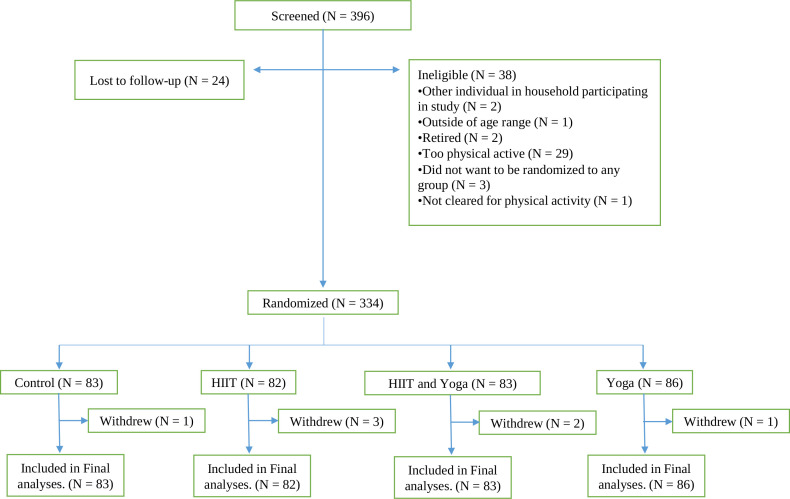
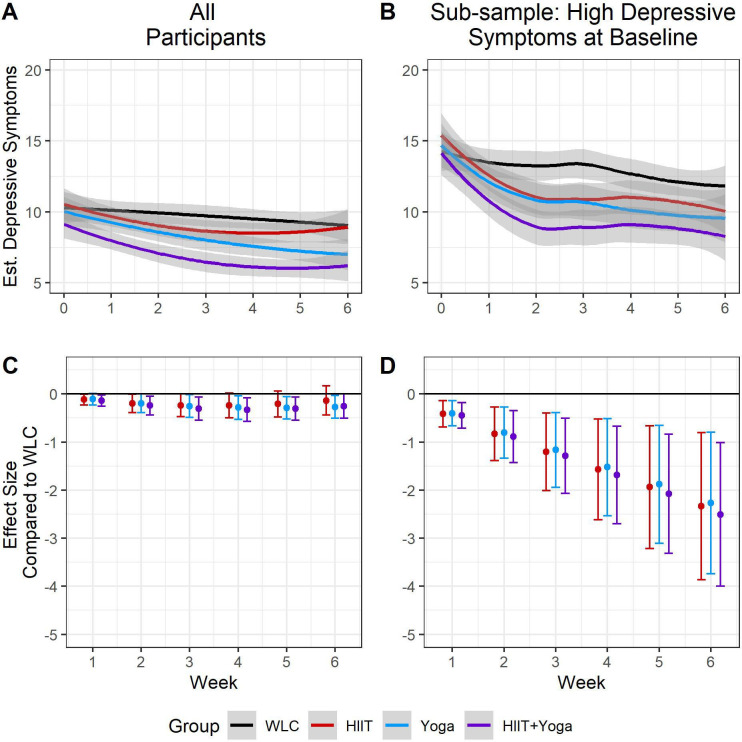
A total of 334 participants were randomised to one of four groups. No differences in depressive symptoms were evident at baseline. The results of latent growth modelling showed significant treatment effects in depressive symptoms for each active group compared with the WLC, with small effect sizes (ESs) in the community-based sample of participants. Treatment groups were not significantly different from each other. Effect sizes were very large (eg, week 6 ES range=-2.34 to -2.52) when restricting the analysis only to participants with high depressive symptoms at baseline.
At-home exercise is a potent behaviour to improve mental health in adults during the pandemic, especially in those with increased levels of depressive symptoms. Promotion of at-home exercise may be a global public health target with important personal, social and economic implications as the world emerges scathed by the pandemic.
NCT04400279.
在 COVID-19 大流行期间,全球有大量成年人出现明显抑郁症状。现有文献支持运动是一种有效的行为,可以显著降低临床和非临床人群的抑郁症状。
在大流行的早期,使用一系列移动应用程序在家中进行运动,包括高强度间歇训练(HIIT)和/或瑜伽,以减少普通人群的抑郁症状。
完成了一项为期 6 周、平行、多臂、实用随机对照试验,共有 4 个组:(1)HIIT,(2)瑜伽,(3)HIIT+瑜伽,和(4)候补对照组(WLC)。纳入的是低活动量、英语为母语、非退休的 18-64 岁加拿大成年人。在随机分组后每周测量一次抑郁症状。
共有 334 名参与者被随机分配到四个组中的一个。在基线时,各组的抑郁症状没有差异。潜在增长模型的结果表明,与 WLC 相比,每个活跃组的抑郁症状都有显著的治疗效果,参与者的社区样本中效应量较小。治疗组彼此之间没有显著差异。当仅分析基线时抑郁症状较高的参与者时,治疗效果的效应量非常大(例如,第 6 周的效应量范围为-2.34 至-2.52)。
在家运动是一种有效的改善大流行期间成年人心理健康的行为,特别是对那些抑郁症状加重的人。在全球遭受大流行重创之际,在家运动的推广可能成为一个具有重要个人、社会和经济意义的全球公共卫生目标。
NCT04400279。