Department of Molecular and Cell Biology, University of California, Berkeley, Berkeley, CA, 94720, USA.
Innovative Genomics Institute, University of California, Berkeley, Berkeley, CA, 94720, USA.
Nat Commun. 2021 Sep 27;12(1):5664. doi: 10.1038/s41467-021-25992-8.
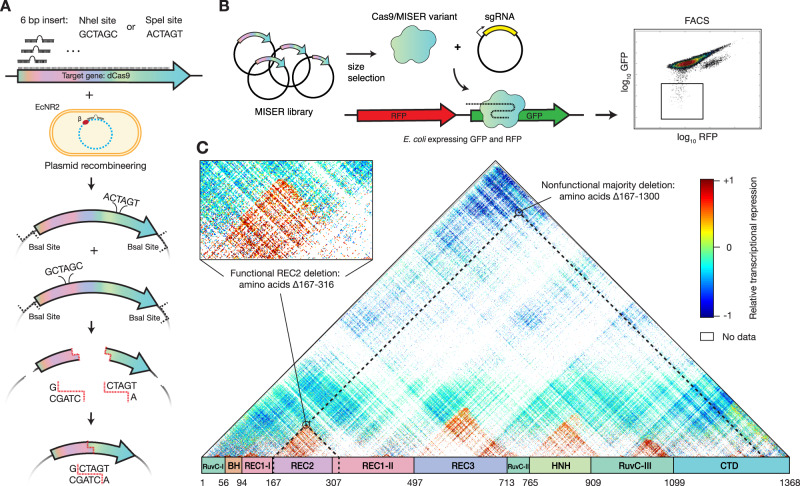
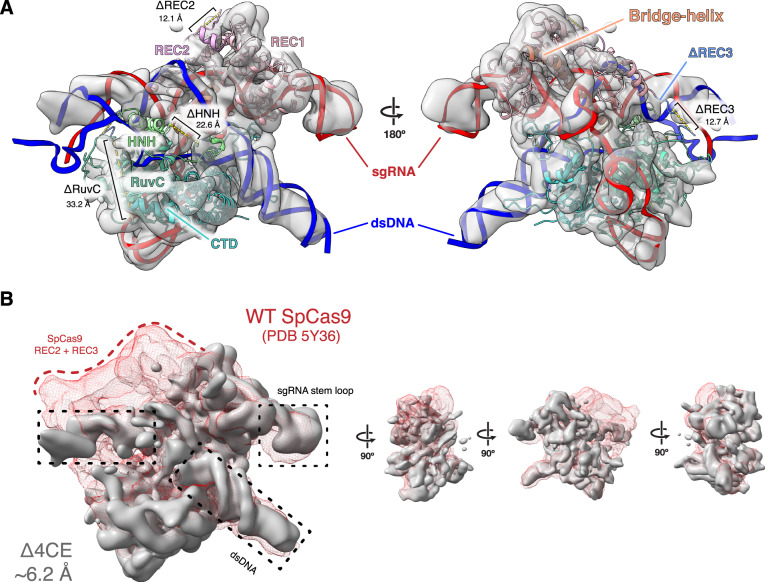
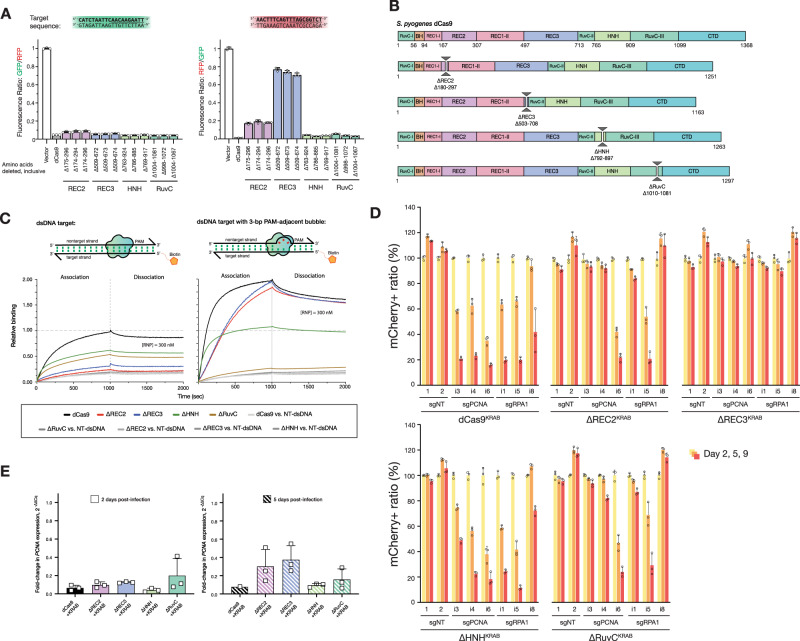
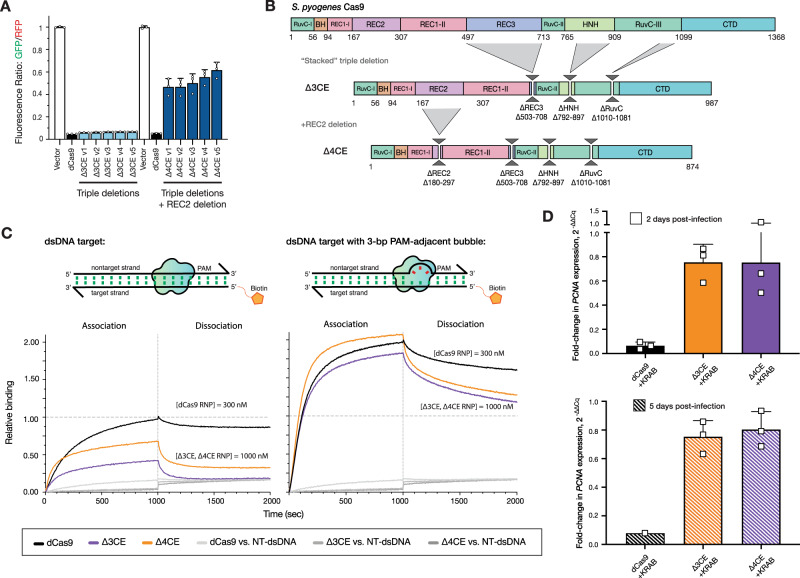
Proteins evolve through the modular rearrangement of elements known as domains. Extant, multidomain proteins are hypothesized to be the result of domain accretion, but there has been limited experimental validation of this idea. Here, we introduce a technique for genetic minimization by iterative size-exclusion and recombination (MISER) for comprehensively making all possible deletions of a protein. Using MISER, we generate a deletion landscape for the CRISPR protein Cas9. We find that the catalytically-dead Streptococcus pyogenes Cas9 can tolerate large single deletions in the REC2, REC3, HNH, and RuvC domains, while still functioning in vitro and in vivo, and that these deletions can be stacked together to engineer minimal, DNA-binding effector proteins. In total, our results demonstrate that extant proteins retain significant modularity from the accretion process and, as genetic size is a major limitation for viral delivery systems, establish a general technique to improve genome editing and gene therapy-based therapeutics.
蛋白质通过称为结构域的元素的模块化重排进行进化。现有的多结构域蛋白质被假设为是结构域添加的结果,但这一观点的实验验证有限。在这里,我们引入了一种通过迭代尺寸排除和重组(MISER)进行遗传最小化的技术,用于全面构建蛋白质的所有可能缺失。使用 MISER,我们生成了 CRISPR 蛋白 Cas9 的缺失景观。我们发现,具有催化活性的化脓性链球菌 Cas9 可以耐受 REC2、REC3、HNH 和 RuvC 结构域中的大单个缺失,同时仍在体外和体内发挥作用,并且这些缺失可以堆叠在一起,以工程最小的 DNA 结合效应蛋白。总之,我们的结果表明,现存的蛋白质保留了来自于添加过程的显著的模块性,并且由于遗传大小是病毒传递系统的主要限制因素,因此建立了一种改进基因组编辑和基于基因治疗的治疗方法的通用技术。