Department of Environmental and Biological Sciences, University of Eastern Finland, Joensuu, Finland.
Hum Reprod. 2021 Nov 18;36(12):3028-3035. doi: 10.1093/humrep/deab221.
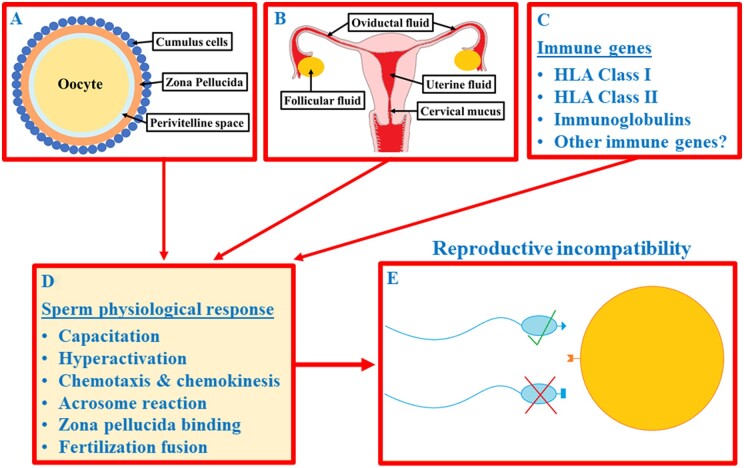
In natural fertilisation, the female reproductive tract allows only a strictly selected sperm subpopulation to proceed in the vicinity of an unfertilised oocyte. Female-mediated sperm selection (also known as cryptic female choice (CFC)) is far from a random process, which frequently biases paternity towards particular males over others. Earlier studies have shown that CFC is a ubiquitous phenomenon in the animal kingdom and often promotes assortative fertilisation between genetically compatible mates. Here, I demonstrate that CFC for genetic compatibility likely also occurs in humans and is mediated by a complex network of interacting male and female genes. I also show that the relative contribution of genetic compatibility (i.e. the male-female interaction effect) to reproductive success is generally high and frequently outweighs the effects of individual males and females. Together, these facts indicate that, along with male- and female-dependent pathological factors, reproductive failure can also result from gamete-level incompatibility of the reproductive partners. Therefore, I argue that a deeper understanding of these evolutionary mechanisms of sperm selection can pave the way towards a more inclusive view of infertility and open novel possibilities for the development of more personalised infertility diagnostics and treatments.
在自然受精过程中,女性生殖道只允许一小部分经过严格选择的精子在未受精的卵母细胞附近继续前进。女性介导的精子选择(也称为隐秘雌性选择(CFC))远非随机过程,它经常偏向于特定的男性而不是其他男性成为父亲。早期的研究表明,CFC 是动物界普遍存在的现象,经常促进遗传上相容的配偶之间的趋同受精。在这里,我证明了遗传相容性的 CFC 可能也发生在人类中,并由相互作用的男性和女性基因的复杂网络介导。我还表明,遗传相容性的相对贡献(即男性-女性相互作用效应)对生殖成功通常很高,并且经常超过个体男性和女性的影响。这些事实表明,除了男性和女性依赖的病理因素外,生殖伴侣配子水平的不兼容也可能导致生殖失败。因此,我认为,更深入地了解这些精子选择的进化机制可以为更全面地理解不孕不育铺平道路,并为开发更个性化的不孕不育诊断和治疗方法开辟新的可能性。